Award-Winning Graduate Level Chemistry
Tutors
Who needs tutoring?
FEATURED BY


TUTORS FROM
- YaleUniversity
- PrincetonUniversity
- StanfordUniversity
- CornellUniversity
Award-Winning Graduate Level Chemistry Tutors

Certified Tutor
6+ years
Noah
Graduate-level chemistry problems often require computational thinking — thermodynamic modeling, reaction kinetics equations, and data analysis that goes well beyond intro coursework. Noah's computer science training at Duke gives him a systematic, quantitative approach to breaking down complex chem...
Duke University
Bachelor of Science in Computer Science

Certified Tutor
6+ years
Adam
Graduate-level chemistry demands a different kind of thinking — deriving thermodynamic relationships from first principles, interpreting spectroscopic data, or connecting quantum mechanics to bonding behavior. Adam's PhD in Materials Science and Engineering from Northwestern means he's navigated tha...
Canisius College
Bachelor of Science, Chemistry
Northwestern University
Doctor of Philosophy, Materials Science

Certified Tutor
9+ years
Katie
I am a PhD student in Inorganic Chemistry at Yale University. I've been spreading my love of chemistry for the past several years as a TA for general chemistry, and I'm excited to share my passion with you! Prior to Yale, I got my B.S. in chemistry from Caltech, where I also served as a TA for both ...
California Institute of Technology
Bachelor of Science in Chemistry
Yale University
Doctor of Science, Inorganic Chemistry

Certified Tutor
10+ years
Andrew
Having completed a PhD in Inorganic Chemistry, Andrew tackles graduate-level material — coordination chemistry, group theory, spectroscopic methods — as someone who's been through the qualifying exams and dissertation process himself. He breaks down complex topics like ligand field theory and organo...
Washington University in St. Louis
PHD, Inorganic Chemistry
Virginia Polytechnic Institute and State University
Bachelors, Chemistry

Certified Tutor
6+ years
Christin
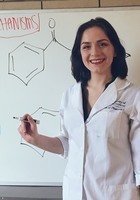
Graduate-level chemistry demands fluency with advanced topics like statistical thermodynamics, spectroscopic methods, and complex reaction mechanisms. Christin earned her PhD in Biochemistry and currently teaches in a university chemistry department, so she tackles these subjects as both a researche...
Misericordia University
Bachelor of Science, Biochemistry
Princeton University
Doctor of Philosophy, Biochemistry
Certified Tutor
8+ years
Xhesika
Graduate-level chemistry demands more than content knowledge; it requires the ability to read primary literature critically, design experiments, and think across subdisciplines. Xhesika is currently in a dual Ph.D./Pharm.D. program at UConn specializing in medicinal chemistry and pharmacology, so sh...
Middlebury College
Bachelor of Science, Biochemistry and Molecular Biology

Certified Tutor
4+ years
Snipta
Graduate-level chemistry often demands computational approaches — molecular modeling, quantum mechanical calculations, thermodynamic simulations — that sit squarely at the intersection of Snipta's computer science and science backgrounds. Experience at the National Institutes of Health gave her dire...
The University of Texas at Dallas
Bachelor of Science, Computer Science

Certified Tutor
6+ years
Zachary
Graduate-level chemistry often demands fluency across subdisciplines — thermodynamics one week, spectroscopic analysis the next, advanced reaction kinetics after that. Zachary earned his pharmacy doctorate and trained as a pharmaceutical chemist, so he's spent years navigating the overlap between ph...
Saint John's University
Bachelor of Science, Pharmacy
Saint John's University
Pharmaceutical Chemist, Pharmacy
Certified Tutor
2+ years
Ziad
As a chemistry professor, I am excited to have the opportunity to introduce myself and share with you why I am confident that I would be an excellent teacher for you. First and foremost, I have a passion for teaching chemistry. Chemistry is a fascinating subject that explains the world around us an...
University of Calgary
PhD
Certified Tutor
2+ years
Mokhtar
I am a chemistry PhD holder. I have been working as a teaching assistant for general and analytical chemistry courses for five years at the Chemistry department, University of Alberta, Canada. I have also been working as a private tutor for university and high school students.
University of Alberta
PhD
Top 20 Science Subjects


Top 20 Subjects
Frequently Asked Questions
Graduate chemistry students typically struggle most with quantum mechanics applications, advanced thermodynamics, and translating between macroscopic observations and molecular-level explanations. Many also find it challenging to synthesize concepts across physical, organic, and analytical chemistry when tackling research problems. Additionally, students often underestimate the rigor required for literature reviews and experimental design—skills that go well beyond undergraduate problem-solving. A tutor experienced in graduate work can help you build these integrative thinking skills and develop the conceptual depth needed for research and comprehensive exams.
Graduate lab work demands understanding not just the procedure, but the underlying chemistry driving each step. A tutor can help you work backward from experimental observations to explain what's happening at the molecular level—for example, why a reaction rate changes with temperature or how spectroscopic data reveals molecular structure. This bridges the gap between following a protocol and truly understanding your research, which is essential for writing strong lab reports, troubleshooting failed experiments, and designing new experiments. Strong conceptual grounding makes you a more independent and creative researcher.
Quantum mechanics is notoriously abstract, and many students memorize equations without grasping the physical intuition behind them. A tutor can help you build mental models—visualizing orbitals, understanding what wavefunctions actually represent, and connecting quantum principles to real spectroscopy and bonding problems you encounter in research. The goal is moving beyond plug-and-chug calculations to understanding why certain transitions are forbidden or why a molecule has the properties it does. This deeper understanding makes advanced topics like computational chemistry and photochemistry much more accessible.
Graduate-level synthesis requires not just knowing reactions, but predicting outcomes under varied conditions and understanding competing pathways. A tutor can work with you on retrosynthetic analysis, helping you think strategically about multi-step syntheses and recognize when protecting groups, regioselectivity, or stereochemistry will be critical. They can also help you interpret mechanistic details in literature—understanding why an author chose a particular solvent, temperature, or catalyst. This kind of guided problem-solving builds the chemical intuition you need to design your own syntheses and troubleshoot experimental setbacks.
Comprehensive exams test not just individual topics, but your ability to synthesize knowledge across the discipline under time pressure. A tutor can help you identify knowledge gaps that span multiple areas—for instance, how kinetics, thermodynamics, and quantum mechanics all inform reaction mechanisms. They can guide you through practice problems that require integrative thinking, help you develop efficient problem-solving strategies, and build your confidence tackling unfamiliar questions. Regular tutoring sessions in the months leading up to comps provide structured review and targeted support on your weakest areas.
Yes—tutors can help with skills that extend beyond coursework, such as interpreting advanced analytical data (NMR, mass spec, X-ray crystallography), understanding literature methods, and troubleshooting experimental design. They can also help you think through how to communicate your chemistry clearly in writing and presentations. If you're working in a specialized area like materials chemistry, biochemistry, or catalysis, a tutor with relevant expertise can accelerate your learning of domain-specific concepts and help you ask better questions in lab meetings. This kind of support strengthens both your research and your development as an independent chemist.
Look for tutors with graduate-level chemistry training—ideally a master's degree or PhD in chemistry or a related field—and active or recent experience with graduate coursework or research. The best tutors can explain advanced concepts clearly, have worked through comprehensive exams themselves, and understand the specific demands of graduate programs. It's also valuable if they have experience in your subfield (organic, analytical, physical, inorganic, biochemistry, etc.) or are familiar with the types of research problems you're tackling. Varsity Tutors connects you with tutors who meet these standards and can provide personalized support tailored to your program's expectations.
Bring your course syllabus, recent exams or problem sets you've struggled with, and any lecture notes or textbook sections that confuse you. If you're working on research, bring relevant lab notebooks, experimental data, or literature papers you're trying to understand. It's also helpful to come with specific questions or topics you want to focus on—this helps the tutor quickly understand your level and tailor the session. The first meeting is about establishing what you need most, so being specific about your challenges and goals will make tutoring much more effective.
Connect with Graduate Level Chemistry Tutors
Get matched with expert tutors in your subject