...Geosciences (double major). My academic interests include the physical sciences, mathematics (especially algebra and calculus), and space/earth/environmental science. Outside of academic, I like to play competitive online video games (LoL, Overwatch) as well as single-player management/multiplayer sandbox games (Astroneer, Space Engineers). I also am learning to garden and create pottery from scratch. I will be pursuing a graduate degree in a related physics/geosciences field within the next year or two. I look forward to working...
Read more
I graduated magma cum laude from the University of Pittsburgh with a focus in Earth and Space Science. I am an outdoors person; I enjoy being outside and observing the surrounding world. In this way I am a classic "natural philosopher" variant of scientist. I like earth science, environmental science, ecology, geology, oceanography, meteorology, astronomy, and cosmology. I am your go-to tutor for anything involving nature on a macro scale.
Read more
...beam dynamics and space-charge mitigation, investigating stochastic wind-driven inertial currents in Lake Superior using advanced mathematics like stochastic differential equations and Stochastic calculus, and conducting neutrino oscillation analysis using ROOT programming. Additionally, I have worked on plasma pyrolysis for hydrogen production, applying chemical kinetics and thermodynamics to sustainable energy solutions. I am passionate about connecting theoretical concepts with real-world applications, and I aim to help students build a strong foundation in physics and mathematics through...
Read more
I have a multitude of skills & qualities including a positive attitude ,a friendly and confident nature, a desire to work to high standards and above all, take full responsibility for the work I produce .I love to carry on learning ,improving and developing in the role of a tutor. The work-experience I have will enable me to work consistently to a high standard whilst helping my students achieve their goals & objectives.
Read more
I studied physics and mathematics at Stephen F. Austin State University, where I also tutored students and taught physics laboratories. I found that I have a passion for teaching and helping people in these fascinating subjects. I'm a big proponent of multimedia teaching and finding ways to use presentations, animations, and demonstrations to help students understand the beauty of our mechanical universe.
Read more
...teaching physics. Since then its been 7 years, I've had the privilege of imparting knowledge to over 700K students across various boards such as CBSE, CISCE, and IGCSE. I've developed tailored curricula for MS, HS, and AP physics (US), as well as AS, A2, and A level (Cambridge University). My teaching philosophy emphasizes experiential learning over rote memorization, ensuring that my students can confidently apply scientific methods in their daily lives, where achieving good marks...
Read more
...tutored, and done lots of volunteer tutoring. I strive to help students not feel patronized or shamed in moments of confusion, but empowered to see that they CAN do it. Everyone is on their own individual education journey and each student should have the opportunity to learn in a way that best suits them. Let's be honest, math and physics can both be really difficult, but the rewards and joys of problem solving, of successfully...
Read more
...feedback, I strive to improve my tutoring techniques and stay abreast of the latest educational strategies and resources. In conclusion, tutoring is more than just imparting knowledge; it is about inspiring confidence, nurturing curiosity, and empowering students to achieve their best. I am committed to making a positive impact on the lives of my students, guiding them towards academic success and instilling a lifelong love of learning. It is this dedication and passion for education...
Read more
Hi! I'm Conrad, a Math major at the University of Utah. As a tutor, my primary purpose is to encourage growth, improvement, and learning for my students in a safe and respectful environment.
Read more
...needs, so I take a personalized approach that fosters both understanding and curiosity. Whether guiding students through challenging coursework or preparing them for standardized tests, I strive to create a supportive environment where they feel empowered to succeed. Outside of tutoring, I enjoy reading classic literature, hiking, and playing the guitar, which help me stay well-rounded and bring fresh perspectives into my teaching. I am committed to making learning both accessible and enjoyable, and I look...
Read more
...helping students and making sure they grasp the content. I am a physics student at the National Autonomous University of Mexico. I have more than five years of tutoring experience and all of the students I have ever tutored thank me that I have made them excel in the subject and that I made them getting the highest marks of their entire classroom. Outside of academia, my main interests consist of activities such as travelling,...
Read more
...all of these fields I strive to teach a complete understanding of the principles at play. My favorite subjects to teach are math (and the mathematical sciences such as physics) and philosophy. Currently I have my BA in Liberal Arts and am enrolled in a MA/PhD program for Philosophy. My philosophical focus is largely on the works of Aristotle and Thomas Aquinas as well as other ancient and medieval philosophers. Particularly, I am interested in...
Read more
...simpler ideas and providing a supportive environment where students can build confidence in their abilities. Having worked with a diverse range of students, I am adept at preparing them for both academic success and critical problem-solving under exam conditions. My experience in preparing students for high-stakes exams like NEET and JEE Advanced has equipped me with a strong grasp of the curriculum, as well as the ability to develop strategies that enhance both speed and...
Read more
...needs, whether they're preparing for exams or tackling challenging topics. I am currently a Senior finishing my undergraduate degree in Astrophysics and minor in Mathematics at the University of Illinois Urbana-Champaign. I am always eager to help students improve their skills and work through difficult problems with patience and clarity. My approach is not just to help students pass their tests, but to help them truly understand and enjoy the material. Outside of academics, I...
Read more
...Regents Exam. Along with school, I also ran D1 cross country and track and field at Lehigh. Since 2019 I've worked as an engineer at a Fortune 500 company and a startup. Along with working as an engineer, I've been a part-time math and science tutor. My passion for math and physics is as strong as ever and I want to help students get the most out of their educations. If you are looking for...
Read more
...career, I have developed a deep understanding of various subjects, including Analytical Chemistry, Biochemistry, Physical Chemistry, Organic Chemistry, and Environmental Chemistry. With over four years of tutoring experience, I have worked with students ranging from elementary to high school, as well as adults preparing for work-related exams. I specialize in subjects such as Algebra, Physics, and Chemistry, tailoring my approach to meet the unique needs of each student. I use various educational resources to enhance...
Read more
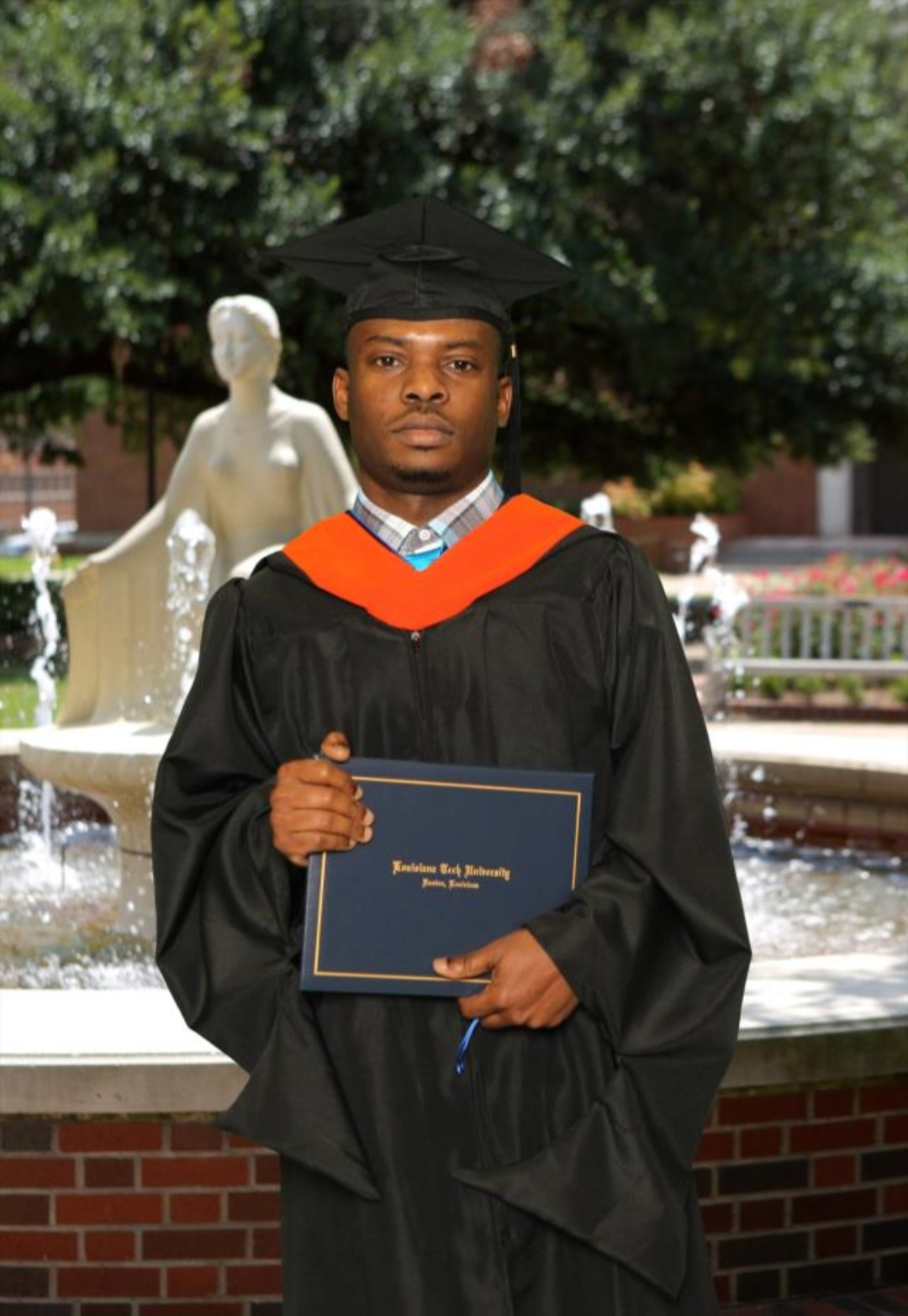
...at Louisiana Tech University. Throughout my career as an Engineer, I've mentored several Junior Engineers. I enjoy helping struggling students reach their maximum potential and turn the tables and have always possessed strong mentorship skills. I also like the challenge of helping a student quickly prepare for a pending exam. Education and academia has always been at the forefront of my life and I like to impart that joy unto others. In my spare time,...
Read more
...centers around visual learning, where imagination meets text, and complex ideas transform into simple, engaging stories. I strive to create an interactive learning environment, fostering a deep understanding of physics and STEM subjects. My approach encourages innovation, critical thinking, and hands-on experiences, making learning a delightful journey. Beyond academics, I am passionate about instilling moral values and life skills in students. I believe in nurturing independence with responsibility, preparing them for a successful future. Outside...
Read more
...focusing on building understanding, confidence, and curiosity. I believe that every challenge is an opportunity to grow, and I strive to create an environment where questions are encouraged, mistakes are embraced as part of the process, and progress feels exciting. Whether it's mastering new concepts, preparing for exams, or simply developing better study habits, I am committed to making learning engaging, empowering, and meaningful. Together, we'll achieve your goals and go beyond them!
Read more
Private Special & General Relativity Tutoring Near You
Receive personally tailored Special & General Relativity lessons from exceptional tutors in a one-on-one setting. We help you connect with the best tutor for your particular needs while offering flexible scheduling to fit your busy life.
Special & General Relativity Tutoring FAQ
Einstein's theory of relativity actually spans two theories: his special theory of relativity, and his general theory of relativity. The earlier of the two theories, special relativity, takes for its basis the idea that the speed of light appears to be the same no matter in what context one observes or measures it. For this idea to hold true for observers moving at very fast speeds, these observers must necessarily experience space and time differently than stationary observers do. Thus, to moving observers, time can be measured to pass more slowly, and the lengths of objects can appear to be reduced in comparison to what a stationary observer experiences. In other words, observations of space and time are relative to an observer's frame of reference.
The theory of special relativity allowed Einstein to come up with his famous equation, which equates mass and energy. It also provided the basis for Minkowski to combine the concepts of space and time into the concept of a space-time continuum. However, special relativity did not account for the ways certain concepts like gravity, motion, and forces interacted with the concept of space-time. General relativity integrated these concepts with the tenets of special relativity to provide a more accurate picture of the universe. Einstein's equations outline the relationship between the geometry of space-time and the properties of matter, and account for how matter warps space-time and how space-time influences the motion of matter. Numerous observed phenomena have provided evidence supporting the theory of general relativity, including the phenomenon of redshift, slight anomalies in the orbit of Mercury, and other cosmological phenomena. In addition, global positioning satellite systems require extremely accurate measurements of time and would not work if the principles of general relativity were not taken into account.
If you're just beginning to learn about relativity or could use some guidance in understanding its finer points and equations, Varsity Tutors can help you connect with a relativity tutor to help you make sense of this important but often counterintuitive pair of theories. We can help you connect with a tutor who not only understands the principles and ideas underlying relativity, but can explain them in ways that make sense to you. Tutoring can be adapted to meet short-term or long-term needs, and your tutor can create a customized lesson plan designed to address just the aspects of relativity you find confusing, so if you've already mastered some of its concepts, you need not waste time in your tutoring sessions reviewing them. You tutor will also make relativity tutoring convenient. You can meet with your tutor whenever and wherever you want, allowing your tutoring to fit into even busy schedules. Moreover, working with a private tutor means that you have control over where you study, and can choose to learn in the comfort of your own home, at the local library, or anywhere else that is convenient to you. The Varsity Tutors live learning platform allows you to meet with a private tutor either in person or face-to-face online. This gives you the flexibility to meet with your tutor at the time and location of your choice.
Because the theory of relativity is complex and can be hard to digest, you will benefit greatly from studying with a private tutor. Unlike classroom-based learning, where teachers have limited time and resources, studying through private lessons allows you to spend time trying to understand complicated material. In addition, you will be working with someone who is an expert at deconstructing difficult concepts, breaking them down into digestible chunks, and presenting information in a simplified way that is easy to understand.
If you are serious about improving your understanding of relativity, contact Varsity Tutors today and ask for help finding a tutor in your area. Whether you want to learn in person or face-to-face online, there is a qualified instructor who is happy to help you reach your educational goals.
4.9/5.0 Satisfaction Rating*
Your Personalized Tutoring Program and Instructor
Identify Needs
Our knowledgeable directors help you choose your tutor with your learning profile and personality in mind.
Customize Learning
Your tutor can customize your lessons and present concepts in engaging easy-to-understand-ways.
Increased Results
You can learn more efficiently and effectively because the teaching style is tailored to you.
Online Convenience
With the flexibility of online tutoring, your tutor can be arranged to meet at a time that suits you.
Recent Special & General Relativity Tutoring Session Notes
Today, the student and I covered genetics, the pea plants of Mendel to different types of dominance. He was able to complete the assignments I gave him last time.
The student and I worked on his biology study guide for his final next week. We focused on the scientific method, cell structure/parts/processes, and basic chemistry. He was very thorough and did a good job! I do recommend lots of focused studying over the weekend.
The student and I reviewed for his biology final. We discussed the three theories of DNA replication. I explained the basics of glycolysis, the Krebs cycle, and electron transport chain and the differences between fermentation and cellular respiration. He and I also talked about prokaryotic and eukaryotic cells.
During our session today, the student and I worked on completing a review sheet that his teacher had given him for his final. This review sheet was comprehensive, covering the vast swath of material that makes up the 9th grade biology curriculum. Because he had not gotten much time to work on the sheet, we started near the beginning and worked forward. Overall, I was pleased to see that he was now retaining some of the material that we had covered in our previous sessions. For instance, I was pleasantly surprised to find that he remembered and could articulate the difference between an autotroph and a heterotroph. Overall, we made good progress.
We went over some practice questions today in preparation for the student's quiz tomorrow. We covered food and nutrition, the digestive system, and the excretory system. He did well with the multiple choice questions and seemed to remember most of the material from the book. He was struggling a bit with expanding his answers for short-response questions. Although I could see that the way he answers is on the right track, he might not be providing detailed enough explanations for his teacher's liking.
We discussed replication, transcription, translation, and the eukaryota cell. We also looked over the student's notes and tried to figure out where her weaknesses are. We spent the second part reviewing calculus, specifically, logarithms.