Award-Winning High School Chemistry Tutors
serving Tacoma, WA
High School Chemistry
Tutors in Tacoma
Private 1-on-1 tutoring, weekly live classes for academic support, test prep & enrichment, practice tests and diagnostics, and more to elevate grades and test scores.
Based on 3.4M Learner Ratings
UniversitiesSchools & Universities
DeliveredHours Delivered
ProficiencyGrowth in Proficiency
Who needs tutoring?
No obligation. Takes ~1 minute.

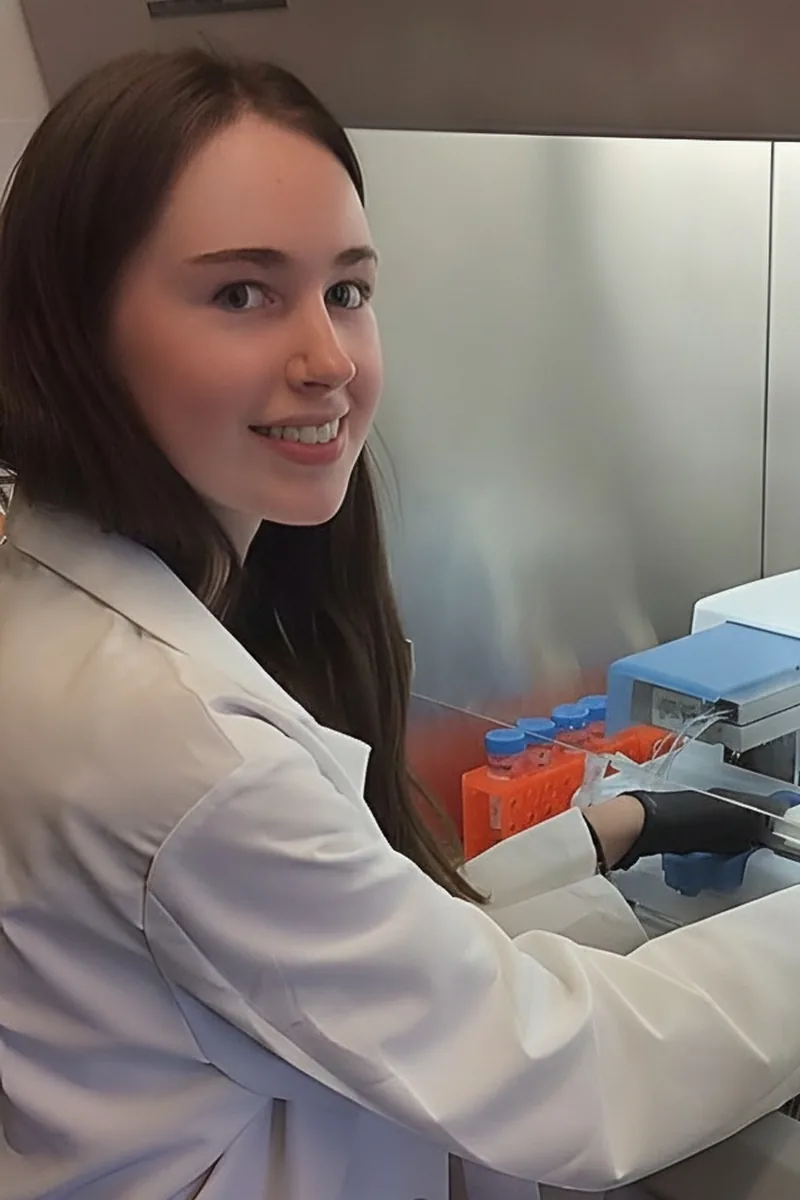
Hi, I'm Stephanie! I recently graduated from Stanford University with a B.S. in Chemical Engineering and a minor in Biology, earning a 3.9 GPA. With three years of research experience and a strong background in chemistry, biology, physics, math, and engineering, I am eager to tutor STEM subjects from middle school through college levels. I look forward to simplifying challenging concepts, fostering a supportive learning environment, and helping students build confidence. I am committed to helping students find excitement in STEM.
Balancing equations, understanding mole ratios, and predicting reaction products all require a kind of structured problem-solving that Helen uses daily in her biomedical engineering studies at Johns Hopkins. She breaks down tricky topics like stoichiometry and periodic trends by linking them to patterns rather than asking students to memorize isolated rules. Rated 4.8 by students.
I am an undergraduate earning my Bachelor's degree in Electrical Engineering from the University of Washington. I have already earned my Associate's of Arts with honors through the running start program, and graduated high school as a Valedictorian. I have worked with Disability Resource Services in taking notes for students, and have also offered assistance with homework to other students. As an engineering student, I am able to use my experience to offer assistance with math. I am also able to tutor in chemistry since I have already completed the general chemistry series. I believe that education is extremely important in life, not only for the purpose of knowledge, but also for the determination and ambition that learning teaches us. Understanding concepts not only takes time, but also dedication. As a student who has also attended many tutoring hours, I have come to understand that concepts sometimes require different approaches to finally have that idea click.
Helping students in their education is my passion. I understand how frustrating it is to keep trying on understanding a concept or master a skill without getting a satisfying result. I aim to help students enjoy learning and acquiring knowledge. Always remember that knowledge is power, and nobody can take it from you. I have sufficient tutoring and teaching experience in secondary and post-secondary settings. I worked as a tutor at the University of Wisconsin Oshkosh. I tutored college students different courses in mathematics, physics, biology, chemistry, and psychology. Also, l worked as a graduate teaching assistant at Marquette University. I taught the laboratory part of general chemistry, analytical chemistry, and organic chemistry. Furthermore, l worked as a science teacher at different secondary schools. I taught science for grades 4,5,6, and 8. Also, l taught chemistry for grade 9. When it comes to my education, l have a bachelor degree in biology healthcare science and chemistry biomolecular science (double major). In addition, l have a master's degree in chemistry. I received my undergraduate education at the University of Wisconsin Oshkosh and my graduate education at Marquette University. I tutor for numerous subjects such as algebra, trigonometry, calculus, physics, organic chemistry, analytical chemistry, human anatomy, developmental biology, ecology, and biochemistry. Also, l tutor for the GRE, DAT, TOEFL, and IELTS. My favorite subjects are the math, physics, biology, and chemistry subjects because l, simply, enjoy these fields. My teaching philosophy and tutoring style are based on practicing with various examples. When you are confronted with numerous problems to solve, you become more confident in that subject area. As a result, better performance in quizzes and exams. Outside of academia, learning about other cultures and countries around the world is my interest.
Currently, I am a Research Technician at New Mexico State University in Las Cruces, NM. I have tutored as an undergraduate student, and I have been the lead TA for General Chemistry courses at UC Berkeley. Chemistry is one of my passions, and I would love to share my experience!
When electron configurations and periodic trends start piling up alongside acid-base equilibria and redox reactions, high school chemistry can feel like two different courses crammed into one. Caroline tackles both sides — the conceptual and the computational — using her engineering mindset to show students how dimensional analysis and logical problem setup make even the trickiest stoichiometry problems approachable.
Between his UCLA biology coursework and medical school, Abrahim has taken chemistry from multiple angles — stoichiometry, equilibrium, acid-base reactions, thermodynamics. He's direct about pinpointing where a student's understanding breaks down, whether that's balancing redox equations or interpreting periodic trends. His 5.0 rating speaks to how well that targeted approach works.
When high school chemistry students hit a wall with mole conversions or balancing redox reactions, the issue is almost always conceptual, not computational. Rahul digs into the 'why' behind each step — why coefficients matter, how electron transfer actually works — drawing on his Cornell chemical engineering background to make the logic visible. He holds a 4.9 rating from students.
Priya's math degree at Vanderbilt gives her a real advantage when chemistry turns quantitative — dimensional analysis, molarity calculations, and stoichiometry all come down to setting up ratios correctly, which is exactly how a mathematician thinks. She teaches students to treat these problems as structured logic puzzles rather than chemistry-specific hurdles, so the math never becomes the reason a student falls behind in the course.
General chemistry was the first subject Alec taught as a TA at Cornell, running problem-solving sessions where students worked through stoichiometry, equilibrium, and acid-base reactions in real time. That hands-on teaching background means he knows exactly where high schoolers get tripped up — whether it's balancing redox equations or making sense of periodic trends. Rated 4.8 by students.
Premed neuroscience coursework at Rice put Aditi through rigorous chemistry sequences where concepts like equilibrium, stoichiometry, and thermodynamics weren't electives — they were prerequisites for everything that followed. She zeroes in on the periodic table as a predictive tool, teaching students to use trends in electronegativity and atomic radius to reason through bonding and reactivity questions rather than memorize isolated facts. Rated 4.8 by students.
Stoichiometry, equilibrium, and acid-base reactions make more sense when a student can see where they lead. Bidyut ties high school chemistry concepts to biomedical applications he's encountered at Johns Hopkins, turning mole calculations and reaction balancing into something more tangible than textbook exercises.
Stoichiometry, equilibrium, and reaction kinetics stop being abstract once a student sees how they connect to each other — and Aimee teaches those connections explicitly. Her chemical and biomolecular engineering degree from Georgia Tech required mastering these concepts at a deep quantitative level, which means she can explain not just how to balance an equation but why the math works the way it does.
Stoichiometry tends to be the first place high school chemistry students feel genuinely lost — and it's a topic Elijah has tackled from every angle through his biochemistry coursework, where mole relationships and reaction yields weren't just problem sets but the backbone of lab work. He teaches students to read a balanced equation like a recipe, tracking atoms and mass so the math feels logical instead of arbitrary. Rated 5.0 by students.
Chemistry can feel like learning a new language — balancing equations, interpreting the mole concept, predicting reaction types — and Asta treats it that way, breaking each topic into its own vocabulary and logic. Her experience tutoring internationally in Hong Kong gave her practice explaining scientific concepts to students from varied academic backgrounds. Rated 5.0 by students.
Starting chemistry for the first time can feel like learning a new language — moles, electron configurations, Lewis structures — and Eric excels at translating that language into something intuitive. He holds a master's in chemistry and approaches introductory topics with patience and specificity, making sure students understand the 'why' behind each concept before moving to the next one.
Stoichiometry clicks differently when someone can trace it all the way up to organic reaction yields and MCAT-level biochemistry — and Rebecca's biology degree plus her deep run through both general and organic chemistry means she's done exactly that. She teaches mole relationships and balancing equations by anchoring them in the reaction logic rather than letting students treat them as standalone math exercises. Rated 5.0 by students.
Testimonials
Because the right High School Chemistry tutor makes all the difference.
Average Session Rating – Based on 3.4M Learner Ratings
Other Tacoma Tutors
Related Science Tutors in Tacoma
Frequently Asked Questions
Varsity Tutors matches Tacoma students with expert High School Chemistry tutors for 1-on-1 instruction. We pair each student with a tutor based on their specific needs, learning style, and goals.
Whether you need homework help, exam prep, or want to get ahead, our High School Chemistry tutors are ready to help.
Common challenges include gaps from earlier material, difficulty with specific concepts, and trouble applying learning to new problems. These issues can snowball quickly in High School Chemistry.
A tutor identifies where you're stuck, fills in gaps, and provides targeted practice. The 1-on-1 format means you get help exactly where you need it.
Tutors work with your student's actual coursework—homework assignments, class notes, and upcoming tests. This keeps tutoring directly relevant to what's happening in the classroom.
When you share information about your student's school and curriculum, we can match you with a tutor who has relevant experience.
All tutors complete background checks, credential verification, and teaching evaluation. Many of our High School Chemistry tutors hold advanced degrees or have years of teaching experience.
You can review tutor profiles to find someone with the right background for your student's level and needs.
Many students see improved grades within a few weeks, along with better understanding of High School Chemistry concepts and more confidence tackling challenging material.
Tutors track progress and adjust their approach to ensure continued improvement.
Most students benefit from 1-2 sessions per week. More frequent sessions help if your student is significantly behind or has an important exam coming up.
Your tutor can recommend a schedule based on your student's specific situation and goals.
Tutoring is purchased in packages of hours, with rates varying by tutor experience. Varsity Tutors offers several options to fit different budgets and needs.
You can discuss pricing during your consultation to find what works best.
Your tutor will assess where your student is, discuss goals, and start working on priority areas. Most students bring current homework or upcoming test material to focus on.
By the end, you'll have a clear sense of how the tutor can help and a plan for moving forward.
Let’s find your perfect tutor
Answer a few quick questions. We’ll recommend the right plan and match you with a top 5% tutor.