Award-Winning Physics Tutors
serving Lafayette, LA
Physics
Tutors in Lafayette
Private 1-on-1 tutoring, weekly live classes for academic support, test prep & enrichment, practice tests and diagnostics, and more to elevate grades and test scores.
Based on 3.4M Learner Ratings
UniversitiesSchools & Universities
DeliveredHours Delivered
ProficiencyGrowth in Proficiency
Who needs tutoring?
No obligation. Takes ~1 minute.

Let me tell you a little bit about myself. I have a Bachelors degree and two Masters degrees in Mathematics from the United States Naval Academy, the University of Pennsylvania, and the University of Georgia. All of my degrees were earned with at least a 3.9 GPA and I earned the honor of being named the top math major from my undergraduate institution when I graduated. I have also had the pleasure of teaching mathematics at two different colleges and started tutoring math and physics over 20 years ago. Please allow me to accompany you on the exciting journey of exploration into math and physics!
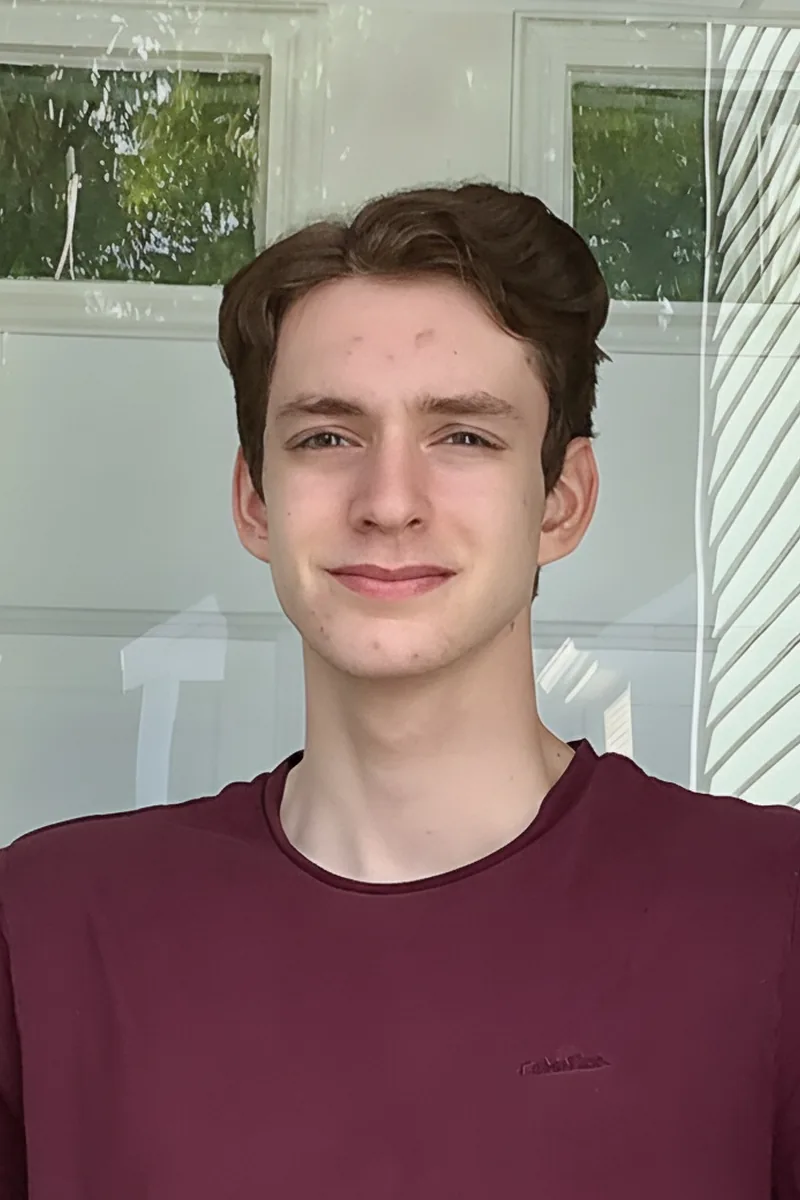
Biomedical engineering at Johns Hopkins is essentially applied physics — Nicholas spends his semesters working through mechanics, electromagnetism, and wave behavior in contexts that go well beyond the textbook. That depth lets him explain not just how to set up a free-body diagram or apply conservation of energy, but why those frameworks actually work. He's particularly strong at teaching students to map a word problem onto the right physical model.
Studying mechanical engineering at Harvard means Christopher doesn't just remember physics — he's actively building on it every semester, from Newtonian mechanics and thermodynamics to electromagnetism and wave behavior. He breaks down complex problems by teaching students to draw clean free-body diagrams, identify which conservation law applies, and translate word problems into solvable equations. That systematic approach turns intimidating multi-step problems into manageable sequences.
Studying civil engineering at Cornell means Ryan doesn't just remember physics — he's still using free-body diagrams, energy conservation, and fluid mechanics in his coursework right now. He explains force problems and kinematics by connecting equations to the physical intuition behind them, which makes problem-solving strategies transferable across chapters. His 35 ACT reflects the same analytical rigor he brings to every tutoring session.
Three years of tutoring introductory physics at Washington University gave Justin a sharp sense of where students get stuck — usually at the gap between understanding a concept verbally and translating it into a free-body diagram or equation. His dual bachelor's degrees in physics and math, plus doctoral training in computational methods, let him attack problems from both the physical intuition side and the mathematical machinery side. Rated 5.0 by students.
Cornell's biology curriculum put Alec through the full gauntlet of introductory and intermediate physics — mechanics, electromagnetism, and thermodynamics — all in the calculus-based sequence that pre-med and science majors dread most. His experience as a general chemistry TA sharpened his instinct for spotting where students lose track of units, signs, or vector directions in multi-step problems, and he teaches the habit of mapping out the physical situation before writing a single equation. Rated 4.8 by students.
Bryan holds a B.S. in Physics and teaches the subject the way it's actually practiced — starting from a real situation, identifying the relevant principles, and building a solution step by step. Whether the problem involves conservation of momentum or circuit analysis, he emphasizes drawing clear free-body diagrams and checking units before touching a calculator.
Engineering is applied physics, so Kate spent years solving the exact kinds of problems — free-body diagrams, energy conservation, circuit analysis — that show up in introductory physics courses. She walks through each problem by identifying what physical principle applies and why, which builds the kind of intuition that makes new problems feel approachable instead of intimidating.
Studying biochemistry means Elijah lives at the intersection of physics and chemistry, applying concepts like thermodynamics, electrostatics, and wave behavior to molecular systems every semester. He tackles physics problems by teaching students to sketch the situation, identify forces, and translate the diagram into equations — a process that works from kinematics through electromagnetism. That systematic breakdown turns intimidating multi-step problems into something students can actually navigate.
Mechanical engineering means Vania has ground through every corner of introductory and intermediate physics — statics, dynamics, thermodynamics, circuits — as core coursework rather than survey material. A 1590 SAT underscores the quantitative precision she brings to setting up free-body diagrams and tracking energy through multi-step problems, and she teaches across calculus and AP Physics 1 and 2, so the mathematical machinery never outpaces the physical reasoning.
Kinematics equations and free-body diagrams are straightforward once a student learns to read a physics problem like a story — identifying what's moving, what forces act on it, and what the question is really asking. Maggie teaches that translation process explicitly, drawing on her science background to walk through mechanics, energy conservation, and wave behavior with clarity. She holds a 5.0 student rating.
Earning a BS in physics from Yale gave Anthony deep comfort with the subject's core challenge: translating a physical scenario into a mathematical model and then interpreting the result. He breaks down force diagrams, energy conservation, and wave behavior by tying each concept back to the underlying math rather than treating equations as formulas to memorize.
Benjamin's physics teaching goes beyond plugging values into kinematic equations. He digs into free-body diagrams, energy conservation, and vector decomposition by asking students to predict outcomes before calculating — a habit that builds the physical intuition textbooks often skip. His math fluency from studying economics at UChicago means the quantitative side never becomes a bottleneck.
Testimonials
Because the right Physics tutor makes all the difference.
Average Session Rating – Based on 3.4M Learner Ratings
Practice Physics
Free practice tests, flashcards, and AI tutoring for Physics
Nearby Physics Tutors
Other Lafayette Tutors
Related Science Tutors in Lafayette
Frequently Asked Questions
Varsity Tutors matches Lafayette students with expert Physics tutors for 1-on-1 instruction. We pair each student with a tutor based on their specific needs, learning style, and goals.
Whether you need homework help, exam prep, or want to get ahead, our Physics tutors are ready to help.
Common challenges include gaps from earlier material, difficulty with specific concepts, and trouble applying learning to new problems. These issues can snowball quickly in Physics.
A tutor identifies where you're stuck, fills in gaps, and provides targeted practice. The 1-on-1 format means you get help exactly where you need it.
Tutors work with your student's actual coursework—homework assignments, class notes, and upcoming tests. This keeps tutoring directly relevant to what's happening in the classroom.
When you share information about your student's school and curriculum, we can match you with a tutor who has relevant experience.
All tutors complete background checks, credential verification, and teaching evaluation. Many of our Physics tutors hold advanced degrees or have years of teaching experience.
You can review tutor profiles to find someone with the right background for your student's level and needs.
Many students see improved grades within a few weeks, along with better understanding of Physics concepts and more confidence tackling challenging material.
Tutors track progress and adjust their approach to ensure continued improvement.
Most students benefit from 1-2 sessions per week. More frequent sessions help if your student is significantly behind or has an important exam coming up.
Your tutor can recommend a schedule based on your student's specific situation and goals.
Tutoring is purchased in packages of hours, with rates varying by tutor experience. Varsity Tutors offers several options to fit different budgets and needs.
You can discuss pricing during your consultation to find what works best.
Your tutor will assess where your student is, discuss goals, and start working on priority areas. Most students bring current homework or upcoming test material to focus on.
By the end, you'll have a clear sense of how the tutor can help and a plan for moving forward.
Let’s find your perfect tutor
Answer a few quick questions. We’ll recommend the right plan and match you with a top 5% tutor.