Gases
Help Questions
Physical Chemistry › Gases
A sample of argon gas at a pressure of 0.959atm and a temperature of 


Explanation
The argon gas, as the problem states, is under constant temperature with varying volume and pressure, so we need to use Boyle's Law:

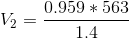
We are given the initial pressure, the initial volume, and the final pressure, and need to solve for the final volume. Therefore, we can rearrange Boyle's law to be as follows:

Plug in known values and solve.

An unknown gas is being analyzed in lab. You place 


Oxygen
Nitrogen
Argon
Chlorine
Explanation
To solve this question we need to use the ideal gas law equation:

Above, 


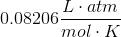




Rearrange the ideal gas law and solve for 



The question states that you place one gram of gas in the container. Since we know the moles, we can solve for the molecular weight of the gas and figure out its identity from the molecular weight.

The molecular weight of oxygen gas, 

At constant temperature and moles, which of the following is true regarding pressure and volume of a gas?
Pressure and volume have a linear relationship with a positive correlation
Pressure and volume are independent of each other
Pressure and volume have an exponential relationship with a negative correlation
Pressure and volume have an exponential relationship with a positive correlation
Explanation
First, we need to figure out which gas law is applicable here. The question states that temperature and moles are constant. This means that we are dealing with Boyle’s law, which states that pressure is inversely proportional to volume. Inversely proportional means that the pressure decreases as volume increases and vice versa. Note that the relationship is still linear (change in one variable causes a proportional change in the other variable), but the two variables have a negative correlation. Positive correlation means increasing or decreasing a variable would also increase or decrease the other variable, respectively.
A sample of argon gas at a pressure of 0.959atm and a temperature of
Explanation
The argon gas, as the problem states, is under constant temperature with varying volume and pressure, so we need to use Boyle's Law:
We are given the initial pressure, the initial volume, and the final pressure, and need to solve for the final volume. Therefore, we can rearrange Boyle's law to be as follows:
Plug in known values and solve.
An unknown gas is being analyzed in lab. You place
Oxygen
Nitrogen
Argon
Chlorine
Explanation
To solve this question we need to use the ideal gas law equation:
Above,
Rearrange the ideal gas law and solve for
The question states that you place one gram of gas in the container. Since we know the moles, we can solve for the molecular weight of the gas and figure out its identity from the molecular weight.
The molecular weight of oxygen gas,
At constant temperature and moles, which of the following is true regarding pressure and volume of a gas?
Pressure and volume have a linear relationship with a positive correlation
Pressure and volume are independent of each other
Pressure and volume have an exponential relationship with a negative correlation
Pressure and volume have an exponential relationship with a positive correlation
Explanation
First, we need to figure out which gas law is applicable here. The question states that temperature and moles are constant. This means that we are dealing with Boyle’s law, which states that pressure is inversely proportional to volume. Inversely proportional means that the pressure decreases as volume increases and vice versa. Note that the relationship is still linear (change in one variable causes a proportional change in the other variable), but the two variables have a negative correlation. Positive correlation means increasing or decreasing a variable would also increase or decrease the other variable, respectively.
Given the ideal gas law:

Where 


Based on the Ideal gas law, which of the following are true?
I. Pressure and volume are inversely proportional
II. Pressure and density are inversely proportional
III. Pressure and temperature are directly proportional
IV. Density and temperature are inversely proportional
V. R and M are inversely proportional
I, III, IV
I, II, III, IV, V
I, III
II, III, V
III, IV, V
Explanation
Condition I is true. Pressure and volume are inversely proportional. The ideal gas law with volume can be rederived to show this:
We introduce an expression for moles:


Where 


Rearranging (1) to solve for 
We get:

Finally, we use the following for density, where 

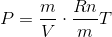
The masses cancel out and we have the ideal gas law expressed with volume and moles.
Condition II is false. It is clear from the equation that pressure and density are directly proportional.
Condition III is true because it is clear from the equation that temperature and pressure are directly proportional.
Condition IV is true because density and temperature are on the same side of the equation in the numerator, so the must be inversely proportional.
Condition V is false because the ideal gas constant and molar mass can be rearranged to be on opposite sides of the equation and in the numerator.
A researcher places a closed piston container at room temperature. He places a Bunsen burner at the bottom of the container and observes that the piston moves up. What can best explain this phenomenon?
The volume of the gas increased because of Charles’ Law
The pressure of the gas decreased because of Charles’ Law
The volume of the gas increased because of Boyle’s Law
The pressure of the gas decreased because of Boyle’s Law
Explanation
There are three main gas laws. Avogadro’s law states that the moles of a gas is directly proportional to the volume (under constant pressure and temperature). Boyle’s law states that the pressure of the gas is inversely proportional to the volume (under constant moles and temperature). This means that the pressure decreases proportionally when the volume increases. Charles’ law states that the temperature is directly proportional to the volume (under constant moles and pressure). The question states that the piston moves up. This means that the volume of the gas is expanding inside and pushing the piston up to make room for the expanding gas. The gas expansion occurs due to increased temperature (Charles’ law).
A researcher places a closed piston container at room temperature. He places a Bunsen burner at the bottom of the container and observes that the piston moves up. What can best explain this phenomenon?
The volume of the gas increased because of Charles’ Law
The pressure of the gas decreased because of Charles’ Law
The volume of the gas increased because of Boyle’s Law
The pressure of the gas decreased because of Boyle’s Law
Explanation
There are three main gas laws. Avogadro’s law states that the moles of a gas is directly proportional to the volume (under constant pressure and temperature). Boyle’s law states that the pressure of the gas is inversely proportional to the volume (under constant moles and temperature). This means that the pressure decreases proportionally when the volume increases. Charles’ law states that the temperature is directly proportional to the volume (under constant moles and pressure). The question states that the piston moves up. This means that the volume of the gas is expanding inside and pushing the piston up to make room for the expanding gas. The gas expansion occurs due to increased temperature (Charles’ law).
Given the van der Waals Equation:
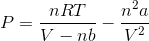
Which statement accurately identifies and explains the corrections that van der Waals made to the ideal gas law, where the first correction is the 

The first correction corrects for volume of molecules by decreasing volume as a function of the number of molecules, and the second correction corrects for molecular attraction by decreasing pressure as volume decreases and number of molecules increases.
The first correction corrects for volume of molecules by increasing volume as a function of the number of molecules, and the second correction corrects for molecular attraction by decreasing pressure as volume increases and number of molecules increases.
The first correction corrects for volume of molecules by increasing volume as a function of the number of molecules, and the second correction corrects for molecular attraction by increasing pressure as volume increases and number of molecules increases.
The first correction corrects for volume of molecules by decreasing volume as a function of the number of molecules, and the second correction corrects for molecular attraction by increasing pressure as volume increases and number of molecules increases.
The first correction corrects for volume of molecules by increasing volume as a function of the number of molecules, and the second correction corrects for molecular attraction by increasing pressure as volume decreases and number of molecules increases.
Explanation
All the statements say similar things, but only one correctly identifies the resulting change to volume and pressure. Let's break things down by the correction.
Correction 1:
The correction decreases the volume, since it is subtracting 
Correction 2:
Since we are subtracting 


