Integers
Help Questions
ACT Math › Integers
A car averages 29 miles per gallon. If gas costs $3.75 per gallon how much money would need to be spent on gas to travel 1464.5 miles?
$189.38
$5491.88
$108.75
$50.5
None of the other answers
Explanation
The question is asking for the amount of money that would need to be spent on gas. Using the value given for the miles per gallon of the car and the amount of miles traveled it is possible to determine the gallons of fuel that will be required. This will be set up as 1464.5 miles travelled divided by the 29 miles per gallon that the car gets. This leaves us with 50.5 gallons of fuel used. From this point we can multiply the amount of fuel used, 50.5 gallons, by the price of fuel per gallon, $3.75, to obtain the amount of money that will spent on fuel, $189.38.
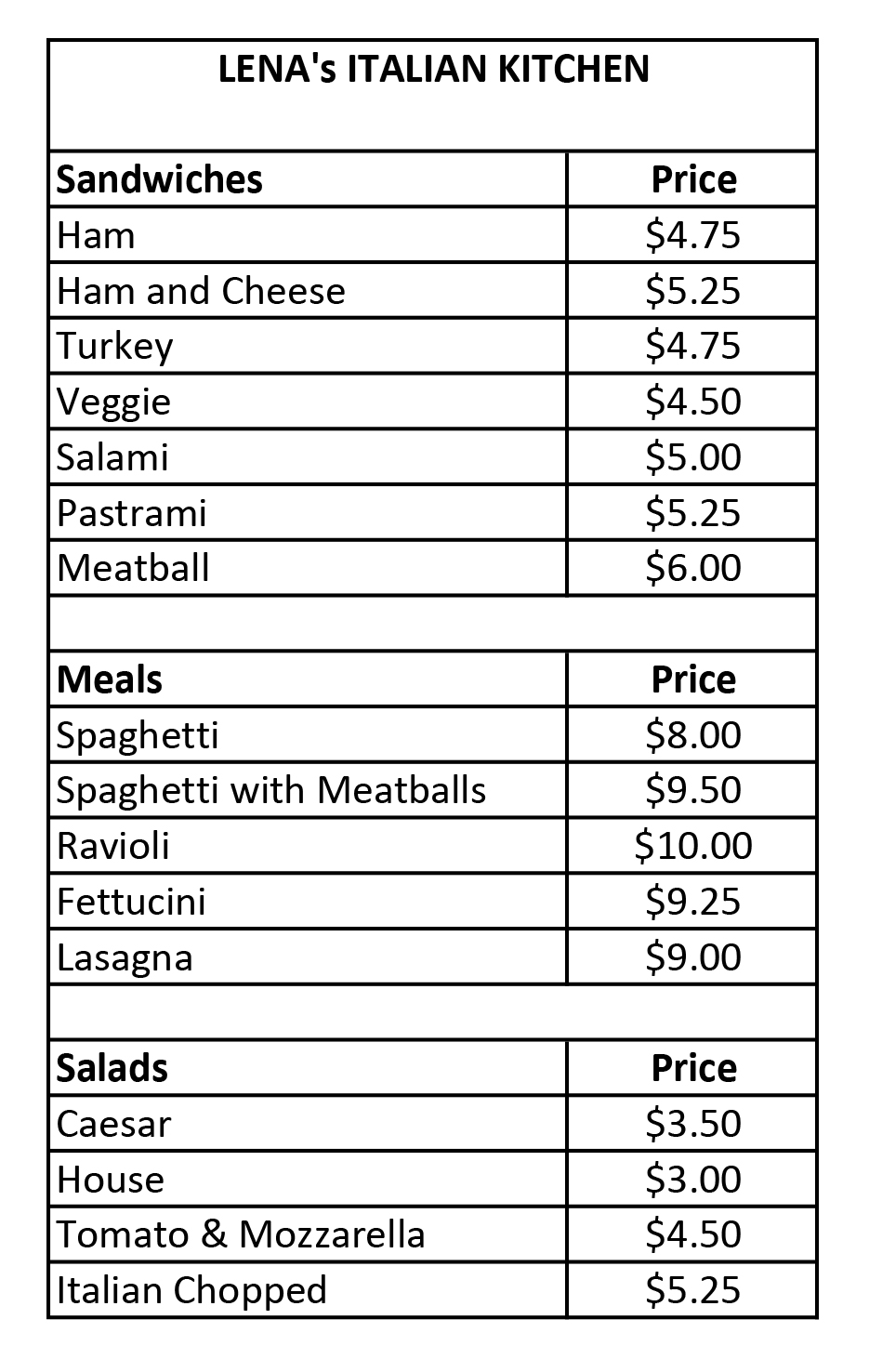
The menu above is from Lena’s Italian Kitchen. If you are going there for dinner, how many different combinations of a meal and a salad are there?
20
5
10
15
25
Explanation
Combinations = # first option * # second option
= # meals * # salads
= 5 * 4 = 20
The menu above is from Lena’s Italian Kitchen. If you are going there for dinner, how many different combinations of a meal and a salad are there?
20
5
10
15
25
Explanation
Combinations = # first option * # second option
= # meals * # salads
= 5 * 4 = 20
In the sequence 3, , , 24, what numbers can fill the two blanks so that consecutive terms differ by a common ratio?
6, 12
9, 18
10, 15
10, 17
12, 16
Explanation
If the common ratio is r, then the sequence can be rewritten as 3, 3r, , . We see then that , which gives us that r=2. Therefore, the missing terms are 6 and 12.
The menu above is from Lena’s Italian Kitchen. If you are going there for dinner, how many different combinations of a meal and a salad are there?
20
5
10
15
25
Explanation
Combinations = # first option * # second option
= # meals * # salads
= 5 * 4 = 20
Solve:


Explanation
This problem can be solved using common factors.
Rewrite 

What is the probability of selecting a prime number out of the following set?
{2, 6, 9, 17, 21, 47, 63, 71, 81}
3/9
4/9
5/9
6/9
9/4
Explanation
Probability is determined by dividing favorable outcomes, by possible outcomes. As there are 9 numbers in the given set, the number of possible outcomes is 9. In the given set, only 2, 17, 47 and 71 are prime numbers (divisible only by 1 and itself). Thus, there are 4 favorable outcomes, yielding a probability of 4/9.
What is the probability of selecting a prime number out of the following set?
{2, 6, 9, 17, 21, 47, 63, 71, 81}
3/9
4/9
5/9
6/9
9/4
Explanation
Probability is determined by dividing favorable outcomes, by possible outcomes. As there are 9 numbers in the given set, the number of possible outcomes is 9. In the given set, only 2, 17, 47 and 71 are prime numbers (divisible only by 1 and itself). Thus, there are 4 favorable outcomes, yielding a probability of 4/9.
In the sequence 3, , , 24, what numbers can fill the two blanks so that consecutive terms differ by a common ratio?
6, 12
9, 18
10, 15
10, 17
12, 16
Explanation
If the common ratio is r, then the sequence can be rewritten as 3, 3r, , . We see then that , which gives us that r=2. Therefore, the missing terms are 6 and 12.
Solve:
Explanation
This problem can be solved using common factors.
Rewrite