Arithmetic
Help Questions
ACT Math › Arithmetic
What common number can you add to the numerator and denominator of 


Explanation
Set up an equation where you add the same unknown number (x) to both the numerator and the denominator of the original fraction, and set the equation equal to 

Cross-multiply the fractions to simplify.


Now, solve for x.


A car averages 29 miles per gallon. If gas costs $3.75 per gallon how much money would need to be spent on gas to travel 1464.5 miles?
$189.38
$5491.88
$108.75
$50.5
None of the other answers
Explanation
The question is asking for the amount of money that would need to be spent on gas. Using the value given for the miles per gallon of the car and the amount of miles traveled it is possible to determine the gallons of fuel that will be required. This will be set up as 1464.5 miles travelled divided by the 29 miles per gallon that the car gets. This leaves us with 50.5 gallons of fuel used. From this point we can multiply the amount of fuel used, 50.5 gallons, by the price of fuel per gallon, $3.75, to obtain the amount of money that will spent on fuel, $189.38.
A car averages 29 miles per gallon. If gas costs $3.75 per gallon how much money would need to be spent on gas to travel 1464.5 miles?
$189.38
$5491.88
$108.75
$50.5
None of the other answers
Explanation
The question is asking for the amount of money that would need to be spent on gas. Using the value given for the miles per gallon of the car and the amount of miles traveled it is possible to determine the gallons of fuel that will be required. This will be set up as 1464.5 miles travelled divided by the 29 miles per gallon that the car gets. This leaves us with 50.5 gallons of fuel used. From this point we can multiply the amount of fuel used, 50.5 gallons, by the price of fuel per gallon, $3.75, to obtain the amount of money that will spent on fuel, $189.38.
To find the sale price for a single item or group of like items, one can use the equation 


A pair of headphones normally sells for 


Explanation
To find the new sale price, apply the discount to the original price in decimal form.


A bowl contains 

Which of the following expressions represents the total number of red marbles in the bowl?


Explanation
It’s best to start with a fraction that is a part over 100. For this problem, we are looking for a fraction that shows 

If there are 4 marbles in the bowl, you’d expect 1 to be red. If we use this equation, we get
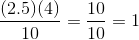
At the beginning of a race, a person's speed is 


Explanation
Recall that in general

Now, let's gather our three rates:
Rate 1:

Rate 2:

Rate 3:

Now, we know that the time is a total of 

This is 

Solve:


Explanation
This problem can be solved using common factors.
Rewrite 

Solve:
Explanation
This problem can be solved using common factors.
Rewrite
Maria owns an art studio and spent 


Explanation
Divide the total money spent by the cost of each painting.
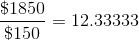
Therefore, to make a profit, she needs to sell more than this amount. Since she can't sell a portion of a painting, the answer has to be the next nearest whole number (
The number 9 is the second smallest integer with 3 factors, 1, 3, and 9. What is the sum of the factors of the smallest integer with only 3 factors?
4
7
13
15
17
Explanation
Here we must do two things. First we must find the smallest integer with 3 factors, then we must add those factors so that we can obtain our answer.
Looking at numbers less than 9 with only 3 factors, the only possibility is the number 4, whose factors are 1, 2, and 4.
The sum of these factors is 1 + 2 + 4 = 7