Mathematical Relationships and Basic Graphs
Help Questions
Algebra 2 › Mathematical Relationships and Basic Graphs
Add the fractions:


Explanation
Find the least common denominator to these fractions.
Multiply both denominators together.

Convert the fractions using this denominator.

The answer is:

Find the value of:


Explanation
The factorial sign (!) just tells us to multiply that number by every integer that leads up to it. So, 
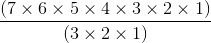
To make this easier for ourselves, we can cancel out the numbers that appear on both the top and bottom:



Explanation


Factor the radical:


Explanation
The radical can be rewritten with common factors.
Pull out the factor of a known square.

The value of 
The answer is:

Add the radicals, if possible:


Explanation
Every radical in this expression is simplified except 
Simplify by rewriting this radical using factors of perfect squares.

Replace the term.

Combine like-terms.
The answer is:

Calculate


Explanation
This is asking us to plug in the integers between 0 and 5, then add these numbers together.


Solve the equation:


Explanation


Add three on both sides.


Divide by 8 on both sides.

The answer is:

Sum the fractions:


Explanation
In order to add the fractions, determine the least common denominator.
The LCD is 44 since this number is divisible by both 11 and 44.
Convert the fractions.

Add the numerator. The denominator remains the same.
The answer is:

Evaluate:


Explanation
Write the powers of the imaginary numbers.


Notice that this will repeat. We can rewrite higher powers if the imaginary term by product of powers.

The answer is:

Solve for 


Explanation
When solving exponential equations, we need to ensure that we have the same base. When that happens, our equations our based on the exponents.


