Create an account to track your scores
and create your own practice tests:
Test: MCAT Physical
Diffusion can be defined as the net transfer of molecules down a gradient created by differing concentrations of the molecule in different locations. This is a passive, spontaneous process and relies on the random movement of molecules and Brownian motion. Diffusion is an important biological process, especially in the respiratory system where oxygen diffuses from alveoli, the basic units of lung mechanics, to red blood cells in the capillaries.
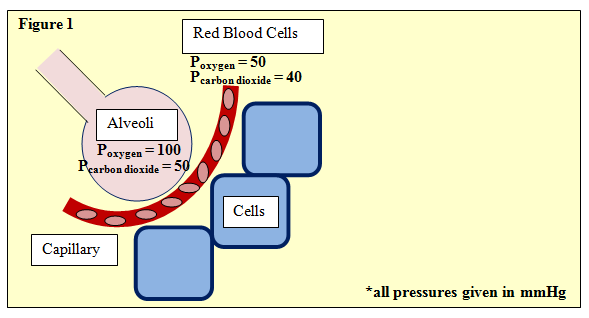
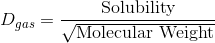
Figure 1 depicts this process, showing an alveolus separated from neighboring cells by a capillary with red blood cells. The partial pressures of oxygen and carbon dioxide are given. One equation used in determining gas exchange is Fick's law, given by:

In this equation, 


| 12. | At high altitudes, the partial pressure of oxygen quickly drops while that of carbon dioxide decreases by much less. Given the following table, at what elevation is the pressure gradient of oxygen equal to half that of carbon dioxide, assuming constant capillary partial pressures of oxygen and carbon dioxide of 50mmHg and 40mmHg, respectively?
|