Quadratic Functions
Help Questions
Math › Quadratic Functions
Which inequality does this graph represent?


Explanation
The hyperbola in the question's graph is 
This could be discerned because it subtracts 


Test a point to tell which inequality is being used in the graph.
The point 


Consider the following two functions:


How is the function 


Explanation
The 


What are the 


There are no 
Explanation
To find the x-intercepts of the equation, we set the numerator equal to zero.


What is the center of the circular function 


Explanation
Remember that the "shifts" involved with circular functions are sort of like those found in parabolas. When you shift a parabola left or right, you have to think "oppositely". A right shift requires you to subtract from the x-component, and a left one requires you to add. Hence, this circle has no horizontal shift, but does shift 6 upward for the vertical component.
You can also remember the general formula for a circle with center at 


Comparing this to the given equation, we can determine the center point.

The center point is at (0,6) and the circle has a radius of 5.
What are the coordinates of the center of a circle with the equation 


Explanation
The equation of a circle is 
A circle is graphed by the equation 


Explanation
First determine the center of the circle. The "x-3" portion of the circle equation tells us that the x coordinate is equal to 3. The "y-3" portion of the circle equation tells us that the y coordinate is equal to 3 as well. Therefore, the center of the circle is at (3,3).
To find the distance between (3,3) and (0,0), it is necessary to use the Pythagorean Theorem  . Where "a" and "b" are equal to 3
(to visualize, you may draw the two points on a graph, and create a triangle. The line connecting the two points is the hypotenuse, aka "c." )


What is the center and radius of the following equation, respectively?



Explanation
The equation given represents a circle.




The center is at:

Set up an equation to solve the radius.

The radius is:

The answer is:

Based on the figure below, which line depicts a quadratic function?

Red line
Blue line
Green line
Purple line
None of them
Explanation
A parabola is one example of a quadratic function, regardless of whether it points upwards or downwards.
The red line represents a quadratic function and will have a formula similar to 
The blue line represents a linear function and will have a formula similar to 
The green line represents an exponential function and will have a formula similar to 
The purple line represents an absolute value function and will have a formula similar to 
Consider the equation:

The vertex of this parabolic function would be located at:


Explanation
For any parabola, the general equation is


For the given problem, the x-coordinate is
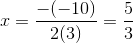
To find the y-coordinate, plug 

Therefore the vertex is at 
Consider the following two functions:
How is the function
Explanation
The