Award-Winning College Physics Tutors
serving Wichita, KS
College Physics
Tutors in Wichita
Private 1-on-1 tutoring, weekly live classes for academic support, test prep & enrichment, practice tests and diagnostics, and more to elevate grades and test scores.
Based on 3.4M Learner Ratings
UniversitiesSchools & Universities
DeliveredHours Delivered
ProficiencyGrowth in Proficiency
Who needs tutoring?
No obligation. Takes ~1 minute.
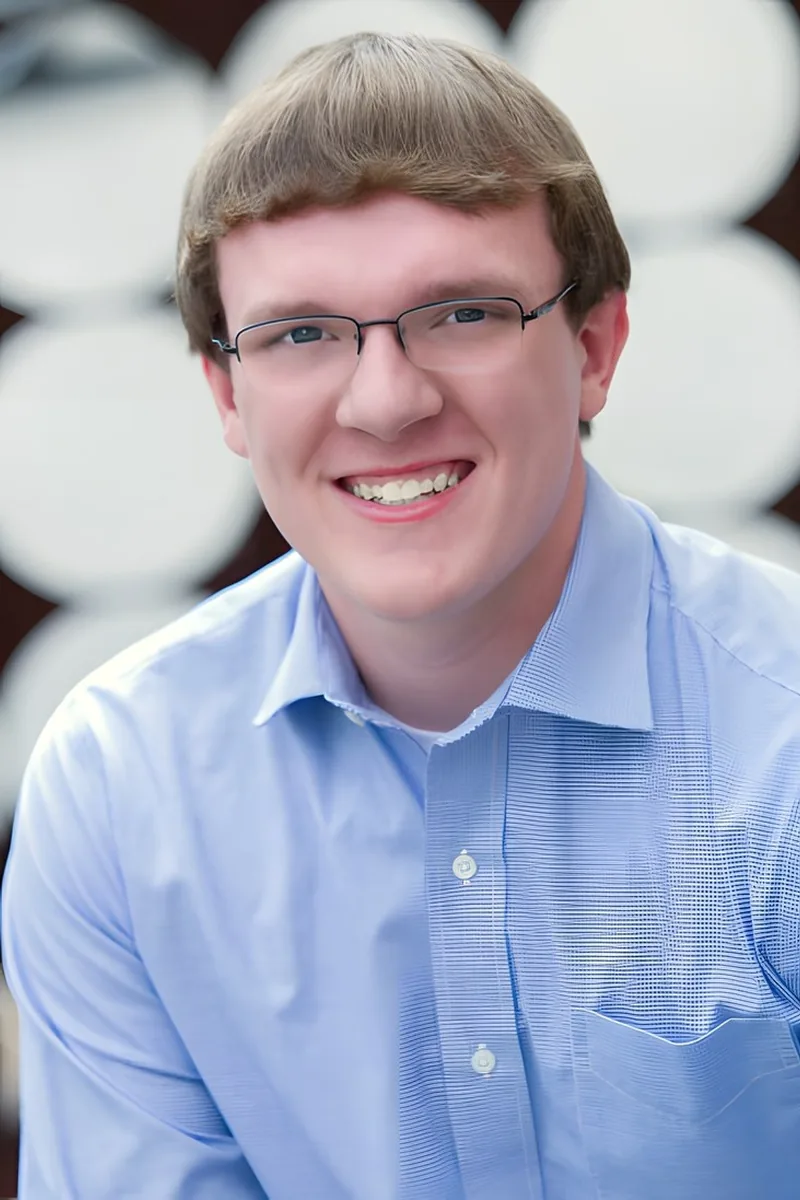
Having served as a teaching assistant for Differential Equations and Mechanics at Notre Dame, Jeffrey has already spent time explaining the exact concepts — torque, oscillations, coupled systems — that trip up students in university physics courses. His mechanical engineering PhD work at Rice deepens that fluency, especially in thermodynamics and rotational dynamics where the math gets dense fast. He's rated 4.9 by students.

An astrophysical sciences degree means Andrew spent his undergraduate years applying Newtonian mechanics, electromagnetism, and thermodynamics to systems where approximations break down and precision matters — stellar interiors, orbital dynamics, radiation processes. That depth shows up when he walks students through college physics problems, because he can explain the physical intuition behind equations of motion or energy conservation rather than just drilling plug-and-chug techniques. Rated 4.9 by students.
I am Chad Bergman, a current Dartmouth student pursuing my Bachelor's in Economics with a physics minor. I have experience tutoring college economics in person on Dartmouth campus as well as online tutoring in high school calculus and physics. I've had great success on the SAT and ACT as well as my AP tests in high school, and I hope to help others succeed as well. My favorite subject to tutor is physics because I feel like learning to apply a few fundamental principles to different real world situations is extremely useful in any discipline. While tutoring I try to help students master the fundamentals so they can apply them to the material we're working on as well as future material. Outside academia, I help look after my four siblings and play more League of Legends online than is perhaps healthy.
Carl's mechanical engineering degree means he spent years solving the exact problems that fill college physics syllabi — free-body diagrams, rotational kinematics, thermodynamic cycles, fluid statics — as daily coursework rather than isolated exercises. That engineering lens lets him walk through force and energy problems with an eye toward practical application, showing students how to set up the physics before grinding through the math. His 32 ACT speaks to the broad analytical chops he brings to quantitative problem-solving.
Computer engineering demands serious physics chops — Lee's coursework covers circuit analysis, electromagnetism, and thermodynamics at the college level, so he tackles these topics as someone who actually uses them in design problems. He breaks down concepts like Kirchhoff's laws, rotational dynamics, and wave behavior by tying them to real engineering applications that make the math feel purposeful.
Between teaching biology, chemistry, and multiple levels of math, Qays covers the exact trio of disciplines that college physics constantly pulls from — setting up differential equations for motion, applying energy concepts that mirror thermochemistry, and reasoning through biological systems governed by fluid dynamics and pressure. He breaks problems into their underlying science and math components so students see the full picture, not just an equation to solve. Holds a 5.0 rating.
Three years of tutoring introductory physics while completing dual bachelor's degrees in physics and mathematics gave Justin a detailed map of exactly where students lose the thread — the jump from one-dimensional kinematics to rotational analogs, the shift from intuitive force reasoning to formal energy methods. His PhD in Computational Mathematics at the University of Chicago deepened that foundation, adding fluency with the differential equations and vector calculus that make the leap from algebra-based to calculus-based physics so steep. Rated 5.0 by students.
Serving as a TA for Duke's Electricity and Magnetism course means Florence has graded the exact types of problems — Gauss's law applications, RC circuits, Faraday's law scenarios — that make college physics students sweat, and she knows precisely where the reasoning breaks down. Her computer science background also gives her a knack for teaching the systematic, step-by-step problem decomposition that turns a wall of physics into something solvable. Holds a 5.0 rating.
Studying computer science at MIT means Brice lives inside the math and physics that most students only encounter on problem sets — his coursework regularly demands fluency in mechanics, wave behavior, and electromagnetism as foundations for everything from signal processing to computational modeling. He breaks physics problems into the same kind of step-by-step logical structure he'd use to debug code, which makes tangled multi-concept questions feel systematic rather than overwhelming. Rated 4.9 by students.
Premed coursework and a computing degree at Notre Dame meant Aidan sat through the full sequence of calculus-based physics — mechanics, E&M, waves — while simultaneously learning to think algorithmically about complex problems. That combination is particularly useful when students hit the wall where physics stops being plug-and-chug and starts requiring multi-step reasoning, like connecting free-body diagrams to energy methods or translating a word problem into the right integral. His 35 ACT speaks to the quantitative fluency he brings to those tougher setups.
A computer science degree from UCLA means Michael spent semesters deep in the physics that underpins simulation and graphics — kinematics, force modeling, energy systems — and his 1560 SAT confirms the quantitative chops to handle calculus-based problem solving. He teaches students to treat each physics problem like debugging code: isolate what you know, identify the governing principle, then execute step by step until the answer falls out.
A PhD in biomedical engineering means Andrew has spent years applying physics to biological systems — modeling forces on joints, analyzing fluid flow through tissues, understanding how electromagnetic fields interact with the body. That depth in mechanics, thermodynamics, and E&M carries directly into the calculus-based problem solving college physics courses demand. Rated 4.9 by students.
Building things that actually work — which is what mechanical engineering is — means Vania spent her degree applying Newton's laws to real structures, calculating heat transfer through materials, and analyzing fluid flow, not as textbook exercises but as design requirements. That hands-on engineering intuition shows up when she breaks down free-body diagrams or walks through energy conservation problems, because she's solved versions of them that had to hold up in the physical world. Her 1590 SAT underscores the quantitative precision she brings to calculus-based problem solving.
A bio-organic chemistry degree means Alex spent semesters in calculus-based physics courses where thermodynamics, electromagnetism, and mechanics weren't electives — they were prerequisites for understanding molecular behavior. That chemistry-physics overlap gives him a knack for unpacking energy conservation and electric potential in ways that click for students who think in terms of atoms and reactions rather than pulleys and ramps.
A chemistry degree from Yale means Zosia spent years in courses where physics does the heavy lifting — thermodynamics driving reaction spontaneity, quantum mechanics explaining atomic structure, electrostatics governing molecular interactions — so she knows these concepts from the inside out. She's particularly effective at teaching students to translate word-heavy problem statements into clean free-body diagrams or energy bar charts before touching an equation. Rated 4.9 by students.
Biomedical engineering at Johns Hopkins means Christine solves physics problems daily that most students only see in textbooks — fluid dynamics in blood flow, pressure gradients across membranes, mechanics of prosthetic joints — giving her a concrete, application-heavy lens for the material. She's particularly strong on the thermodynamics and mechanics portions of college physics, where her coursework overlaps most directly with standard problem sets. Holds a 5.0 rating.
Between simulating supernova shock fronts at Princeton and building optical filters at Norfolk State, Dennis has applied college-level physics across mechanics, electromagnetism, thermodynamics, and wave optics in real research settings. He unpacks difficult problem sets by connecting each concept to the physical scenario it describes — an approach that's especially effective for students transitioning from plug-and-chug to genuine problem-solving.
Studying applied physics at Cornell means Ritesh isn't just teaching college physics concepts — he's actively using them in coursework and research. He digs into the areas that trip up most introductory students, like applying Newton's laws to rotational systems, working through Gauss's law problems, or connecting energy conservation to real circuits. His 4.6 rating speaks to his ability to make those connections click.
Testimonials
Because the right College Physics tutor makes all the difference.
Average Session Rating – Based on 3.4M Learner Ratings
Other Wichita Tutors
Related Science Tutors in Wichita
Frequently Asked Questions
College Physics students often struggle with translating abstract concepts—like electromagnetic fields, wave properties, and quantum mechanics—into concrete mental models. Beyond conceptual understanding, many students find unit conversions, dimensional analysis, and multi-step problem-solving challenging. Personalized tutoring helps you move beyond memorizing formulas to truly understanding the physics principles at work, which makes tackling complex problems much more manageable.
Expert tutors connect abstract concepts to tangible examples—explaining how electromagnetic principles power your phone, how projectile motion applies to engineering, or how thermodynamics relates to everyday energy use. This approach makes the material more memorable and helps you develop scientific reasoning skills that extend beyond the classroom. When you understand the 'why' behind physics, problem-solving becomes intuitive rather than formulaic.
Yes. Tutors can help you understand the scientific method, design experiments, analyze data, and interpret results—all critical components of physics labs. Whether you're struggling with experimental procedure, data analysis, or writing lab reports, personalized instruction ensures you grasp both the hands-on and theoretical sides of physics. This comprehensive support strengthens your overall understanding and boosts your lab grades.
Your first session focuses on understanding your specific challenges—whether that's conceptual gaps, problem-solving strategy, or exam preparation. The tutor will assess your current level, identify which topics need the most attention, and tailor a learning plan to your goals. You'll walk away with clarity on next steps and a sense of how personalized instruction can help you succeed in the course.
Absolutely. Many students memorize formulas but lack a systematic approach to tackling problems. Expert tutors teach you how to break down complex problems, identify what's given and what you're solving for, choose the right physics principles, and check your work for reasonableness. With guided practice and feedback, you'll build confidence and efficiency—skills that pay off on exams and in upper-level physics courses.
Tutors use diagrams, animations, physical demonstrations, and step-by-step explanations to make invisible forces and fields visible in your mind. Whether it's vector addition, magnetic field lines, or wave interference, breaking down abstract ideas into visual and kinesthetic components helps you build lasting understanding. This approach is especially valuable for College Physics, where intuition about motion, forces, and energy is essential.
Ideally, start 3-4 weeks before a major exam to allow time for concept review, problem practice, and targeted reinforcement of weak areas. However, even starting 1-2 weeks out can make a meaningful difference if you focus on high-impact topics. Consistent, ongoing tutoring throughout the semester is most effective—it prevents knowledge gaps from piling up and builds the deep understanding that leads to strong exam performance.
Varsity Tutors connects you with expert tutors who have strong backgrounds in College Physics and experience teaching students in Wichita. You'll be matched based on your specific needs, learning style, and schedule. Once connected, you can start personalized instruction right away and adjust your tutoring plan as your understanding deepens and your goals evolve.
Let’s find your perfect tutor
Answer a few quick questions. We’ll recommend the right plan and match you with a top 5% tutor.