Create an account to track your scores
and create your own practice tests:
Test: ACT Science
A fiber-optic Michelson interferometer is a device that detects changes in optical paths. In a fiber-optic interferometer, a coherent light source (usually a laser) is sent through a beam splitter that splits the light along two paths. These beams are coupled into fiber optic cables that can be arranged and manipulated more freely than mirrors. The two beams are finally recombined by a second beam splitter and superimposed on a screen. If there is a phase difference between the two waves, interference fringes will be viewed on the screen.
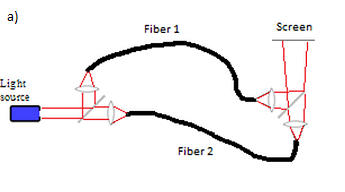
By observing fringe shifts, one can quantify the change in optical path difference between the two fibers using the following equation:

where m is the number of fringe shifts, x is the difference between the optical paths of the two beams, and 
Experiment 1:
A student sets up a fiber-optic Michelson interferometer and heats one of the fibers with various resistors and power supplies, fans air over one of the fibers, and then bends one of the fibers. The resulting fringe shifts, as well as the change in optical path difference (OPD), are shown below.
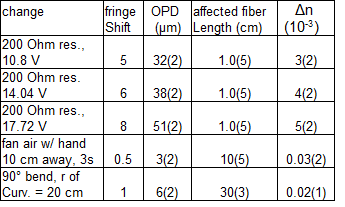
| 12. | What is one valid hypothesis for why fanning the air near a fiber optic cable should cause 0.5 fringe shifts in the student's experiment? |
The air changes how the light is coupled into the fiber-optic cables by the lens.
The air cools or heats one of the fiber optic cables more than the other, causing it to shrink or expand.
The air's motion causes refraction of the beam, thereby distorting the interference pattern observed on the screen.
The air introduces disturbances into the optics of the light source, leading to diffraction patterns.