Award-Winning AP Physics C: Mechanics Tutors
serving San Antonio, TX
AP Physics C: Mechanics
Tutors in San Antonio
Private 1-on-1 tutoring, weekly live classes for academic support, test prep & enrichment, practice tests and diagnostics, and more to elevate grades and test scores.
Based on 3.4M Learner Ratings
UniversitiesSchools & Universities
DeliveredHours Delivered
ProficiencyGrowth in Proficiency
Who needs tutoring?
No obligation. Takes ~1 minute.

Bidyut's biomedical engineering coursework at Johns Hopkins fuses calculus-based mechanics with real physical systems — analyzing forces on prosthetic joints, modeling fluid dynamics in arteries — so the Newtonian mechanics and rotational problems on the AP Physics C exam feel like simplified versions of what he already does daily. He scored a 36 ACT and holds a 5.0 tutoring rating, and he's particularly sharp at showing students how to translate a word problem into the correct integral or differential equation before touching any numbers.
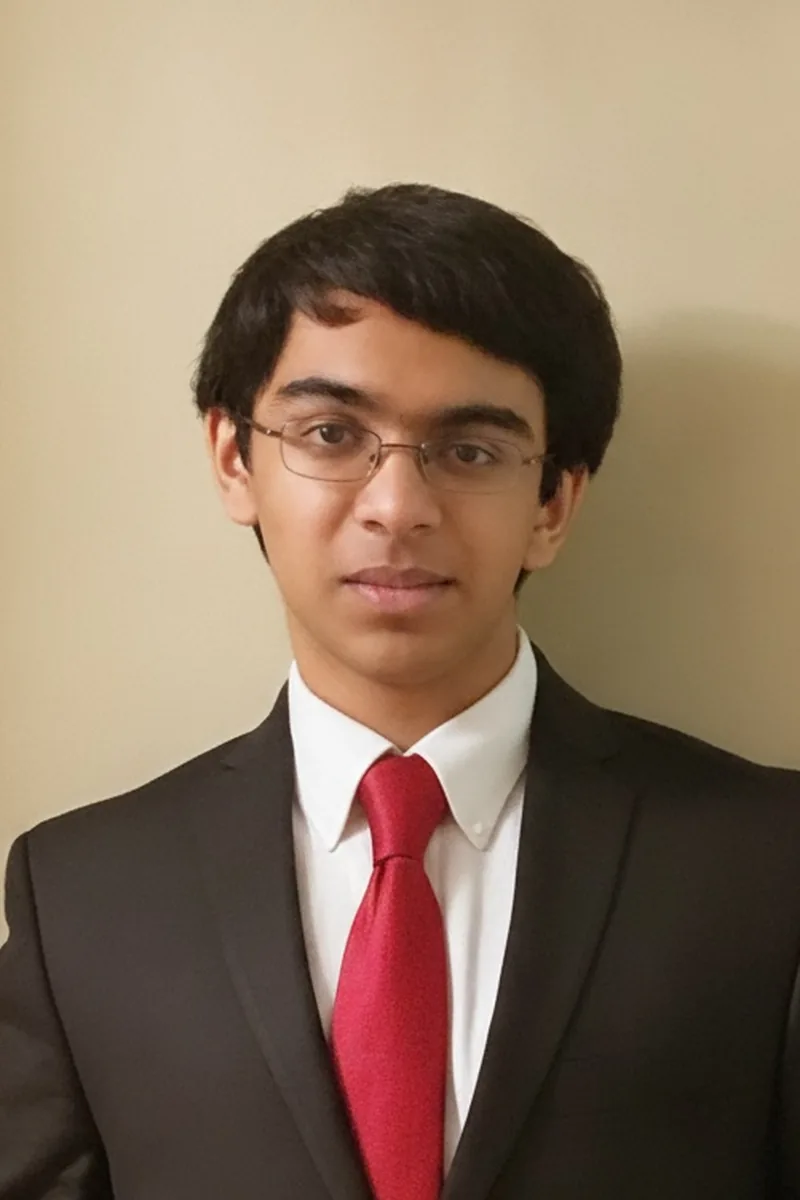
Biophysics at Rice means Aadith solves mechanics problems where the calculus isn't optional — modeling forces on protein structures, analyzing torque in molecular motors, applying Newton's laws to systems most students never picture in a physics classroom. That cross-disciplinary lens gives him a knack for teaching students how to read a physical scenario and decide whether to reach for an energy integral or a force-based differential equation. His 1590 SAT underscores the mathematical precision he brings to every free-response setup.
Computational mathematics at Rice is essentially applied calculus with the volume turned up — Vinson's coursework in differential equations and numerical methods maps directly onto the mechanics problems where students need to set up Newton's second law as a differential equation and solve it, not just memorize kinematic formulas. His 36 ACT and National AP Scholar status (including AP Physics and the full calculus sequence) mean he's been through the exact exam pressure these students face. Rated 4.8 by students.
Decades of chemical engineering work gave Steven a particular fluency with the calculus-based mechanics that AP Physics C demands — he's applied Newton's laws, energy methods, and differential equations to real industrial systems, not just textbook scenarios. He explains each concept multiple ways, layering physical intuition with worked examples until the connection between the physics and the integral clicks. Rated 4.9 by students.
Rice's mechanical engineering program puts Ashton through calculus-based statics, dynamics, and kinematics every semester — the same core mechanics that AP Physics C tests, just applied to real structural and machine systems. That daily exposure means he can spot whether a student's free-response mistake is a physics misread or a calculus execution error, and address the right one. His 32 ACT underscores the quantitative fluency backing his approach.
John scored a 36 on the ACT and tutors the full calculus-to-physics pipeline — AP Calculus AB, AP Physics 1, and AP Physics C: Mechanics — so he sees exactly where students' math skills break down under the pressure of a mechanics problem. He teaches students to recognize which physical scenarios call for integration versus differentiation before they even write an equation, turning the free-response section into a series of deliberate decisions rather than panicked formula hunts. Rated 4.9 by students.
AP Physics C: Mechanics isn't the obvious fit for a political science major — but Lila also tutors calculus, pre-calculus, and both AP Physics C courses, and her 36 ACT reflects the quantitative chops that calculus-based mechanics actually demands. She's especially useful for students who need someone to slow down and rebuild the connection between a free-body diagram and the integral it implies, rather than racing through derivations.
Biomedical engineering at Rice means Aurnab regularly applies calculus-based mechanics to biological systems — modeling forces on skeletal structures, analyzing motion in prosthetic designs — so the kinematics and Newton's laws on the AP Physics C exam map directly onto problems he's already solving in his coursework. His 36 ACT and 1590 SAT point to the mathematical precision that matters most when students need to cleanly set up a work-energy integral or differentiate a position function under exam time pressure. Rated 4.9 by students.
Computational engineering at UT Austin means Atharva lives at the intersection of calculus, physics, and code — so when an AP Physics C problem requires setting up a differential equation for a variable-force scenario or computing rotational inertia through integration, he's drawing on skills he uses across multiple disciplines daily. His 33 ACT and 5.0 tutoring rating back up an approach that emphasizes building the free-body diagram and mathematical model together, so students see exactly where the physics ends and the calculus begins.
Mechanical engineering at UT Austin means Shroothi isn't just reviewing AP Physics C: Mechanics concepts — she's applying them in coursework where getting a free-body diagram wrong has real design consequences. That engineering context sharpens how she teaches the transition from kinematics to force analysis, especially when problems layer in friction, variable forces, or constraints that demand careful calculus setup. Rated 5.0 by students.
What makes Miguel's approach to AP Physics C: Mechanics distinctive is his dual background in computer science and English — he treats each mechanics problem like a piece of code to debug and a paragraph to interpret, teaching students to read force diagrams and word problems with the same precision they'd need to parse a function or an argument. His 35 ACT confirms the quantitative chops, but it's the CS training that sharpens his method for breaking variable-force and rotational problems into clean, sequential logic rather than a tangle of half-remembered equations. Rated 4.9 by students.
Freshman-year statics and dynamics at Purdue's mechanical engineering program threw Austin into calculus-based mechanics problems every week — variable-force work integrals, moment-of-inertia derivations, and the kind of multi-body free-body diagrams that mirror the hardest AP Physics C free-response questions. His 34 ACT and 1520 SAT back up the mathematical fluency needed to teach students not just which equation applies, but how to build it from Newton's second law in differential form. Rated 4.9 by students.
Engineering science at the undergraduate level means Stan works through the calculus-based statics, dynamics, and energy methods that AP Physics C: Mechanics tests — except his coursework applies them to actual structural and mechanical systems. He's particularly strong at teaching students to draw clean free-body diagrams and then translate those diagrams into the integrals and derivatives the exam's free-response questions demand. His 33 ACT and 4.9 tutoring rating back up the quantitative chops.
Currently pursuing her physics degree at UT Austin, Bonita is taking the same calculus-based mechanics courses that feed directly into AP Physics C — Lagrangian setups, variable-force integrations, and the rotational dynamics problems that make the free-response section unforgiving. She also tutors calculus, Python, and quantum computing, which means she can attack a mechanics problem from the math side, the computational side, or the pure physics side depending on where a student is getting stuck.
Rami's physics degree at UT Austin means he's solving the same kinds of variable-force integrals, rotational inertia derivations, and differential equations for oscillatory systems that AP Physics C: Mechanics tests — just at a deeper level. He also tutors AP Calculus BC, so when a student gets stuck, he can tell whether the gap is in the physics setup or the calculus execution and address the right one. Rated 4.9 by students.
I am a mechanical engineering student at the esteemed University of Texas at Austin, with an expected graduation in 2026. I am thrilled to have this opportunity to share my passion for teaching with students of all ages.
Thompson's mechanical engineering degree didn't just teach him Newtonian mechanics — it forced him to apply it, designing systems where getting a free-body diagram or moment of inertia calculation wrong means the structure fails. That practical instinct shapes how he teaches AP Physics C: Mechanics, especially when students need to move from a physical setup to the correct calculus formulation on free-response problems. Rated 4.8 by students.
Hi! I'm an Aerospace Engineering student at UT Austin with experience tutoring physics and a passion for helping students succeed in STEM. I focus on making challenging topics clear, engaging, and approachable through personalized, student centered instruction. As a Microsoft Certified Educator, I aim to build confidence, strengthen understanding, and help students reach their academic goals in a supportive learning environment.
Chemical engineering at McCombs means Mahan spent semesters grinding through the same calculus-based force analysis, work-energy integrals, and rigid body problems that AP Physics C tests — except his versions usually involved fluid systems and thermodynamic constraints on top of the mechanics. That dual fluency in physics and applied math makes him especially effective when a problem requires setting up Newton's second law as a differential equation and then actually solving it without losing the physical meaning along the way.
Three physics degrees and a 1570 SAT give Bryan the kind of deep mathematical fluency that AP Physics C: Mechanics rewards — particularly on problems where students need to set up differential equations for non-uniform circular motion or derive momentum impulse through integration. He teaches the course across both high school and college levels, so he knows exactly which conceptual leaps trip students up when the exam shifts from straightforward kinematics to multi-step rotational problems. Rated 5.0 by students.
Studying mathematics and physics at Harvard, Matthew is building the calculus and mechanics toolkit simultaneously — which means he sees the connection between a differential equation and a physical system as one idea, not two separate steps. His 34 ACT and deep comfort with multivariable calculus let him dig into the trickier AP Physics C territory, like work done by position-dependent forces or setting up moment-of-inertia integrals for composite objects, with real mathematical fluency. Rated 4.9 by students.
Three years of tutoring introductory physics students while completing dual bachelor's degrees in physics and mathematics — followed by a PhD in Computational Mathematics — means Justin has taught the calculus-based mechanics in AP Physics C from both sides of the chalkboard. He digs into the spots where students typically stall, like setting up angular momentum problems or knowing when a scenario calls for energy methods versus force analysis, and walks through the underlying math until the physics clicks. Rated 5.0 by students.
Mechanics is where Cory is most at home. He treats AP Physics C: Mechanics as a student's first real encounter with calculus-based reasoning about the physical world — deriving kinematic equations from integrals, connecting Newton's laws to differential equations in rotational dynamics, and building intuition for conservation laws that goes beyond plugging into formulas. His physics degree means the vector calculus never gets hand-waved away.
Holding dual degrees in mathematics and physics, Maxwell brings the rare ability to see both sides of every AP Physics C: Mechanics problem simultaneously — the physical intuition and the calculus machinery. Where many students stumble is in translating a free-body diagram into the correct line integral or second-order differential equation; Maxwell treats that translation step as the core skill to master, not an afterthought. Rated 5.0 by students, with a 1520 SAT backing up the quantitative chops.
Studying Mechanical & Aerospace Engineering at Princeton, Nicolas solves calculus-based mechanics problems daily that go well beyond what the AP exam asks — rigid body dynamics, energy methods for complex systems, and the vector calculus behind rotational motion. That depth lets him quickly pinpoint whether a student's mistake lives in the physics reasoning or the integral setup, and fix the actual gap. Rated 5.0 by students.
Cornell pre-med students rarely double down on calculus-based physics, but Pratik tutors AP Physics C: Mechanics alongside AP Chemistry and AP Biology — giving him a cross-disciplinary lens that's especially useful when mechanics problems involve biological or chemical systems in free-response scenarios. His 35 ACT confirms the quantitative fluency needed to walk students through setting up torque equations or integrating variable forces without losing sight of the underlying physics.
Thirty years of teaching physics and holding a state certification means Michael has watched thousands of students hit the same stumbling blocks in calculus-based mechanics — the shift from memorizing kinematic equations to actually deriving motion from Newton's second law in integral form. His molecular biology graduate work gave him the quantitative rigor to teach across disciplines, and he uses that cross-training to connect force diagrams and energy methods to the kind of systematic reasoning that clicks on free-response problems.
As a PhD physics student with a theoretical and mathematical physics degree, Eamonn doesn't just know the mechanics — he knows the calculus-based formalism behind it, from deriving angular momentum for extended bodies to solving the differential equations that govern damped oscillations. He teaches AP Physics C: Mechanics with the kind of mathematical rigor that prepares students to set up and execute problems the way the free-response section actually scores them. Rated 4.9 by students.
Sanjana's applied math studies at Harvard and her role as a Course Assistant for introductory calculus mean she's fluent in the exact differential and integral techniques that AP Physics C: Mechanics layers onto every force, torque, and energy problem. She's especially effective at bridging the gap when students grasp the physics intuitively but struggle to translate a scenario — say, a block on a spring with friction — into the correct differential equation and solve it cleanly. Rated 5.0 by students.
Having scored a 1580 SAT and studied computer science, Rishik brings a programmer's discipline to AP Physics C: Mechanics — treating each problem like an algorithm where you define your variables (forces, constraints, coordinate system) before executing the calculus. He also tutors both AP Physics C exams alongside AP Calculus BC, so he's comfortable moving between the electricity side and the mechanics side while keeping the underlying math sharp. Rated 4.6 by students.
Data analytics trains you to model systems mathematically and interpret what the numbers actually mean — skills Vishank applies directly when tackling AP Physics C: Mechanics problems that require setting up kinematic equations or integrating variable forces. His coursework in calculus through linear algebra, combined with tutoring across both math and science, means he can diagnose whether a student's struggle on a free-response problem is a physics misunderstanding or a calculus execution error. Rated 4.9 by students.
Testimonials
Because the right AP Physics C: Mechanics tutor makes all the difference.
Average Session Rating – Based on 3.4M Learner Ratings
Practice AP Physics C: Mechanics
Free practice tests, flashcards, and AI tutoring for AP Physics C: Mechanics
Nearby AP Physics C: Mechanics Tutors
Other San Antonio Tutors
Related Science Tutors in San Antonio
Frequently Asked Questions
AP Physics C: Mechanics is a calculus-based physics course that covers kinematics, dynamics, energy, momentum, and rotational motion with significantly more mathematical depth than AP Physics 1. While AP Physics 1 uses algebra and trigonometry, AP Physics C: Mechanics requires calculus to derive and apply physics equations, making it ideal for students planning to study engineering, physics, or mathematics in college. The exam consists of two sections—multiple choice and free response—and a score of 3 or higher typically earns college credit.
The main difficulty is integrating calculus concepts with physics problem-solving—many students struggle with when and how to use derivatives and integrals to model motion and forces. Time management is another critical challenge; the exam requires solving complex multi-step problems under pressure, and students often underestimate how long calculations take. Additionally, translating word problems into mathematical models and avoiding careless errors in algebraic manipulation can significantly impact scores. Personalized tutoring helps identify whether gaps are in calculus skills, physics conceptual understanding, or test-taking strategy.
Expert tutors work with you to diagnose specific weak areas—whether that's free-body diagrams, energy conservation, rotational dynamics, or calculus application—and build targeted practice around those gaps. Tutors also teach efficient problem-solving strategies, help you recognize question patterns, and provide timed practice tests to build confidence and pacing skills. With personalized 1-on-1 instruction, you get immediate feedback on your work and can ask clarifying questions in real time, which accelerates learning far more than group classes or self-study alone.
Score improvement depends on your starting point, consistency, and time invested. Students who start with foundational gaps and work with a tutor for 2-3 months typically see 1-2 point improvements (e.g., from a 2 to a 4), while those closer to a 3 or 4 may improve by 1 point with focused work on free-response strategies and timing. The most significant gains come from regular tutoring sessions combined with consistent practice between sessions—tutors help you work smarter, not just harder, by targeting the highest-impact areas first.
Your first session is an assessment and planning meeting. A tutor will review your current understanding of key AP Physics C: Mechanics topics, discuss your goals (target score, timeline, college plans), and identify your biggest challenges—whether conceptual, computational, or test-strategy related. Together, you'll create a personalized study plan that outlines which topics to prioritize, how often to meet, and what practice materials to use. This foundation ensures every future session is focused and productive.
Practice tests are essential—they reveal which topics you've mastered, expose timing issues, and help you get comfortable with the exam format before test day. Most students benefit from taking 3-4 full practice exams spaced throughout their study period, starting 6-8 weeks before the AP exam. Tutors use practice test results to guide instruction, focusing on the question types and topics where you lose the most points. Between full exams, targeted practice on specific problem types (like rotational motion or impulse-momentum) builds skill more efficiently than random problem-solving.
Varsity Tutors connects you with expert tutors for students in San Antonio who specialize in AP Physics C: Mechanics and understand the curriculum, exam format, and common student challenges. When you reach out, you'll be matched with a tutor based on your schedule, goals, and learning style. Tutors offer flexible scheduling and personalized instruction tailored to your needs, whether you need help with specific units, exam strategy, or comprehensive preparation.
Most students benefit from 3-4 months of consistent preparation, starting after winter break for a May exam. If you're strong in calculus and physics fundamentals, 2-3 months of focused tutoring may be sufficient; if you're building foundational skills, 4-5 months allows time to master concepts before shifting to test strategy and practice exams. The key is consistency—regular weekly sessions with practice between meetings yield better results than cramming or sporadic study. Your tutor will help you create a realistic timeline based on your starting level and target score.
Let’s find your perfect tutor
Answer a few quick questions. We’ll recommend the right plan and match you with a top 5% tutor.