Award-Winning College Algebra Tutors
serving Phoenix, AZ
College Algebra
Tutors in Phoenix
Private 1-on-1 tutoring, weekly live classes for academic support, test prep & enrichment, practice tests and diagnostics, and more to elevate grades and test scores.
Based on 3.4M Learner Ratings
UniversitiesSchools & Universities
DeliveredHours Delivered
ProficiencyGrowth in Proficiency
Who needs tutoring?
No obligation. Takes ~1 minute.

Philosophy trains you to take a dense, tangled argument and break it into clean logical steps — Rachelle applies that same decomposition to college algebra problems involving logarithmic properties, rational equations, and function behavior. She graduated summa cum laude from Arizona State, where her coursework demanded rigorous formal logic that translates surprisingly well to algebraic reasoning. Her approach treats each problem as a structured argument: identify what you know, determine what the question actually asks, then build toward the answer one justified step at a time.
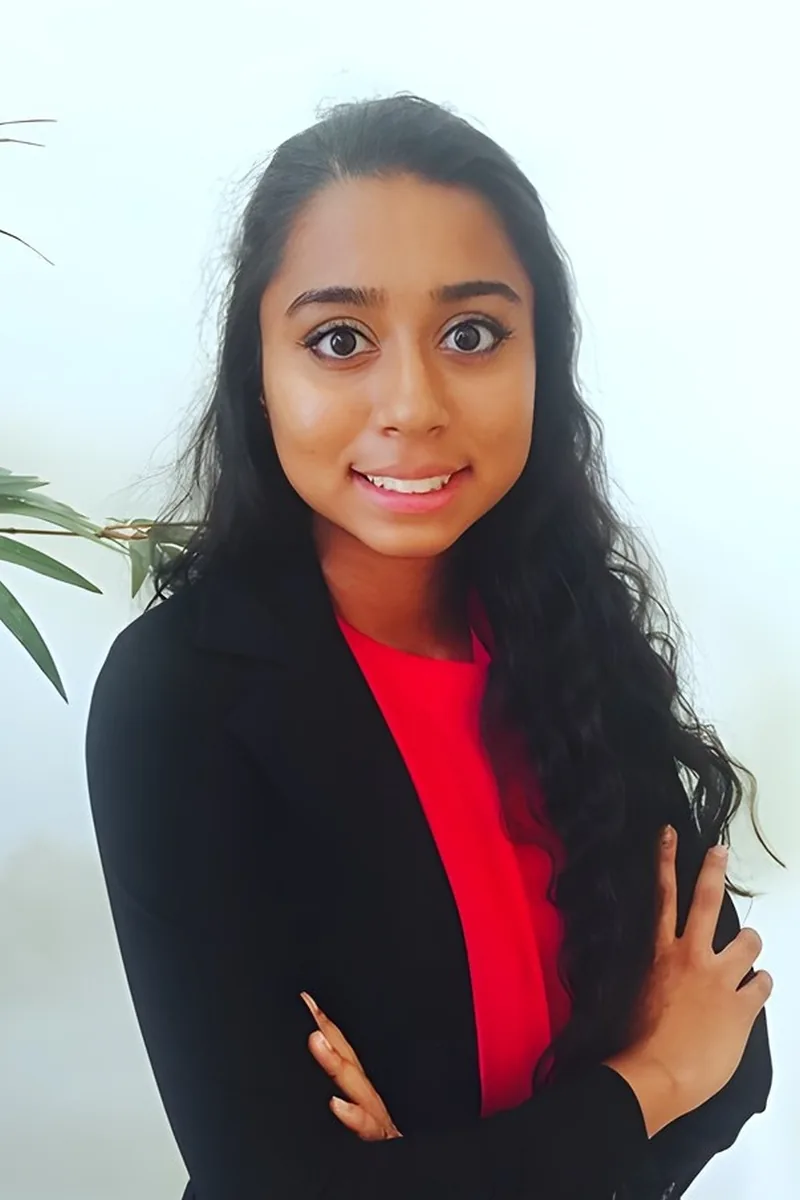
Algebra is one of Thara's most-tutored subjects, and her pre-med coursework at Duke keeps the skills sharp — she's actively using polynomial and exponential relationships in her biology and chemistry classes every week. That recent, repeated contact with the material means she can walk through topics like factoring strategies, rational expressions, and logarithmic equations with the kind of detail that comes from having just worked through them herself.
Chemical engineering coursework throws Adrian into heavy algebraic manipulation on a daily basis — solving systems for mass balance equations, working with exponential decay in reactor kinetics, and rearranging rational expressions for thermodynamic models. That constant practice means he can pinpoint exactly why a logarithmic property or function transformation works, not just walk through the steps. His 34 ACT backs up the quantitative instincts he brings to every session.
College algebra covers a lot of ground fast — polynomial division, rational functions, logarithmic equations, and systems of inequalities can pile up within weeks. Tracey approaches each topic by tying it back to graphical behavior, so students learn to predict what an equation looks like before they solve it. Her 5.0 rating comes from making that kind of deeper understanding feel accessible.
Jared holds three B.A. degrees including one in Romance Languages, but his 1590 SAT score reveals serious quantitative muscle — the kind that makes him especially effective at unpacking the algebraic reasoning behind logarithmic properties, rational expressions, and function behavior. As a state-certified teacher, he knows how to structure a lesson so that each new technique builds logically from the last, turning a sprawling college algebra syllabus into a coherent sequence rather than a pile of disconnected rules.
Polynomial functions, rational expressions, and logarithmic equations all click faster when you understand the logic behind them — not just the steps. Cameron's PhD in Genetics required constant fluency with algebraic modeling, and he brings that practical grounding to college algebra topics that often feel abstract in a lecture hall.
Geological sciences coursework at Ohio University had Paul constantly solving for unknowns — calculating mineral compositions with systems of equations, modeling seismic wave propagation with logarithmic and exponential functions, and applying polynomial curve-fitting to field data. That real-world algebraic fluency, reinforced by graduate-level coursework, means he can unpack why a technique like completing the square or simplifying a rational expression actually works instead of just walking through the steps.
Three and a half years as a peer math tutor during undergrad means Chris has walked dozens of students through the exact sticking points in college algebra — particularly the jump from concrete arithmetic to abstract function notation and logarithmic reasoning. His applied mathematics minor gave him the formal training to explain *why* algebraic rules work, while his psychology background sharpens his read on where a student's confusion actually lives. Rated 5.0 by students.
Psychology research at Notre Dame gave Teresa a surprisingly solid algebraic foundation — statistical modeling, interpreting regression outputs, and manipulating equations to isolate variables are all daily demands of the discipline. She leans on that background to demystify topics like systems of equations and function behavior, walking students through the logic of each step rather than rushing to the answer. Rated 4.9 by students.
Mechanical engineering at the BS level means Daniel didn't just pass college algebra — he pressure-tested every piece of it in statics, dynamics, and thermodynamics courses where a shaky grasp of rational expressions or logarithmic equations would have been immediately exposed. That gives him a practical read on which algebraic techniques actually matter and how to make them stick, especially for students who need to carry these skills into STEM coursework. His 34 ACT backs up the quantitative instincts.
When a college algebra problem suddenly involves piecewise functions or composite expressions, the issue usually isn't the new material — it's an older concept like order of operations or variable manipulation that never fully solidified. Jamison zeros in on those hidden gaps, often reframing a tricky problem through an analogy or unconventional example until the logic genuinely clicks. Rated 5.0 by students.
Samuel teaches across the full algebra sequence — from pre-algebra through algebra 3/4 and into pre-calculus — which means he can pinpoint exactly which earlier gaps are causing trouble when a college algebra student struggles with something like logarithmic equations or rational expressions. He's particularly effective at rebuilding those missing connections so that topics like function composition and polynomial division stop feeling like arbitrary rules and start making structural sense.
Twenty-five years of engineering and software development gave Tim a relationship with algebra that most tutors can't replicate — he's used systems of equations to model real systems, manipulated polynomial expressions in production code, and applied logarithmic scaling to actual datasets. His physics degree anchors the theoretical side, so he can walk through why a technique like completing the square or decomposing partial fractions works, not just demonstrate the steps.
Diana describes algebra as detective work — figuring out what a problem is asking before reaching for any formula — and that instinct comes from a Stanford and Brown philosophy background built entirely on logical analysis and argument structure. She's spent years tutoring the full college algebra sequence, from rational expressions to logarithmic equations, and adapts her explanations by probing what a student already understands before choosing which approach to a problem will actually click. Rated 4.9 by students.
John's path from a history degree through law school to co-founding a tech company means he's had to teach himself rigorous quantitative thinking more than once — and that self-taught fluency with algebraic structures like systems of equations and logarithmic functions gives him a sharp instinct for where college algebra students lose the thread. He breaks problems into the kind of logical, sequential steps that mirror how he builds software, making abstract manipulation feel more like debugging than guessing. Holds a 5.0 rating from students.
Kyle's international studies and global management background meant constant work with quantitative models — trade flow analysis, economic forecasting, and statistical comparisons across countries — all built on the algebraic manipulation of functions, inequalities, and systems of equations. That real-world grounding lets him teach topics like logarithmic and polynomial problem-solving by connecting them to scenarios where the math actually matters, not just textbook drills. His 32 ACT confirms the quantitative instincts behind that approach.
I am Arizona born and raised, my education includes an NYC law school degree with an undergraduate BS degree from University of Miami. In college I majored in Health Sciences with minors in Psychology and Public Health while in law school I leaned into corporate law and finance. Between law school and college I've pretty much covered every topic under the sun! In my spare time, I enjoy reading (especially mystery novels), pretending I'm a chef, and meditating.
I am here because I thoroughly enjoy working with students and watching them succeed in their academic studies. As a Mathematics major at the University of Arizona (currently a junior), I have extensive experience teaching and tutoring: I have been a teacher's assistant for a Calculus II section at my university and have spent a great deal of time assisting students with non-math related subjects as well such as English and essay-writing, time management and study skills techniques, and standardized test prep (SAT).
An economics degree from Northwestern means Andrew spent years working with the exact algebraic tools that trip up college students — polynomial functions, systems of equations, and logarithmic models all showed up in his coursework long before he started tutoring them. He breaks these topics into logical steps, treating each problem like building an argument where every line has to follow from the last. Rated 4.9 by students.
Studying both anthropology and biology gave Amanda an unusual double fluency — she's as comfortable building statistical models for fieldwork data as she is working through the exponential and logarithmic functions that underpin biological growth curves. That cross-disciplinary background means she can anchor abstract college algebra concepts like function transformations and polynomial operations in concrete examples that actually mean something. Rated 4.9 by students.
A dual degree in physics and mathematics means Sam doesn't just remember college algebra — he's still using it constantly, from solving differential equations to modeling quantum systems where every step depends on fluent manipulation of functions, exponents, and polynomial expressions. He's particularly sharp at unpacking the logic behind logarithmic and exponential relationships, connecting each rule to the broader mathematical structure so the techniques make sense rather than feel arbitrary. Holds a 5.0 rating from students.
Three accounting degrees — including a Master of Science in Accountancy from Notre Dame — mean Steven has spent years inside the algebraic machinery that drives financial modeling: solving systems of equations, manipulating formulas with multiple variables, and working through exponential and logarithmic relationships in contexts like compound interest and depreciation schedules. That real-world repetition gives him a practical, no-nonsense way of teaching college algebra concepts, since he's used them to solve actual problems rather than just textbook exercises. Rated 4.8 by students.
When rational expressions, logarithmic equations, or piecewise functions start piling up in college algebra, having someone who thinks in mathematical structure makes a real difference. Madeleine earned her applied math degree at ASU's Barrett Honors College and breaks these topics down by connecting each new rule back to the algebraic logic underneath it.
Polynomial functions, rational expressions, logarithmic equations — college algebra throws a lot of abstract tools at students in a short semester. Chris earned his bachelor's in Astrophysics from the University of Arizona, where these concepts weren't just coursework but daily necessities for modeling real phenomena. He breaks down each topic by connecting it to practical applications, making the logic behind the algebra click.
Chemical engineering grad school at UT Austin keeps Morgan immersed in the algebraic machinery that college algebra courses are built on — solving systems of equations, manipulating exponential and logarithmic expressions, modeling reaction kinetics — except she's doing it under real constraints with real data. That daily fluency means she can zero in on why a student's approach to, say, a rational equation or a domain restriction isn't working, and rebuild the reasoning step by step. Holds a 5.0 rating.
Eighteen years of designing houses gave Aaron an intuitive grasp of the algebra underneath architectural engineering — solving systems of equations to balance structural loads, using logarithmic and exponential relationships in energy modeling, and manipulating functions to optimize material specifications. He brings that practical, problem-solving lens to college algebra, breaking down abstract procedures by connecting them to the organizing principles behind them rather than asking students to memorize steps. Rated 5.0 by students.
Polynomial long division, rational inequalities, logarithmic equations — Geoffrey tackles these College Algebra topics the way his engineering training taught him: by connecting each technique to a concrete problem it actually solves. He treats every new function type as a building block rather than an isolated chapter, so students see how the pieces lock together. Rated 5.0 by students.
Lindsay's math minor and biology degree from the University of Arizona mean she's spent years applying algebraic tools — modeling growth curves, linearizing data, solving systems — in contexts where getting the algebra wrong means getting the science wrong. That dual fluency lets her unpack topics like logarithmic properties or rational expressions by showing students the internal logic rather than just the steps. Rated 4.9 by students.
Civil engineering trained Alina to treat algebra as a practical language — sizing structural loads, modeling drainage flows, and balancing material quantities all come down to fluency with polynomials, rational expressions, and systems of equations. She brings that real-world engineering lens to college algebra, walking through each technique with the patience of someone who's been tutoring math across all levels since she was a student herself. Rated 5.0 by students.
Eight years of tutoring middle and high school math means Charles has watched hundreds of students build up to college algebra — and he knows exactly which gaps in factoring, function notation, or exponent rules cause the most trouble when the pace picks up. His biochemistry degree from Arizona State required serious algebraic fluency for kinetics equations and equilibrium modeling, so he teaches techniques like logarithmic properties and rational expressions with the confidence of someone who's applied them in real scientific contexts.
Polynomial long division, rational expressions, logarithmic equations — college algebra packs a lot of new machinery into a single semester. As a math major at Smith College, Emily teaches each technique by connecting it to the bigger structural ideas behind it, so students aren't just memorizing steps for each problem type. She holds a 5.0 client rating.
Leah earned her math degree doing the thing most college algebra students dread — working through rigorous proofs of why logarithmic rules, function properties, and polynomial theorems actually hold, not just memorizing how to apply them. That foundation means she can pinpoint exactly where a student's reasoning breaks down on a problem like solving a system or simplifying a complex rational expression, and rebuild the logic from that spot. Her 1520 SAT backs up the quantitative instincts she brings to every session.
Ayushi's computer science coursework at Arizona State — algorithm analysis, discrete structures, data modeling — runs on algebraic thinking, from manipulating functions to solving systems of equations to working with logarithmic complexity measures. That daily immersion means she can unpack college algebra concepts like polynomial operations or rational expressions by showing how they connect to the computational logic she actually uses. Her experience at ASU's engineering tutoring center sharpened her ability to pinpoint exactly where a problem's logic breaks down for each student.
When I was in high school, I remember seeing the joy of my math teachers when they would teach in class. This inspired me to become a high school math teacher. The first step was becoming a peer tutor to my classmates. This lead to tutoring math to college students. Then tutoring students while working as a TA. Then I worked as a data scientist which not only did I understand more how to apply math in the workspace, but also learned how to explain math concepts to coworkers without a strong math background. This helped me to shape my tutoring philosophy to relate to the person being tutored and this opened the door to me teaching high school calculus 1 & calculus 2! I am currently teaching precalculus at a community college.
Gabrielle's pre-med track at Arizona State's Barrett Honors College keeps her actively working through calculus, which means the college algebra toolkit — logarithmic equations, polynomial manipulation, rational expressions — is material she's recently mastered and still uses regularly. She's especially good at walking through multi-step problems by connecting each algebraic move to a clear reason, turning procedures that feel arbitrary into logical sequences. Rated 5.0 by students.
Studying pure mathematics at Rice, Aaron is building theory on top of the exact algebraic machinery — polynomial factoring, rational expressions, logarithmic and exponential equations — that college algebra courses are designed to cement. That means he can spot the specific step where a problem goes sideways and reframe it, whether it's a sign error in a complex fraction or a misapplied log rule. Rated 4.9 by students.
As an electrical engineering student at Arizona State, Robert solves circuit analysis problems that run on the exact algebra college students are learning — manipulating rational expressions for impedance calculations, working through systems of equations in Kirchhoff's laws, and handling exponential functions in RC circuits. That daily, applied use of the college algebra toolkit means he can walk through a tricky logarithmic equation or function transformation and show exactly why each step works, not just what to do next.
Biomedical engineering at the graduate level means Alyssa uses the entire college algebra toolkit — exponential models for drug delivery rates, logarithmic transformations for lab data, systems of equations for biological modeling — as working tools rather than textbook exercises. She treats each problem like a puzzle, breaking it into smaller pieces from her quantitative training until the logic behind techniques like function manipulation or solving rational equations becomes clear. Rated 5.0 by students.
Grad-level biomedical engineering throws Dale into matrix algebra, differential equations, and nonlinear modeling on a weekly basis — so the polynomial, exponential, and rational function work in a college algebra course is territory he navigates fluently and can explain from multiple angles. He's especially good at walking through the logic of why a particular algebraic move works, not just showing the steps, which keeps students from hitting a wall when problems look slightly different from the textbook. Rated 5.0 by students.
Testimonials
Because the right College Algebra tutor makes all the difference.
Average Session Rating – Based on 3.4M Learner Ratings
Practice College Algebra
Free practice tests, flashcards, and AI tutoring for College Algebra
Other Phoenix Tutors
Related Math Tutors in Phoenix
Frequently Asked Questions
College Algebra typically covers functions, polynomials, rational expressions, exponential and logarithmic equations, sequences, and systems of equations. Many students struggle with the transition from procedural math (just following steps) to conceptual understanding—knowing *why* methods work and when to apply them. Personalized 1-on-1 instruction helps you build these connections by working through problems together, identifying patterns, and developing problem-solving strategies tailored to your learning style.
Word problems require you to translate real-world scenarios into mathematical equations—a skill that takes practice and metacognitive awareness. A tutor can teach you a structured approach: identifying what you know, defining variables clearly, translating sentences into equations, and checking your answer against the original problem. Working through word problems together helps you recognize patterns across different problem types and builds confidence in tackling unfamiliar scenarios.
Absolutely. Math anxiety often stems from gaps in foundational concepts or past negative experiences, making new material feel overwhelming. One-on-one instruction creates a judgment-free space where you can ask questions freely, work at your own pace, and celebrate small wins. Tutors help you identify exactly where confusion starts, fill those gaps systematically, and show you that you *can* understand College Algebra. Building competence directly builds confidence.
Graphing requires you to visualize abstract relationships—how changes in equations translate to shifts, stretches, and reflections on a coordinate plane. Many students memorize transformations without truly understanding them. A tutor helps you connect the algebra to the geometry by building graphs step-by-step, exploring how different parameters affect the shape, and using visual tools to reinforce conceptual understanding. This approach makes graphing intuitive rather than mechanical.
Showing work reveals your thinking process and helps identify where errors happen—essential for learning, not just getting answers. Many students rush through steps or skip reasoning, which masks gaps in understanding. Tutors train you to write clear, logical solutions by modeling organized work, explaining *why* each step follows from the previous one, and reviewing your solutions together. This builds better problem-solving habits and makes it easier for instructors to give you meaningful feedback.
Varsity Tutors connects students in Phoenix with expert tutors who have deep knowledge of College Algebra and proven teaching experience. When you get matched with a tutor, you'll work with someone who understands the specific challenges students face—from multi-step equations to logarithmic problems—and knows how to explain concepts clearly. You can discuss your goals, learning style, and schedule to ensure the match is right for your needs.
Yes. Placement exams often cover algebra fundamentals needed for success in higher-level math courses, and personalized instruction helps you strengthen weak areas quickly. A tutor can assess your current skills, focus on high-impact topics, teach efficient problem-solving strategies, and build the confidence you need going into the exam. With targeted preparation, you can improve your placement level and start your college math journey on solid ground.
Let’s find your perfect tutor
Answer a few quick questions. We’ll recommend the right plan and match you with a top 5% tutor.