Award-Winning Calculus Tutors
serving Louisville, KY
Calculus
Tutors in Louisville
Private 1-on-1 tutoring, weekly live classes for academic support, test prep & enrichment, practice tests and diagnostics, and more to elevate grades and test scores.
Based on 3.4M Learner Ratings
UniversitiesSchools & Universities
DeliveredHours Delivered
ProficiencyGrowth in Proficiency
Who needs tutoring?
No obligation. Takes ~1 minute.

Studying biocomputation at Stanford means Kevin uses calculus constantly — optimization, integration for modeling biological systems, and differential equations for population dynamics. He unpacks the intuition behind derivatives and integrals so that the chain rule or integration by parts feels like a logical next step, not a magic trick. Students working through AP Calc or college-level courses get someone who genuinely thinks in calculus every day.
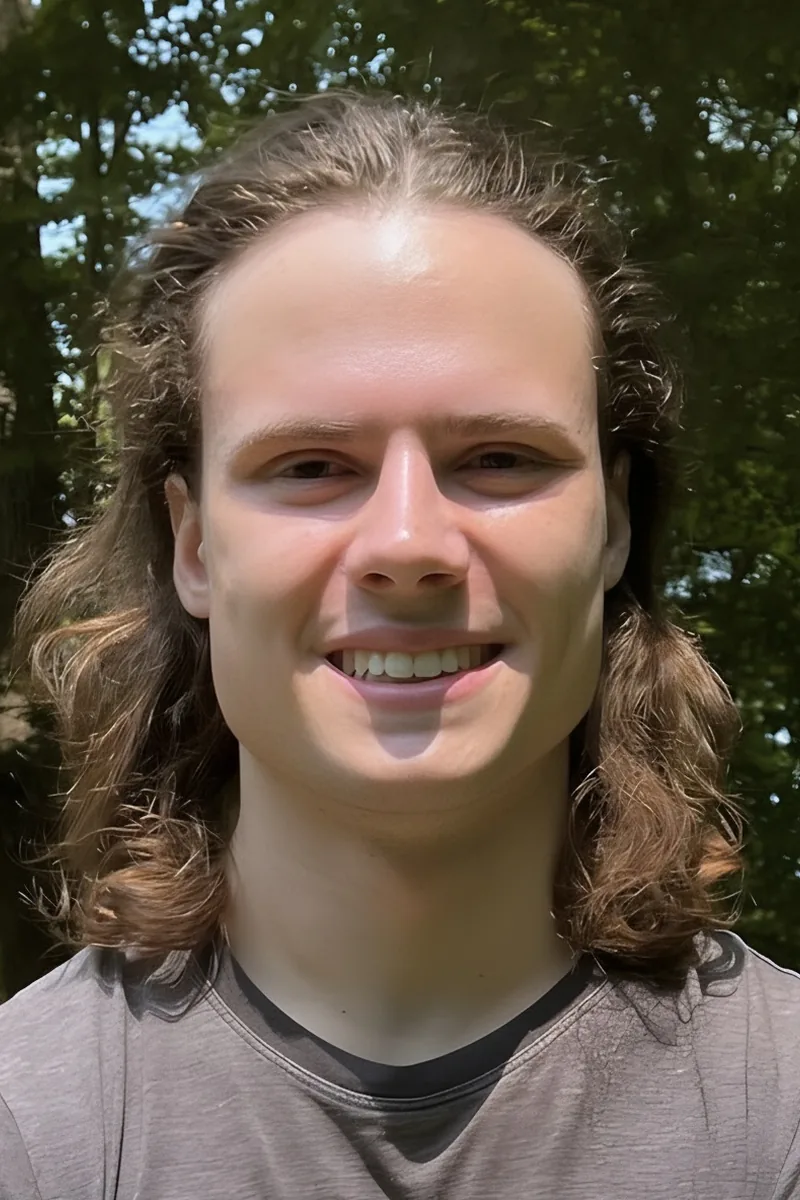
Computer science coursework at Kentucky meant Evan didn't just take calculus — he applied it, using derivatives in optimization algorithms and integrals in physics simulations for game engines. That hands-on context makes him especially effective at teaching concepts like the chain rule or Riemann sums, because he can show exactly where the math reappears in code. His 34 ACT composite confirms the quantitative chops to back it up.
Logan's background is in communication and divinity, not mathematics, so calculus isn't his deepest subject — but a 36 ACT composite shows he can handle rigorous quantitative reasoning, and his broad tutoring range across math and science means he's comfortable with the conceptual territory. He takes a communicator's approach to the material, translating dense notation around limits and derivatives into language that actually makes sense on first pass.
An MFA and a Latin degree don't scream calculus, and Kelsey is honest about that — this isn't her deepest subject. What she does bring is years of teaching across grade levels and a knack for breaking down intimidating material into manageable steps, which means she can support students wrestling with the conceptual groundwork of limits and early derivatives where clear explanation matters more than advanced math credentials.
Kinesiology coursework at Rice University put Addison through calculus in its most physical form — velocity and acceleration curves, joint torque analysis, and the integration problems that describe how forces act on the human body during movement. That hands-on experience with derivatives and integrals as descriptions of real motion gives him a concrete toolkit for teaching the material, especially when students struggle to see what a rate of change actually represents.
Biomedical engineering demands heavy calculus — from modeling blood flow with integrals to using differential equations for drug delivery kinetics — so Matthew has worked through these concepts under real pressure. He breaks down limits, derivatives, and integration techniques by tying them to tangible problems, making abstract rules easier to internalize and apply on exams.
What draws Benjamin to calculus is the abstraction — the moment a student sees that a derivative isn't just a formula but a way of capturing how change itself behaves. His humanities MA might seem unrelated, but his mathematical background spans through pre-calculus and beyond, and he teaches concepts like limits, continuity, and integration by building the conceptual framework first so that the mechanics follow naturally. Rated 4.8 by students.
Two English degrees don't scream calculus, and Anthony won't pretend otherwise — this is far from his wheelhouse. That said, his analytical reading background translates surprisingly well to parsing the dense notation and multi-step logic that trip students up in early limits and derivative problems, where understanding what a problem is actually asking matters as much as the computation itself.
I am no longer needed.
An English degree doesn't scream calculus, but Diana's 32 ACT composite shows she can handle quantitative reasoning, and her tutoring across algebra and broader math means she's familiar with the function behavior and graphing intuition that early calculus builds on. She takes the same close-reading instinct she applies to texts and turns it on problems — picking apart what a limit expression is actually asking before jumping to any computation.
Limits, derivatives, and integrals each demand a different kind of thinking, and most calculus struggles come from not recognizing which tool a problem is actually asking for. Jesse earned his B.S. in Mathematics, so he teaches calculus from the conceptual level — explaining why the chain rule works, not just when to apply it. That depth makes problem-solving faster and more reliable, especially on optimization and related-rates questions.
Environmental studies coursework involves rate-of-change problems more often than people expect — modeling pollution dispersion, resource depletion curves, and population dynamics all require calculus thinking. Grace's background in that field gives her a practical frame for explaining derivatives and integrals, connecting the mechanics of each problem to systems where quantities are constantly shifting.
Growing up with a learning disability taught Kaylee something most tutors haven't experienced firsthand — the frustration of hitting a wall with abstract material and having to rebuild understanding from a different angle. That adaptability matters in early calculus, where a concept like limits or instantaneous rate of change often needs to be explained three different ways before it clicks. Her speech-language pathology training reinforces that instinct to rephrase and restructure until the idea lands.
Accounting coursework at Louisville put Sowmya through the quantitative side of business — marginal analysis, cost functions, and the optimization problems that are really just derivatives in disguise. Her economics minor reinforced that foundation, giving her a practical frame for explaining what a rate of change actually represents before diving into the mechanics of differentiation and integration.
Fifteen years of playing flute built Patty's comfort with reading complex notation and tracking patterns across a page — skills that translate surprisingly well to parsing calculus expressions and following multi-step derivations. Her humanities degree means this isn't her deepest mathematical territory, but her experience tutoring across the full K-12 math spectrum gives her a methodical way of walking through limits and basic derivative rules so the notation stops being the barrier.
History majors don't usually end up teaching calculus, and Alexander is honest that it's not his deepest subject — but his broader math tutoring experience means he can support students working through the conceptual groundwork of limits and early derivatives. His instinct as a historian to ask "why does this work?" rather than just "how do I solve it?" brings a useful lens to unpacking the logic behind rate-of-change problems.
Biochemistry coursework means Andrew has pushed through calculus not as an abstract math exercise but as the language behind reaction rates, enzyme kinetics, and thermodynamic modeling — contexts where derivatives and integrals carry real meaning. That applied fluency, backed by a 34 ACT composite, lets him teach concepts like the chain rule or integration by parts by connecting each step to problems where the math actually does something.
Ecology research demands calculus daily — modeling population growth with differential equations, analyzing rates of change in ecosystems, and interpreting area-under-the-curve data from field studies. Haileigh brings that applied perspective to derivatives, integrals, and limit problems, connecting abstract notation to tangible meaning. Rated 5.0 by students.
Between a biology major and a neuroscience minor, Dharani has put calculus to work in contexts most math tutors never touch — modeling enzyme kinetics, analyzing neural signal rates, and solving the differential problems that underpin biological systems. That applied background means she teaches derivatives and integrals as tools with real scientific meaning, not just symbol-pushing exercises. Rated 4.9 by students.
Jenna's biochemistry degree from the University of Kentucky meant heavy coursework in calculus — from limits and derivatives through multivariable integration — all applied to real scientific problems like reaction rates and molecular modeling. That science-meets-math perspective lets her explain not just how to solve a derivative but why the chain rule or L'Hôpital's rule matters in practice.
Five semesters teaching chemistry labs meant Troy was constantly using calculus without calling it that — reaction rates, concentration changes over time, and the math behind equilibrium are all derivative and integral problems at their core. His biochemistry degree at UofL required the full calculus sequence, so he teaches the material with a scientist's instinct for what these tools actually do rather than treating them as abstract symbol manipulation.
Neuroscience coursework doesn't just use calculus — it lives in it, from modeling action potential propagation to quantifying synaptic transmission rates that are fundamentally derivative and integral problems. Janki's B.S. in Neuroscience means she learned calculus by applying it to real biological systems, so she teaches concepts like the chain rule or area under a curve by connecting them to the dynamic processes they actually describe. Her 34 ACT composite and 4.8 rating back up that quantitative strength.
Teaching organic chemistry recitation at the University of Kentucky gave Jason a particular skill: explaining chain-of-reasoning problems where each step depends on the last. That translates directly to calculus, where setting up an integral or applying the chain rule requires the same sequential thinking. He walks through problems conversationally, making sure the 'why' is clear at every stage.
International business coursework covers optimization and marginal analysis — the calculus behind deciding how much to produce, when to adjust pricing, and where profit peaks on a curve. Wilson's BBA training gives him a practical frame for teaching derivatives as decision-making tools rather than abstract symbol manipulation. He's especially useful for students who need to see what a function's slope actually means in a real scenario before the notation makes sense.
Dietetics coursework doesn't skip the math — Amy's degree required working through the quantitative side of metabolism, including rate calculations for nutrient absorption and energy expenditure that are fundamentally calculus problems. That background gives her a practical handle on derivatives and integrals as tools for describing how things change over time, which she uses to anchor abstract rules in something students can actually picture.
Agricultural biotechnology coursework at the University of Kentucky means Isabella has applied calculus to real problems — growth rate modeling, yield optimization, and the kind of rate-of-change analysis that makes derivatives feel like tools rather than abstract exercises. She teaches early calculus concepts by connecting them to the quantitative reasoning she uses in her science studies, grounding each new rule in something tangible.
Nicole's degrees and teaching career center on Spanish and communication, so she's transparent that calculus falls well outside her wheelhouse. That said, her experience tutoring algebra means she can support the conceptual groundwork — slope as rate of change, function behavior, the logic behind limits — that makes the early transition into calculus less intimidating.
From single-variable integration techniques to differential equations and series convergence, Jacob has tutored calculus at every level — introductory through advanced college coursework. His B.S. in Mathematics from Rose-Hulman means he doesn't just know the procedures; he can explain why L'Hôpital's Rule works or what a Riemann sum is actually measuring. Rated 4.9 by students, he brings both rigor and clarity to a subject that rewards both.
I am a graduate of a liberal arts university, with majors in both Spanish and Studio Arts. As a Teach for America alumni I have worked as a Spanish and Art teacher in elementary, middle, and high school settings in both public and private schools. Additionally I have worked with nonprofit organizations to provide arts education. I primarily tutor Spanish, English, Reading and ACT prep. I believe everyone deserves access to a quality education, and I look forward to working with you to meet and exceed your goals!
Faith's BFA in English means calculus isn't her home turf, and she's honest about that. What she does bring is a knack for translating intimidating notation into plain conversation — her tutoring style is collaborative and confidence-driven, which goes a long way when a student is staring down their first limit problem and needs someone patient enough to talk through the logic step by step.
Every week in his chemical physics coursework, Carter applies integration techniques, series expansions, and multivariable methods to solve problems that actually matter — modeling heat flow, wave behavior, and molecular energy. He brings that same concreteness to calculus tutoring, anchoring each new concept in a real application so the math feels purposeful instead of arbitrary.
Studying neuroscience and behavioral biology means Nick spent semesters knee-deep in the calculus that underpins how biological systems work — modeling action potential propagation, receptor binding kinetics, and the differential equations behind neural adaptation. That hands-on experience with derivatives and integrals in a lab context gives him a practical vocabulary for explaining chain rules, related rates, and integration techniques in terms that go beyond abstract symbol-pushing. Rated 4.8 by students.
While I may not have professional experience in tutoring or teaching, that is definitely not the case in the literal sense. All my life I've been called upon by my teachers and professors to help the students in class that struggled, and I loved to do so. I realized that while things came easily to me, it was not always the case for my fellow classmates, so I happily helped them pick up the slack. As long as someone wanted to learn, I was always available to help them out. My love of learning I tried to engender in them, with mixed results. First, off I have a degree in Mathematics, graduated with a 4.0 (in a 4.0 GPA system), and was on the Dean's List. I scored well enough on my AP Calculus exam in High School that I was able to skip the initial courses in College. And when I made it to college, I excelled at those courses too, acing all work and tests. (Note the similarities in my subjects of ability, I'm pretty evenly skilled in both fields) First, off I have a degree in Physics, graduated with a 4.0 (in a 4.0 GPA system), and was on the Dean's List. On top of that, I was at the top of my class in all my mathematics courses and was known to help other students when they had difficulties. I was accepted into classes that were usually not available to my grade level due to my aptitude and interest in the subject. (Note the similarities in my subjects of ability, I'm pretty evenly skilled in both fields) If you want to learn, just like I did, or if you just want help with something that might not quite "click" for you, well I'm happy to lend my services and help you excel just like I did, when someone helped me.
Between a biology degree heavy on quantitative coursework and a perfect 36 ACT, Emily has the mathematical chops to teach calculus with real depth — not just procedure but the reasoning behind integration techniques and derivative applications. Her epidemiology training at Yale's School of Public Health meant working with rate-of-change models constantly, from disease transmission curves to survival analysis, so she can ground abstract calculus concepts in problems where the math actually drives decisions. Rated 5.0 by students.
Art history and education aren't the usual path to calculus, and Mimi is straightforward about that — but her 1560 SAT demonstrates real quantitative strength, and her Masters in Education from Harvard means she knows how to design a learning sequence that actually builds understanding. She brings that inquiry-based instinct to early calculus, walking through what a derivative means conceptually before jumping to computation, so the rules feel like they follow logically rather than appearing out of nowhere.
Limits, derivatives, and integrals become far more intuitive when a tutor can point to what they mean in a physical system — velocity as a derivative of position, area under a curve as accumulated work. As a mechanical engineering major at Yale, Charles lives in calculus every day and brings that applied fluency to sessions, whether the topic is chain rule mechanics or setting up a Riemann sum.
Mechanical engineering grad work is essentially applied calculus — Aaron uses derivatives to model thermal systems, integrals to analyze fluid flow, and differential equations to predict how structures respond to stress, every single day. That daily fluency means he can teach integration techniques or the chain rule by connecting them to problems where the math is doing real physical work. Rated 5.0 by students.
Ellie doesn't just study calculus — she teaches it. As a weekly tutor for a Differential Equations course at Yale, she regularly walks students through integration techniques, series convergence, and the conceptual leaps that textbooks tend to rush past. Her engineering background means she can show exactly where derivatives and integrals appear in real modeling problems, giving abstract rules a concrete purpose.
Curriculum development — Elena's day job — is essentially about sequencing ideas so each one builds logically on the last, which is exactly what early calculus demands when students move from limits to derivatives to integration. Her McGill and Edinburgh training is in the humanities, not math, so she's transparent about the boundaries of her calculus expertise, but her knack for making abstract concepts click through analogy and structured explanation (she was named Scotland's International Young Thinker of the Year for that skill) carries over well to unpacking the reasoning behind rules like the chain rule or the fundamental theorem.
Pre-med coursework threw Sydny into calculus with real stakes — understanding rates of change in drug concentration curves, modeling exponential decay in pharmacokinetics, and applying integration to biological systems. She breaks down limits, derivatives, and integrals by connecting each concept to a concrete problem rather than leaving students adrift in abstraction.
Testimonials
Because the right Calculus tutor makes all the difference.
Average Session Rating – Based on 3.4M Learner Ratings
Nearby Calculus Tutors
Other Louisville Tutors
Related Math Tutors in Louisville
Frequently Asked Questions
Many students struggle with the transition from algebra and precalculus to the conceptual thinking required in Calculus. The biggest pain points include understanding limits and continuity, mastering derivative and integral rules, and applying calculus concepts to word problems. Additionally, students often feel anxious about the abstraction level—Calculus requires seeing patterns and connections rather than just following procedures. Personalized tutoring helps students build this conceptual foundation so the procedural work makes sense.
During the first session, a tutor will assess your current understanding of prerequisite concepts (like functions, limits, and algebraic manipulation) and identify specific areas where you need support. They'll discuss your learning goals, whether that's improving your grade, preparing for the AP Calculus exam, or building confidence for college-level math. This foundation helps the tutor create a personalized plan tailored to your pace and learning style.
Word problems require translating real-world scenarios into mathematical language—a skill that takes practice and strategic thinking. Tutors help students develop a problem-solving framework: identifying what's given, determining what you're solving for, setting up equations correctly, and interpreting results in context. With personalized instruction, students learn to recognize patterns in different problem types and gain confidence tackling unfamiliar scenarios.
In Calculus, showing work isn't just about getting the right answer—it demonstrates your understanding of the process and helps identify where errors occur. Tutors guide students through writing clear, logical steps and explaining their reasoning, which deepens conceptual understanding and improves exam performance. This practice also builds the communication skills needed for college-level mathematics.
Louisville schools use various Calculus approaches, from traditional AB/BC Calculus to IB or college-level courses. Tutors work with your specific curriculum and textbook to ensure consistency with what you're learning in class. Whether your course emphasizes graphical, numerical, or analytical approaches, personalized instruction aligns with your teacher's expectations and your school's standards.
Math anxiety is real, especially in Calculus where concepts feel abstract and the stakes feel high. Tutors create a low-pressure environment where you can ask questions, make mistakes safely, and gradually build mastery. By breaking complex topics into manageable pieces and celebrating progress, students develop confidence in their problem-solving abilities and see that Calculus is learnable.
Yes. Tutors can help you master both the content and test-taking strategies for AP Calculus AB or BC. They'll focus on your weak areas, teach you how to manage time on the multiple-choice and free-response sections, and help you understand what graders are looking for. With targeted practice and personalized feedback, students improve their understanding and exam performance.
Varsity Tutors connects you with expert tutors who have strong backgrounds in Calculus and experience teaching in your specific course level. You'll be matched based on your learning needs, schedule, and goals. Once connected, you can start personalized instruction at a pace that works for you, building the conceptual understanding and problem-solving skills needed to succeed.
Let’s find your perfect tutor
Answer a few quick questions. We’ll recommend the right plan and match you with a top 5% tutor.