Rock Layers Show History - Middle School Earth and Space Science
Card 1 of 25
Which unconformity type is an erosional gap between parallel sedimentary layers?
Tap to reveal answer
Disconformity. The erosion surface separates two parallel sedimentary rock sequences.
← Didn't Know|Knew It →
What is the principle of original horizontality in sedimentary strata?
Tap to reveal answer
Sedimentary layers are deposited in nearly horizontal layers. Gravity causes sediments to settle flat when deposited in water or air.
← Didn't Know|Knew It →
What is the main difference between relative dating and absolute dating?
Tap to reveal answer
Relative: order of events; Absolute: numerical age in years. Relative dating sequences events; absolute dating provides specific ages.
← Didn't Know|Knew It →
What two traits make a fossil most useful as an index fossil?
Tap to reveal answer
Wide geographic range and short time range. Widespread but short-lived species best mark specific times.
← Didn't Know|Knew It →
Identify the relative ages: Layer A is cut by Fault F. Which is younger, A or F?
Tap to reveal answer
Fault F is younger than Layer A. Cross-cutting principle: the fault formed after Layer A existed.
← Didn't Know|Knew It →
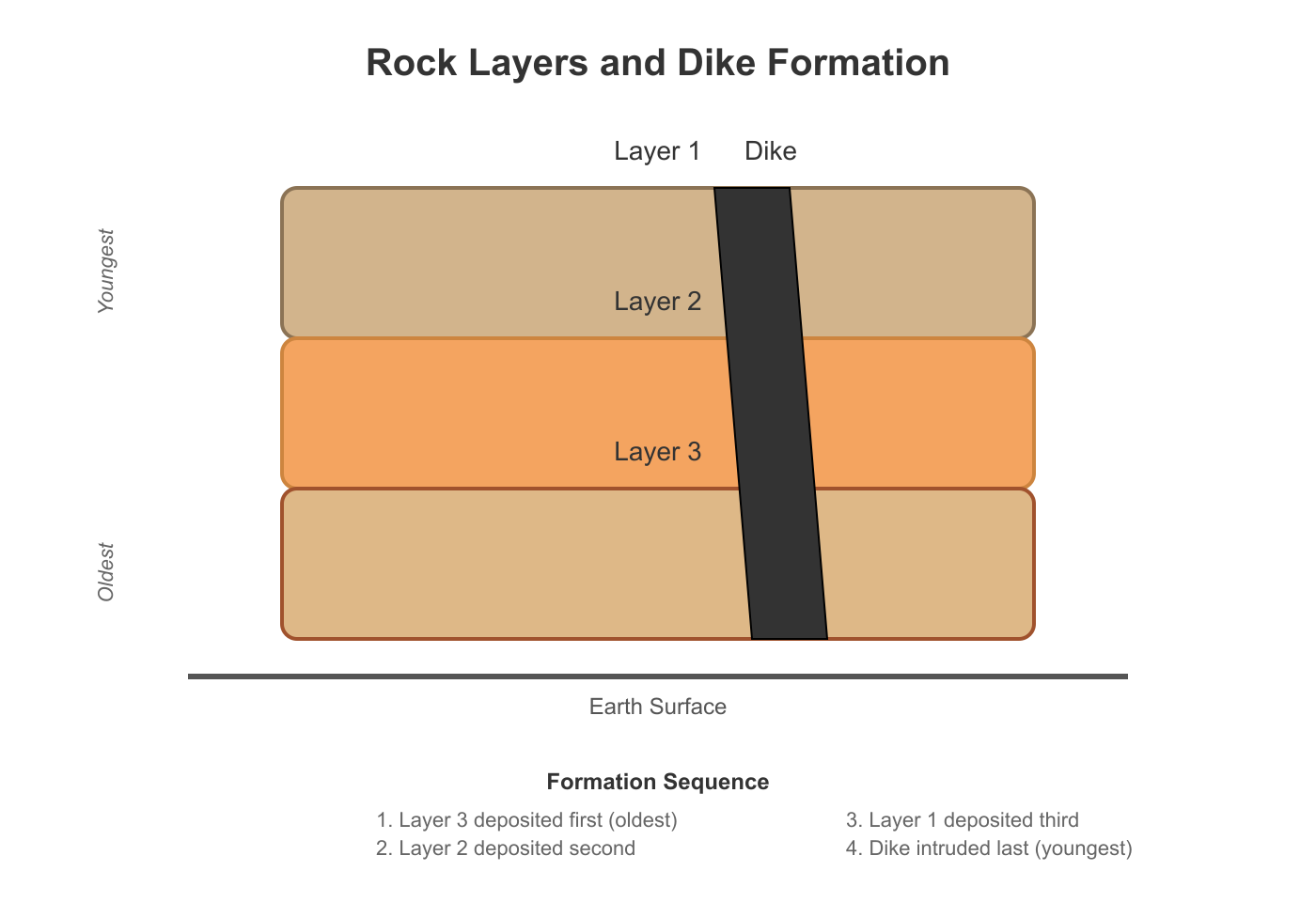
Identify the relative ages: Igneous Dike D cuts layers B and C. Which is oldest, D or C?
Tap to reveal answer
Layer C is older than Dike D. The dike intruded after Layer C formed, making C older.
← Didn't Know|Knew It →
What two key traits make a fossil an effective index fossil?
Tap to reveal answer
Short time range and wide geographic distribution. These traits ensure the fossil marks a specific, brief time period globally.
← Didn't Know|Knew It →
Identify what a ripple-marked sandstone layer most directly indicates about past conditions.
Tap to reveal answer
Moving water or wind at the time of deposition. Ripples form from flowing water or wind moving sediment particles.
← Didn't Know|Knew It →
Identify what mud cracks preserved in a rock layer most directly indicate about the past.
Tap to reveal answer
Wet sediment dried and shrank after exposure to air. Mud cracks form when wet mud dries out, creating polygonal patterns.
← Didn't Know|Knew It →
Identify the event most directly recorded by a layer containing unsorted, mixed-size sediment.
Tap to reveal answer
Rapid deposition by ice (glacier) or a high-energy mass flow. Poor sorting indicates rapid deposition without size separation by water.
← Didn't Know|Knew It →
Which event is indicated by a fault that offsets several sedimentary layers?
Tap to reveal answer
Faulting occurred after the youngest offset layer formed. Cross-cutting principle: the fault is younger than all layers it cuts.
← Didn't Know|Knew It →
Identify the relative age: pebbles of basalt are inside a conglomerate; which is older, basalt or conglomerate?
Tap to reveal answer
The basalt pebbles are older. Principle of inclusions: fragments predate the rock containing them.
← Didn't Know|Knew It →
Which conclusion is supported if the same index fossil is found in two separated rock layers?
Tap to reveal answer
The layers are the same relative age (correlated in time). Index fossils indicate simultaneous deposition in different locations.
← Didn't Know|Knew It →
Identify the event: Sedimentary layers are tilted and then overlain by horizontal layers. What occurred between them?
Tap to reveal answer
Tilting, uplift, and erosion occurred before new deposition. Angular unconformity shows tectonic activity between depositions.
← Didn't Know|Knew It →
Identify the past event suggested by mud cracks preserved in a rock layer.
Tap to reveal answer
Sediment dried after exposure to air. Wet mud shrinks and cracks when exposed and dried.
← Didn't Know|Knew It →
Which option is older: a sedimentary layer or an igneous dike that cuts across it?
Tap to reveal answer
The sedimentary layer is older. Cross-cutting principle: the dike cuts existing rock.
← Didn't Know|Knew It →
Identify the relative age: an igneous dike cuts across sedimentary layers. Which is younger?
Tap to reveal answer
The igneous dike is younger than the sedimentary layers it cuts. The dike intruded after the sedimentary layers were already present.
← Didn't Know|Knew It →
What principle states that a geologic feature cutting across layers is younger than the layers it cuts?
Tap to reveal answer
Principle of cross-cutting relationships. Features must exist before they can be cut through.
← Didn't Know|Knew It →
Identify the event order: If a fault cuts across Layers A, B, and C, which formed last: the fault or the layers?
Tap to reveal answer
The fault formed last. Cross-cutting principle: the fault cuts existing layers.
← Didn't Know|Knew It →
Identify the older feature: A basalt dike cuts through limestone. Which is older, the dike or the limestone?
Tap to reveal answer
The limestone is older. Cross-cutting principle: the dike intruded after limestone formed.
← Didn't Know|Knew It →
Identify the missing-time clue: What feature indicates erosion or nondeposition between two rock layers?
Tap to reveal answer
An unconformity. Represents a gap in the geologic record between rock units.
← Didn't Know|Knew It →
Which unconformity forms when sedimentary rock overlies eroded igneous or metamorphic rock?
Tap to reveal answer
Nonconformity. Forms when sediments deposit on eroded crystalline basement rocks.
← Didn't Know|Knew It →
Which unconformity forms between parallel sedimentary layers with an erosional surface?
Tap to reveal answer
Disconformity. Parallel layers with time gap show erosion without tilting.
← Didn't Know|Knew It →
What is an index fossil, and what is it used for in rock strata?
Tap to reveal answer
A widespread, short-lived fossil used to correlate and date layers. Their brief existence helps match layers from different locations.
← Didn't Know|Knew It →
What is the key idea of faunal succession used in interpreting rock strata?
Tap to reveal answer
Fossil assemblages follow a predictable order through rock layers. Species appear and disappear in consistent sequence through time.
← Didn't Know|Knew It →