All questions
Question 1
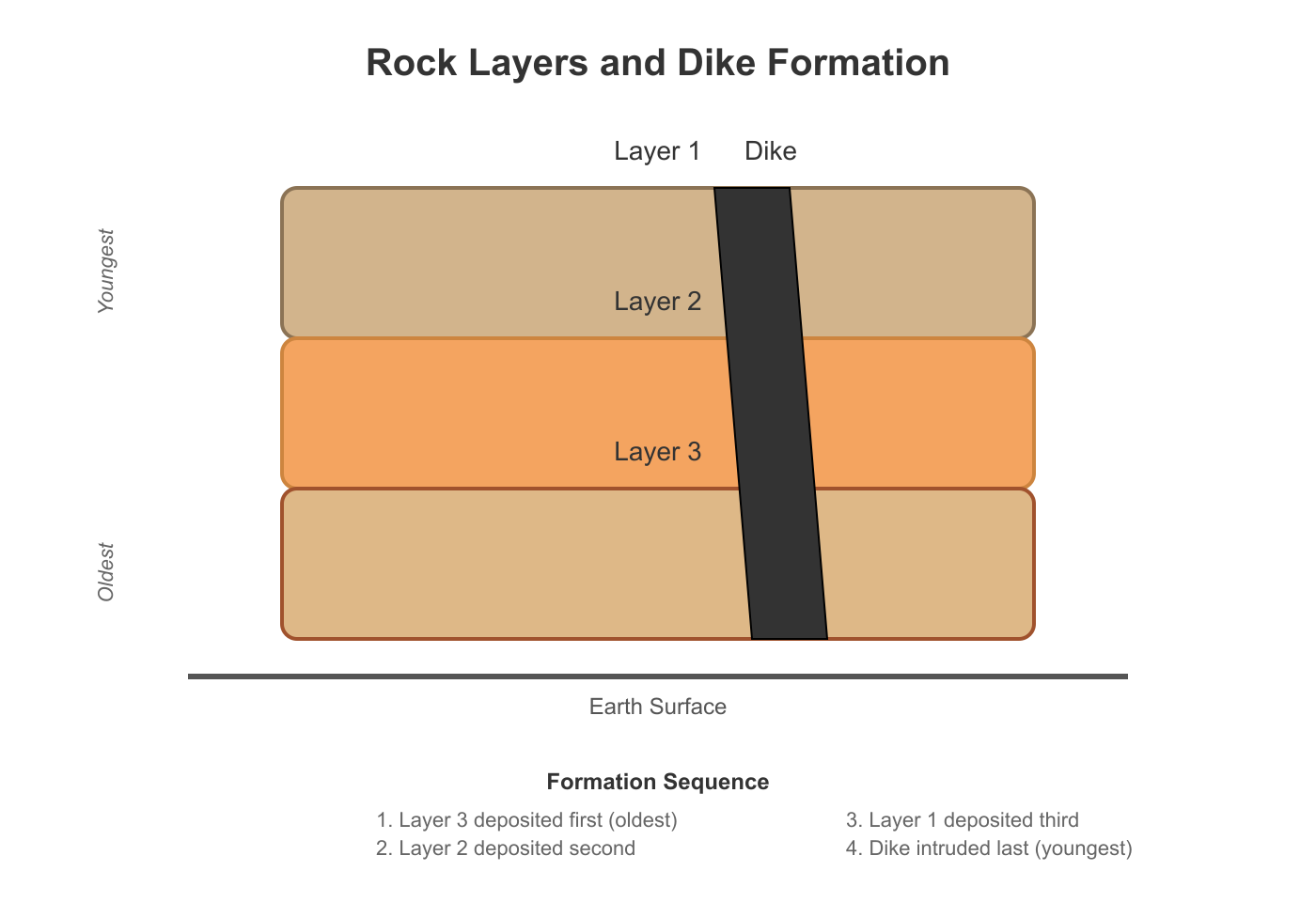
The diagram shows three rock layers that formed by deposition over time. A dark vertical feature labeled 'Dike' cuts through all layers. Which event happened most recently?
Layers from bottom to top: Layer 3, Layer 2, Layer 1. The dike cuts across Layers 3, 2, and 1.
- Layer 3 was deposited
- The dike formed cutting through the layers (correct answer)
- Layer 2 was deposited
- Layer 1 was deposited
Explanation: Scientists use rock layers to infer past events in Earth's history by examining their order and features. The principle of relative age states that in undisturbed rock sequences, lower layers are usually older than those above them. Rock layers form over time through deposition, where sediments like sand or mud accumulate and harden into rock, building up from the bottom. To infer the sequence of events, read the rock layers from bottom to top, as this reveals the order in which they were deposited. A common misconception is that features cutting through layers, like dikes, are older than the layers, but they form after the layers they cut. Rock layers record a sequence of events, such as depositions or intrusions, even without knowing exact dates. Diagrams of rock columns simplify real geology but preserve the relative order to help understand Earth's past.
Question 2
The diagram shows a vertical rock column. The layers represent deposition over time (older layers are generally below younger layers). Based on the diagram, which layer is the oldest?
Rock column (top to bottom):
- Layer 1 (top): light gray
- Layer 2: tan
- Layer 3 (bottom): dark brown
- Layer 1 (top, light gray)
- Layer 2 (middle, tan)
- Layer 3 (bottom, dark brown) (correct answer)
- All three layers formed at the same time
Explanation: Scientists use rock layers to infer past events in Earth's history by examining their order and features. The principle of relative age states that in undisturbed rock sequences, lower layers are usually older than those above them. Rock layers form over time through deposition, where sediments like sand or mud accumulate and harden into rock, building up from the bottom. To infer the sequence of events, read the rock layers from bottom to top, as this reveals the order in which they were deposited. A common misconception is that the top layer is the oldest, but actually, it is the youngest since new layers form on top of older ones. Rock layers record a sequence of events, such as depositions or erosions, even without knowing exact dates. Diagrams of rock columns simplify real geology but preserve the relative order to help understand Earth's past.
Question 3
The diagram shows rock layers that formed by deposition over time. A new layer is deposited on top of the existing stack. Where would the new layer appear in the rock column?
Current layers from bottom to top: Layer A, Layer B, Layer C (top). A new Layer D is deposited later.
- Between Layer A and Layer B
- On top of Layer C (correct answer)
- Below Layer A
- It could appear anywhere because deposition order is random
Explanation: Scientists use rock layers to infer past events in Earth's history by examining their order and features. The principle of relative age states that in undisturbed rock sequences, lower layers are usually older than those above them. Rock layers form over time through deposition, where sediments like sand or mud accumulate and harden into rock, building up from the bottom. To infer the sequence of events, read the rock layers from bottom to top, as this reveals the order in which they were deposited. A common misconception is that new layers can form anywhere in the stack, but they always deposit on top of existing ones. Rock layers record a sequence of events, such as ongoing depositions, even without knowing exact dates. Diagrams of rock columns simplify real geology but preserve the relative order to help understand Earth's past.
Question 4
The diagram shows rock layers that formed by deposition over time. A student says, "The thickest layer must be the oldest because it took the longest time to form." Which statement is supported by the diagram?
From bottom to top: Layer 1 (thin), Layer 2 (very thick), Layer 3 (medium).
- Layer 2 is oldest because it is the thickest
- Layer 3 is oldest because it is on top
- Layer 1 is oldest because it is at the bottom (correct answer)
- The ages cannot be compared without exact dates
Explanation: Scientists use rock layers to infer past events in Earth's history by examining their order and features. The principle of relative age states that in undisturbed rock sequences, lower layers are usually older than those above them. Rock layers form over time through deposition, where sediments like sand or mud accumulate and harden into rock, building up from the bottom. To infer the sequence of events, read the rock layers from bottom to top, as this reveals the order in which they were deposited. A common misconception is that thickness equals age, but thicker layers may form faster, not necessarily over longer time. Rock layers record a sequence of events, such as varying deposition rates, even without knowing exact dates. Diagrams of rock columns simplify real geology but preserve the relative order to help understand Earth's past.
Question 5
The diagram shows rock layers that formed by deposition over time. A wavy line between two layers shows an erosion surface (some rock was removed before the next layer was deposited). Which event happened last?
From bottom to top:
- Layer A (bottom)
- Layer B
- Wavy erosion surface
- Layer C (top)
- Layer A was deposited
- Layer B was deposited
- Erosion occurred at the wavy surface
- Layer C was deposited (correct answer)
Explanation: Scientists use rock layers to infer past events in Earth's history by examining their order and features. The principle of relative age states that in undisturbed rock sequences, lower layers are usually older than those above them. Rock layers form over time through deposition, where sediments like sand or mud accumulate and harden into rock, building up from the bottom. To infer the sequence of events, read the rock layers from bottom to top, as this reveals the order in which they were deposited. A common misconception is that erosion surfaces mean all previous layers are the same age, but they indicate a gap where material was removed before new deposition. Rock layers record a sequence of events, such as depositions or erosions, even without knowing exact dates. Diagrams of rock columns simplify real geology but preserve the relative order to help understand Earth's past.
Question 6
Two rock columns show layers (strata) deposited over time. Compare the two columns.
Column 1 (left):
[Top]
Layer A
────────
Layer B
────────
Layer C
[Bottom]
Column 2 (right):
[Top]
Layer A
────────
Layer D
────────
Layer C
[Bottom]
Which statement is supported by the diagrams?
- Layer D formed at exactly the same time as Layer B because they are both in the middle.
- Both locations share an older layer (C) and a younger layer (A), but the middle layer differs. (correct answer)
- Column 2 must be older overall because it has a different middle layer.
- All six layers shown are the same age because they are drawn with the same thickness.
Explanation: Scientists use rock layers to infer past events in Earth's history by examining their order and features. The principle of relative age states that in undisturbed rock layers, lower layers are usually older than those above them. Rock layers form over time through deposition, where sediments settle in horizontal beds, building up from the bottom. To infer the sequence of events, read the layers from bottom to top, as this reveals the order from oldest to youngest. A common misconception is that layers of the same thickness are the same age, but age is determined by position, not thickness. Rock layers record a sequence of geological events even without exact dates, helping us understand changes like sea level rises or volcanic activity. Diagrams simplify complex rock formations but preserve the essential order of deposition and events.
Question 7
The diagram shows rock layers that formed by deposition over time. The top layer was later eroded away (removed). After erosion removes only the top layer completely, which layer would be exposed at the surface?
From bottom to top: Layer M, Layer N, Layer O (top).
- Layer N (correct answer)
- Layer M
- Layer O
- No layers would remain because erosion resets the history
Explanation: Scientists use rock layers to infer past events in Earth's history by examining their order and features. The principle of relative age states that in undisturbed rock sequences, lower layers are usually older than those above them. Rock layers form over time through deposition, where sediments like sand or mud accumulate and harden into rock, building up from the bottom. To infer the sequence of events, read the rock layers from bottom to top, as this reveals the order in which they were deposited. A common misconception is that erosion removes all history, but it exposes older layers while preserving the sequence below. Rock layers record a sequence of events, such as depositions and erosions, even without knowing exact dates. Diagrams of rock columns simplify real geology but preserve the relative order to help understand Earth's past.
Question 8
The diagram shows rock layers that formed by deposition over time. A fault is shown as a diagonal break that offsets the layers. Which event happened first?
From bottom to top: Layer X, Layer Y, Layer Z. A diagonal fault cuts across and offsets all three layers.
- The fault occurred
- Layer Z was deposited
- Layer X was deposited (correct answer)
- All events happened at the same time
Explanation: Scientists use rock layers to infer past events in Earth's history by examining their order and features. The principle of relative age states that in undisturbed rock sequences, lower layers are usually older than those above them. Rock layers form over time through deposition, where sediments like sand or mud accumulate and harden into rock, building up from the bottom. To infer the sequence of events, read the rock layers from bottom to top, as this reveals the order in which they were deposited. A common misconception is that faults happen before the layers they offset, but faults occur after the layers form. Rock layers record a sequence of events, such as depositions or faulting, even without knowing exact dates. Diagrams of rock columns simplify real geology but preserve the relative order to help understand Earth's past.
Question 9
Two outcrops are shown. The layers represent deposition over time. Which statement is best supported by comparing the two rock columns?
[Column 1 (left): Top P, middle Q, bottom R. Column 2 (right): Top P, middle S, bottom R. Layers P and R look the same in both columns; the middle layer differs.]
- Column 1 is older than Column 2 because it has a different middle layer
- Both locations likely share older and younger layers, but had different conditions when the middle layer formed (correct answer)
- The middle layers must be the same age because they are both in the middle position
- The thicker middle layer is always younger than the thinner middle layer
Explanation: Rock layers from different locations help geologists understand how environments varied across ancient landscapes. The principle of superposition applies at each location, with older layers below younger ones. Layers form through deposition, but the type of sediment deposited can vary between locations due to different environmental conditions at the same time. To compare rock columns, match distinctive layers that appear in both locations, then note where they differ to understand past environmental variations. A misconception is that layers in the same position must be the same age everywhere, but lateral changes in deposition create different rocks at the same time. Rock layers record both regional patterns and local variations in Earth's history. Comparing multiple locations reveals a more complete picture of past environments than any single rock column could provide.
Question 10
The diagram shows rock layers that formed by deposition over time. A student claims: "Because we can see Layer G at the bottom, it must be the first rock layer that ever formed in this area." Which claim is not supported by the diagram?
From bottom to top: Layer G, Layer H, Layer I (top). No deeper layers are shown below Layer G.
- Layer G is older than Layer H
- Layer I was deposited after Layer H
- Layer G is the first layer that ever formed here (correct answer)
- Layer H is younger than Layer G
Explanation: Scientists use rock layers to infer past events in Earth's history by examining their order and features. The principle of relative age states that in undisturbed rock sequences, lower layers are usually older than those above them. Rock layers form over time through deposition, where sediments like sand or mud accumulate and harden into rock, building up from the bottom. To infer the sequence of events, read the rock layers from bottom to top, as this reveals the order in which they were deposited. A common misconception is that the bottom layer shown is always the absolute oldest ever, but there could be unseen older layers below. Rock layers record a sequence of events, such as partial histories, even without knowing exact dates. Diagrams of rock columns simplify real geology but preserve the relative order to help understand Earth's past.
Question 11
Two rock columns are shown. In each column, layers represent deposition over time.
Column X (top to bottom):
┌──────────────┐
│ X1 │
├──────────────┤
│ X2 │
├──────────────┤
│ X3 │
└──────────────┘
Column Y (top to bottom):
┌──────────────┐
│ Y1 │
├──────────────┤
│ Y2 │
├──────────────┤
│ Y3 │
└──────────────┘
A scientist claims: "Because X2 and Y2 are the same thickness, they formed at the same time." Which choice best evaluates this claim using the columns?
- Supported: thicker or thinner layers always show which formed first
- Not supported: thickness alone does not show that two layers formed at the same time (correct answer)
- Supported: any middle layer in any column must be the same age as any other middle layer
- Not supported: the top layers are always the oldest in both columns
Explanation: Scientists use rock layers to infer past events in Earth's history by examining their order and composition. The principle of relative age states that in undisturbed rock sequences, lower layers are usually older than those above them. Layers form over time through deposition, where sediments or volcanic materials accumulate gradually in environments like oceans or riverbeds. To infer the sequence of events, read the rock column from bottom to top, as this reveals the order from oldest to youngest. A common misconception is that layer thickness equals age, but thickness depends on deposition rates and does not directly indicate timing. Rock layers record a sequence of geological events even without providing exact dates, helping us understand changes like sea level rises or volcanic eruptions. Diagrams simplify real rock formations but preserve the essential order of deposition.