Adding and Subtracting Rational Expressions - Algebra 2
Card 1 of 228
Subtract the following expressions: 
Subtract the following expressions:
Tap to reveal answer
In order to subtract the fractions, multiply both denominators together in order to obtain the least common denominator.

Simplify the numerators.

Combine the numerators.

The answer is: 
In order to subtract the fractions, multiply both denominators together in order to obtain the least common denominator.
Simplify the numerators.
Combine the numerators.
The answer is:
← Didn't Know|Knew It →

Determine the value of  .
.
Determine the value of
Tap to reveal answer
(x+5)(x+3) is the common denominator for this problem making the numerators 7(x+3) and 8(x+5).
7(x+3)+8(x+5)= 7x+21+8x+40= 15x+61
A=61
(x+5)(x+3) is the common denominator for this problem making the numerators 7(x+3) and 8(x+5).
7(x+3)+8(x+5)= 7x+21+8x+40= 15x+61
A=61
← Didn't Know|Knew It →
Solve: 
Solve:
Tap to reveal answer
To simplify this expression, we will need to multiply both denominators together to find the least common denominator.

Convert both fractions to the common denominator.


Combine the fractions.

The answer is: 
To simplify this expression, we will need to multiply both denominators together to find the least common denominator.
Convert both fractions to the common denominator.
Combine the fractions.
The answer is:
← Didn't Know|Knew It →
Simplify: 
Simplify:
Tap to reveal answer
First, simplify the expression before attempting to combine like-terms.


Combine like-terms.

First, simplify the expression before attempting to combine like-terms.
Combine like-terms.
← Didn't Know|Knew It →
Simplify. 
Simplify.
Tap to reveal answer
The values can only be added or subtracted if there are like-terms in the expression. Since there are no like-terms in the question, the question is already simplified as is. All the other answers given are incorrect.
The values can only be added or subtracted if there are like-terms in the expression. Since there are no like-terms in the question, the question is already simplified as is. All the other answers given are incorrect.
← Didn't Know|Knew It →
Simplify:

Simplify:
Tap to reveal answer

Because the two rational expressions have the same denominator, we can simply add straight across the top. The denominator stays the same.
Therefore the answer is  .
.
Because the two rational expressions have the same denominator, we can simply add straight across the top. The denominator stays the same.
Therefore the answer is
← Didn't Know|Knew It →
Simplify the rational expression: 
Simplify the rational expression:
Tap to reveal answer
There are multiple operations required in this problem. The exponent must be eliminated before distributing the negative sign. Use the FOIL method which means to mulitply the first terms together, then multiply the outer terms together, then multiply the inner terms togethers, and lastly, mulitply the last terms together.


The negative sign can now be distributed.

There are multiple operations required in this problem. The exponent must be eliminated before distributing the negative sign. Use the FOIL method which means to mulitply the first terms together, then multiply the outer terms together, then multiply the inner terms togethers, and lastly, mulitply the last terms together.
The negative sign can now be distributed.
← Didn't Know|Knew It →
Add:

Add:
Tap to reveal answer
First factor the denominators which gives us the following:

The two rational fractions have a common denominator hence they are like "like fractions". Hence we get:
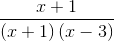
Simplifying gives us

First factor the denominators which gives us the following:
The two rational fractions have a common denominator hence they are like "like fractions". Hence we get:
Simplifying gives us
← Didn't Know|Knew It →
Subtract:

Subtract:
Tap to reveal answer
First let us find a common denominator as follows:

Now we can subtract the numerators which gives us : 
So the final answer is 
First let us find a common denominator as follows:
Now we can subtract the numerators which gives us :
So the final answer is
← Didn't Know|Knew It →
Simplify 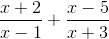
Simplify
Tap to reveal answer
This is a more complicated form of 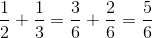
Find the least common denominator (LCD) and convert each fraction to the LCD, then add the numerators. Simplify as needed.

which is equivalent to 
Simplify to get 
This is a more complicated form of
Find the least common denominator (LCD) and convert each fraction to the LCD, then add the numerators. Simplify as needed.
which is equivalent to
Simplify to get
← Didn't Know|Knew It →
Solve the rational equation:

Solve the rational equation:
Tap to reveal answer
With rational equations we must first note the domain, which is all real numbers except  . (Recall, the denominator cannot equal zero. Thus, to find the domain set each denominator equal to zero and solve for what the variable cannot be.)
The least common denominator or  and
and  is
is  . Multiply every term by the LCD to cancel out the denominators. The equation reduces to
  . We can FOIL to expand the equation to
  . Combine like terms and solve:
  . Factor the quadratic and set each factor equal to zero to obtain the solution, which is
  or
or  . These answers are valid because they are in the domain.
With rational equations we must first note the domain, which is all real numbers except
The least common denominator or
← Didn't Know|Knew It →
Simplify

Simplify
Tap to reveal answer
a. Find a common denominator by identifying the Least Common Multiple of both denominators. The LCM of 3 and 1 is 3. The LCM of  and
and  is
is  . Therefore, the common denominator is
  .
.
b. Write an equivialent fraction to  using
using  as the denominator. Multiply both the numerator and the denominator by
  to get
  . Notice that the second fraction in the original expression already has
  as a denominator, so it does not need to be converted.
The expression should now look like:  .
.
c. Subtract the numerators, putting the difference over the common denominator.

a. Find a common denominator by identifying the Least Common Multiple of both denominators. The LCM of 3 and 1 is 3. The LCM of
b. Write an equivialent fraction to
The expression should now look like:
c. Subtract the numerators, putting the difference over the common denominator.
← Didn't Know|Knew It →
Combine the following expression into one fraction:

Combine the following expression into one fraction:
Tap to reveal answer
To combine fractions of different denominators, we must first find a common denominator between the two. We can do this by multiplying the first fraction by  and the second fraction by
  . We therefore obtain:


Since these fractions have the same denominators, we can now combine them, and our final answer is therefore:

To combine fractions of different denominators, we must first find a common denominator between the two. We can do this by multiplying the first fraction by
Since these fractions have the same denominators, we can now combine them, and our final answer is therefore:
← Didn't Know|Knew It →
What is  ?
?
What is
Tap to reveal answer
We start by adjusting both terms to the same denominator which is 2 x 3 = 6
Then we adjust the numerators by multiplying x+1 by 2 and 2x-5 by 3

The results are:

So the final answer is,

We start by adjusting both terms to the same denominator which is 2 x 3 = 6
Then we adjust the numerators by multiplying x+1 by 2 and 2x-5 by 3
The results are:
So the final answer is,
← Didn't Know|Knew It →
What is  ?
?
What is
Tap to reveal answer
Start by putting both equations at the same denominator.
2x+4 = (x+2) x 2 so we only need to adjust the first term:


Then we subtract the numerators, remembering to distribute the negative sign to all terms of the second fraction's numerator:

Start by putting both equations at the same denominator.
2x+4 = (x+2) x 2 so we only need to adjust the first term:
Then we subtract the numerators, remembering to distribute the negative sign to all terms of the second fraction's numerator:
← Didn't Know|Knew It →

Tap to reveal answer
First, find the common denominator, which is  . Then, make sure to offset each numerator. Multiply
  by y to get
  . Multiply
  by x to get
  . Then, combine numerators to get
  . Then, put the numerator over the denominator to get your answer:
  .
.
First, find the common denominator, which is
← Didn't Know|Knew It →
Subtract the expressions: 
Subtract the expressions:
Tap to reveal answer

Make a common denominator:


Combine and subtract numerators:


Make a common denominator:
Combine and subtract numerators:
← Didn't Know|Knew It →

Tap to reveal answer
To start this problem, you must first identify the common denominator, which in this case is teh two denominators multiplied together:  . Next, offset the numerators with the newly changed denominators:
  . Then, add numerators to get:
  . Put the numerator over your denominator and check to make sure it can't be simplified anymore (it can't). Your answer is:
  .
.
To start this problem, you must first identify the common denominator, which in this case is teh two denominators multiplied together:
← Didn't Know|Knew It →

Tap to reveal answer
To combine these rational expressions, first find the common denominator. In this case, it is  . Then, offset the second equation so that you get the correct denominator:
  . Then, combine the numerators:
  . Put your numerator over the denominator for your answer:
  .
.
To combine these rational expressions, first find the common denominator. In this case, it is
← Didn't Know|Knew It →
Simplify: 
Simplify:
Tap to reveal answer
First find the lowest common denominator. In this case, it will be x(x+2).
Multiply each fraction to get the common denominator then solve:


First find the lowest common denominator. In this case, it will be x(x+2).
Multiply each fraction to get the common denominator then solve:
← Didn't Know|Knew It →