Finding Conditional Probability in Models
Help Questions
Statistics › Finding Conditional Probability in Models
A class has 10 students. Each student is equally likely to be selected at random.
The students are:
- Soccer: Ana, Ben, Cam, Dee
- Basketball: Eli, Fay, Gus
- Neither: Hal, Ivy, Jay
Let event $A$ be “the selected student plays soccer” and event $B$ be “the selected student plays a sport (soccer or basketball).”
Using the list above, what is $P(A\mid B)$? Give your answer as a simplified fraction.
$\frac{7}{4}$
$\frac{4}{10}$
$\frac{7}{10}$
$\frac{4}{7}$
Explanation
This question tests conditional probability from a model of equally likely student selections. 'Given B' means we restrict our attention to only the outcomes in event B, which is 'the selected student plays a sport.' There are 7 outcomes in B: the 4 soccer players and 3 basketball players. Of these 7, 4 are also in A, which are the soccer players. Therefore, the correct fraction 4/7 represents P(A|B), as it shows the proportion of sport-playing students who play soccer. A common mistake is using the total 10 students as the denominator, leading to 4/10 instead of focusing on B. To avoid this, first list or circle the outcomes in B, then count how many of those are in A.
A two-step experiment is performed: first choose a letter from {X, Y} and then choose a number from {1, 2, 3}. All 6 outcomes are equally likely.
The outcomes are: {X1, X2, X3, Y1, Y2, Y3}.
Let event $A$ be “the outcome has number 1” and event $B$ be “the outcome starts with Y.”
From the outcomes listed, what is $P(A\mid B)$? Give your answer as a simplified fraction.
$\frac{3}{6}$
$\frac{1}{3}$
$\frac{3}{1}$
$\frac{1}{6}$
Explanation
This question tests conditional probability using a model of equally likely two-step experiment outcomes. 'Given B' means we restrict our attention to only the outcomes in event B, which is 'the outcome starts with Y.' There are 3 outcomes in B: Y1, Y2, and Y3. Of these 3, 1 is also in A, which is Y1 for number 1. Therefore, the correct fraction 1/3 represents P(A|B), as it shows the proportion of Y-starting outcomes with number 1. A common mistake is using the total 6 outcomes as the denominator, which could give 2/6 instead of restricting to B. To avoid this, first circle the outcomes in B, then count how many of those are in A.
A fair six-sided die is rolled once. The equally likely outcomes are {1, 2, 3, 4, 5, 6}.
Let event $A$ be “the roll is greater than 4” and event $B$ be “the roll is even.”
Using the outcomes listed, which value best represents $P(A\mid B)$? Give your answer as a simplified fraction.
$\frac{1}{2}$
$\frac{2}{3}$
$\frac{1}{6}$
$\frac{1}{3}$
Explanation
This question tests conditional probability from a model of equally likely die rolls. 'Given B' means we restrict our attention to only the outcomes in event B, which is 'the roll is even.' There are 3 outcomes in B: 2, 4, and 6. Of these 3, 1 is also in A, which is 6 for greater than 4. Therefore, the correct fraction 1/3 represents P(A|B), as it shows the proportion of even rolls that are greater than 4. A common mistake is using the total 6 outcomes as the denominator, leading to 2/6 instead of focusing on B. To avoid this, first circle the outcomes in B, then count how many of those are in A.
A card is chosen at random from the 16 equally likely cards labeled:
A1, A2, A3, A4, B1, B2, B3, B4, C1, C2, C3, C4, D1, D2, D3, D4.
Event $B$: the letter is C or D.
Event $A$: the number is 1.
Based on the outcomes listed, which value best represents $P(A\mid B)$? Give your answer as a simplified fraction.
$\frac{2}{16}$
$\frac{1}{4}$
$\frac{1}{2}$
$\frac{1}{8}$
Explanation
This question tests conditional probability using a card model with 16 equally likely labels. Given event B, we restrict attention to letters C or D: C1-C4 and D1-D4, totaling 8 outcomes. Of these, the ones in A with number 1 are C1 and D1, so 2 outcomes. The fraction 2/8 simplifies to 1/4, representing P(A|B) as the proportion of C or D cards with number 1. A common mistake is using the total 16 as the denominator, giving 4/16 which simplifies similarly but misses the restriction. To avoid errors, circle the B group first, then count A within it for the proper conditional probability.
A fair coin is flipped twice. The 4 equally likely outcomes are: HH, HT, TH, TT.
Event $B$: at least one flip is H.
Event $A$: the two flips match (HH or TT).
From the outcomes listed, what is $P(A\mid B)$? Give your answer as a simplified fraction.
$\frac{1}{3}$
$\frac{2}{3}$
$\frac{1}{4}$
$\frac{1}{2}$
Explanation
This question tests conditional probability in a coin flip model with 4 equally likely outcomes. Given event B, we restrict attention to at least one H: HH, HT, TH, which are 3 outcomes. Among them, the matching flips in A are only HH, so 1 outcome. The fraction 1/3 is P(A|B), showing the share of at-least-one-H outcomes where flips match. A common mistake is using all 4 outcomes as the denominator, like 2/4 for all matches, ignoring the condition. A helpful strategy is to circle B outcomes first, then count A inside to focus on the restricted space.
A card is drawn at random from a set of 12 equally likely cards labeled:
{S1, S2, S3, S4, H1, H2, H3, H4, D1, D2, D3, D4}
The letter indicates the suit (S, H, D) and the number is 1–4.
Let event $A$ = “the suit is H” and event $B$ = “the number is 3 or 4.”
Using the outcomes listed, what fraction of outcomes in $B$ also belong to $A$? Answer as a fraction.
$\frac{2}{3}$
$\frac{1}{3}$
$\frac{1}{6}$
$\frac{1}{2}$
Explanation
This question tests conditional probability using a model with listed outcomes. 'Given B' means we restrict our attention to only the outcomes in B, which are cards with number 3 or 4. There are 6 outcomes in B: S3, S4, H3, H4, D3, D4. Of these, 2 outcomes are also in A, meaning the suit is H: H3, H4. The fraction 2/6 or 1/3 represents the proportion of B's outcomes that satisfy A. A common mistake is using the total number of H suits as numerator over total cards, like 4/12=1/3, but that's P(A); or wrong denominator for 2/4=1/2. A good strategy is to first circle the outcomes in B, then count how many of those are in A.
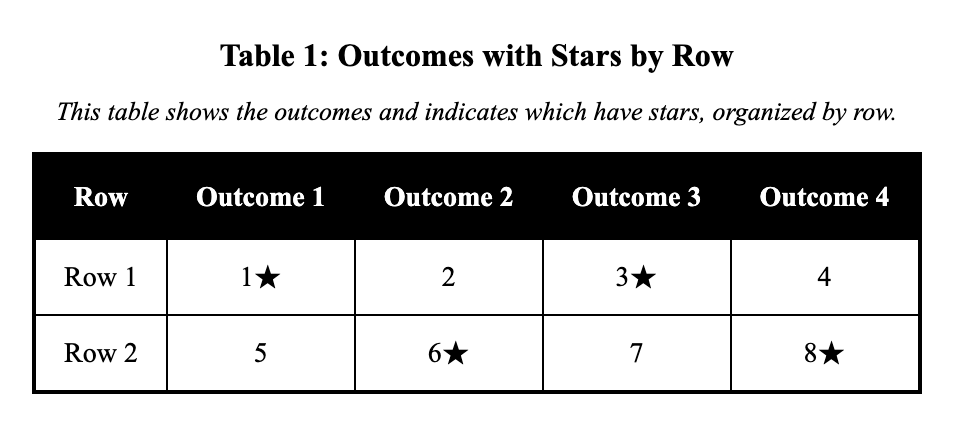
A student randomly selects one of the 8 equally likely outcomes shown in the table.
Let event $A$ = “the outcome has a star” and event $B$ = “the outcome is in Row 2.”
Using the table, what is $P(A\mid B)$? Give your answer as a fraction.
Table of outcomes:
- Row 1: 1★, 2, 3★, 4
- Row 2: 5, 6★, 7, 8★
$\frac{1}{2}$
$\frac{3}{4}$
$\frac{2}{8}$
$\frac{1}{4}$
Explanation
This question tests conditional probability using a model with listed outcomes in a table. 'Given B' means we restrict our attention to only the outcomes in B, which are in Row 2. There are 4 outcomes in B: 5, 6★, 7, 8★. Of these, 2 outcomes are also in A, meaning they have a star: 6★ and 8★. The fraction 2/4 or 1/2 represents P(A|B) because it shows the proportion of B's outcomes that satisfy A. A common mistake is using the total outcomes as the denominator, like 4 stars out of 8 for 1/2, but that's P(A); or counting only one star in Row 2 wrongly. A good strategy is to first circle the outcomes in B, then count how many of those are in A.
A coin is flipped and then a number cube (1–4) is rolled. All outcomes are equally likely.
Outcomes (coin, number):
(H,1) (H,2) (H,3) (H,4)
(T,1) (T,2) (T,3) (T,4)
Let event $A$ = “the number is odd” and event $B$ = “the coin shows H.”
From the outcomes listed, what is $P(A\mid B)$? Give your answer as a fraction.
$\frac{1}{4}$
$\frac{1}{8}$
$\frac{1}{2}$
$\frac{2}{3}$
Explanation
This question tests conditional probability using a model with listed outcomes. 'Given B' means we restrict our attention to only the outcomes in B, which are those with the coin showing H. There are 4 outcomes in B: (H,1), (H,2), (H,3), (H,4). Of these, 2 outcomes are also in A, meaning the number is odd: (H,1) and (H,3). The fraction 2/4 or 1/2 represents P(A|B) because it shows the proportion of B's outcomes that satisfy A. A common mistake is using the total number of outcomes as the denominator, like 4 odd out of 8 total for 1/2, but that's P(A), not conditional; here it coincides but the reasoning matters. A good strategy is to first circle the outcomes in B, then count how many of those are in A.
A fair die with faces 1–6 is rolled once.
Outcomes: {1, 2, 3, 4, 5, 6}
Let event $A$ = “the roll is a multiple of 3” and event $B$ = “the roll is even.”
Based on the outcomes listed, what is $P(A\mid B)$? Give your answer as a fraction.
$\frac{1}{3}$
$\frac{2}{3}$
$\frac{1}{2}$
$\frac{1}{6}$
Explanation
This question tests conditional probability using a model with listed outcomes. 'Given B' means we restrict our attention to only the outcomes in B, which are even rolls. There are 3 outcomes in B: 2, 4, 6. Of these, 1 outcome is also in A, meaning it is a multiple of 3: 6. The fraction 1/3 represents P(A|B) because it shows the proportion of B's outcomes that satisfy A. A common mistake is using the total outcomes as the denominator, like 2 multiples of 3 out of 6 for 1/3, but that's P(A); or counting 3 as even wrongly for 2/3. A good strategy is to first circle the outcomes in B, then count how many of those are in A.
A two-stage experiment is performed: first choose a shape from {Circle, Square}, then choose a color from {Red, Blue, Green}. All outcomes are equally likely.
Outcomes:
(Circle,Red) (Circle,Blue) (Circle,Green)
(Square,Red) (Square,Blue) (Square,Green)
Let event $A$ = “the shape is Square” and event $B$ = “the color is Blue or Green.”
From the outcomes listed, what fraction of outcomes in $B$ also belong to $A$? Answer as a fraction.
$\frac{1}{2}$
$\frac{2}{6}$
$\frac{2}{3}$
$\frac{1}{3}$
Explanation
This question tests conditional probability using a model with listed outcomes. 'Given B' means we restrict our attention to only the outcomes in B, which are those with color Blue or Green. There are 4 outcomes in B: (Circle,Blue), (Circle,Green), (Square,Blue), (Square,Green). Of these, 2 outcomes are also in A, meaning the shape is Square: (Square,Blue) and (Square,Green). The fraction 2/4 or 1/2 represents the proportion of B's outcomes that satisfy A. A common mistake is using the total outcomes as the denominator, like 3 squares out of 6 for 1/2, but that's P(A); or counting only one color wrongly for 1/3. A good strategy is to first circle the outcomes in B, then count how many of those are in A.