Coordinate Geometry
Help Questions
SSAT Upper Level Quantitative › Coordinate Geometry
Which of the following lines is parallel to the line 


Explanation
For two lines to be parallel, their slopes must be the same. Thus, the line that is parallel to the given one must also have a slope of 
Find the equation of a line that goes through the point 


Explanation
For lines to be parallel, they must have the same slope. The slope of the line we are looking for then must be 
The point that's given in the equation is also the y-intercept.
Using these two pieces of information, we know that the equation for the line must be

Which of the following lines is parallel with the line 


Explanation
Parallel lines have the same slope. The slope of a line in slope-intercept form 


There is a line defined by the equation below:

There is a second line that passes through the point 


Explanation
Parallel lines have the same slope. Solve for the slope in the first line by converting the equation to slope-intercept form.
3x + 4y = 12
4y = _–_3x + 12
y = –(3/4)x + 3
slope = _–_3/4
We know that the second line will also have a slope of _–_3/4, and we are given the point (1,2). We can set up an equation in slope-intercept form and use these values to solve for the y-intercept.
y = mx + b
2 = _–_3/4(1) + b
2 = _–_3/4 + b
b = 2 + 3/4 = 2.75
Plug the y-intercept back into the equation to get our final answer.
y = –(3/4)x + 2.75
Which of the following lines is parallel to the line
Explanation
For two lines to be parallel, their slopes must be the same. Thus, the line that is parallel to the given one must also have a slope of
Consider the lines described by the following two equations:
4y = 3x2
3y = 4x2
Find the vertical distance between the two lines at the points where x = 6.
36
21
12
44
48
Explanation
Since the vertical coordinates of each point are given by y, solve each equation for y and plug in 6 for x, as follows:

Taking the difference of the resulting y -values give the vertical distance between the points (6,27) and (6,48), which is 21.

What equation is graphed in the above figure?


Explanation
The greatest integer function, or floor function, 


The given graph is the above graph shifted downward four units. The graph of any function 


What line is perpendicular to 


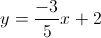


Explanation
Convert the given equation to slope-intercept form.



The slope of this line is 
The perpendicular slope is 
Plug the new slope and the given point into the slope-intercept form to find the y-intercept.


So the equation of the perpendicular line is 
There is a line defined by the equation below:
There is a second line that passes through the point
Explanation
Parallel lines have the same slope. Solve for the slope in the first line by converting the equation to slope-intercept form.
3x + 4y = 12
4y = _–_3x + 12
y = –(3/4)x + 3
slope = _–_3/4
We know that the second line will also have a slope of _–_3/4, and we are given the point (1,2). We can set up an equation in slope-intercept form and use these values to solve for the y-intercept.
y = mx + b
2 = _–_3/4(1) + b
2 = _–_3/4 + b
b = 2 + 3/4 = 2.75
Plug the y-intercept back into the equation to get our final answer.
y = –(3/4)x + 2.75
Find the equation of a line that goes through the point
Explanation
For lines to be parallel, they must have the same slope. The slope of the line we are looking for then must be
The point that's given in the equation is also the y-intercept.
Using these two pieces of information, we know that the equation for the line must be