Algebra
Help Questions
PSAT Math › Algebra
Simplify:






Explanation
To solve this problem, use the FOIL method. Start by multiplying the First term in each set of parentheses:

Then multiply the outside terms:

Next, multiply the inside terms:

Finally, multiply the last terms:

When you put the pieces together, you have 


Solve for 



Explanation
First distribute the fractions:

Combine like terms:


If 


Cannot be determined
Explanation
Start by simplifying the numerator and denominator separately. In the numerator, (c3)2 is equal to c6. In the denominator, c2 * c4 equals c6 as well. Dividing the numerator by the denominator, c6/c6, gives an answer of 1, because the numerator and the denominator are the equivalent.
Simplify the radical expression.


Explanation
Look for perfect cubes within each term. This will allow us to factor out of the radical.


Simplify.

If 5 + x is 5 more than 5,what is the value of 2_x_?
10
5
15
20
Explanation
5 more than 5 = 10
5 + x = 10
Subtract 5 from each side of the equation: x = 5 → 2_x_ = 10
Evaluate the following equation when 
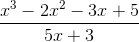


Explanation
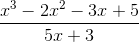
1. Plug in 

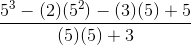
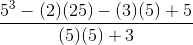
2. Perform the above operations.
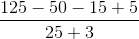

Factor the following equation.
x2 – 16
(x + 4)(x + 4)
(x – 4)(x – 4)
(x + 4)(x – 4)
(x)(x – 4)
(x2)(4 – 2)
Explanation
The correct answer is (x + 4)(x – 4)
We neen to factor x2 – 16 to solve. We know that each parenthesis will contain an x to make the x2. We know that the root of 16 is 4 and since it is negative and no value of x is present we can tell that one 4 must be positive and the other negative. If we work it from the multiple choice answers we will see that when multiplying it out we get x2 + 4x – 4x – 16. 4x – 4x cancels out and we are left with our answer.
Simplify the expression, 


Can't be simplified

Explanation
The 


The exponents on the denominator can then be subtracted from the exponent in the numerator to give

Simplify the expression,
Can't be simplified
Explanation
The
The exponents on the denominator can then be subtracted from the exponent in the numerator to give
Simplify:
Explanation
To solve this problem, use the FOIL method. Start by multiplying the First term in each set of parentheses:
Then multiply the outside terms:
Next, multiply the inside terms:
Finally, multiply the last terms:
When you put the pieces together, you have