Simple Functional Relationships
Help Questions
ISEE Upper Level: Quantitative Reasoning › Simple Functional Relationships
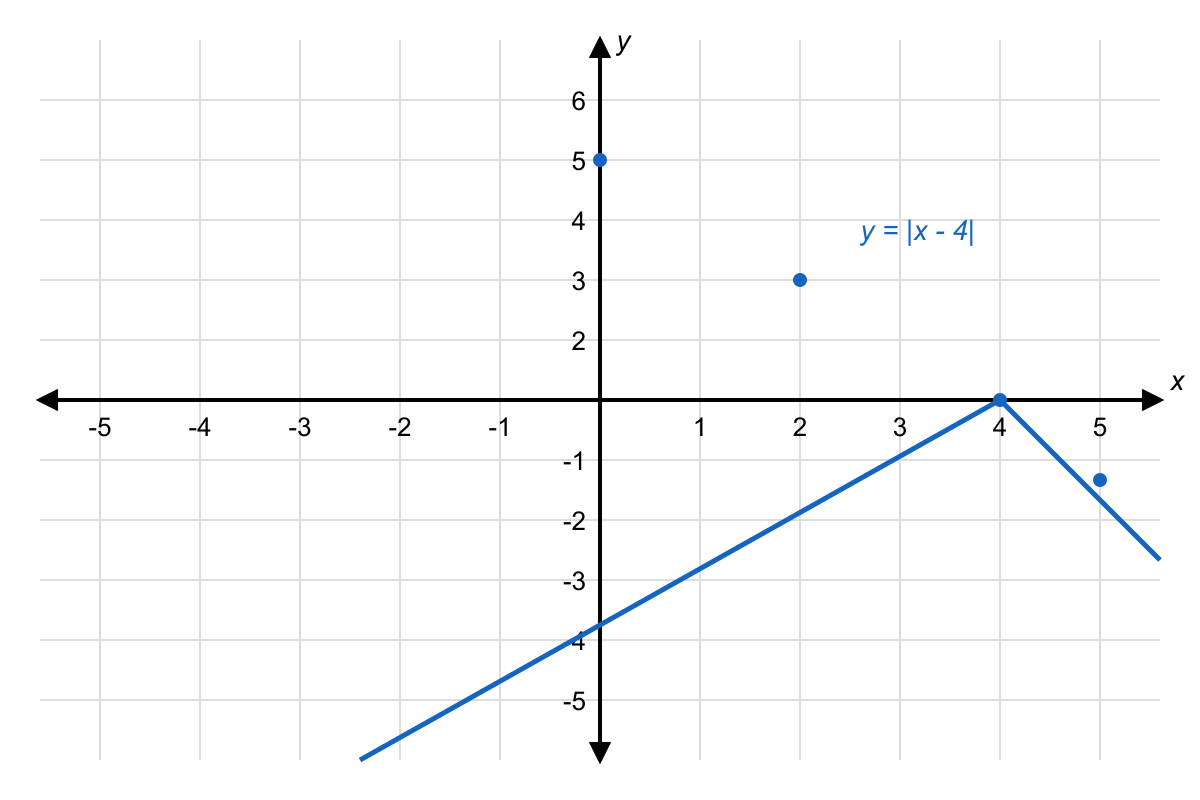
The function $$q(x) = |x - 4|$$ is graphed below. For which value of $$x$$ is $$q(x) = q(x + 2)$$?
$$x = 5$$
$$x = 1$$
$$x = 2$$
$$x = 3$$
Explanation
We need $$|x - 4| = |(x + 2) - 4| = |x - 2|$$. This occurs when $$x - 4$$ and $$x - 2$$ have the same absolute value but possibly opposite signs. Setting $$x - 4 = -(x - 2)$$: $$x - 4 = -x + 2$$, so $$2x = 6$$ and $$x = 3$$. Check: $$q(3) = |3 - 4| = 1$$ and $$q(5) = |5 - 4| = 1$$.
A function $$f$$ is defined such that $$f(x) = 2x + 3$$ for all real numbers $$x$$. If $$f(a) = 15$$, what is the value of $$f(a - 2)$$?
11
13
17
19
Explanation
Function problems like this test your ability to substitute values and work systematically with function notation. When you see $$f(x) = 2x + 3$$, remember that this means "whatever input you put in place of $$x$$, multiply it by 2 and add 3."
First, you need to find the value of $$a$$. Since $$f(a) = 15$$, substitute $$a$$ into the function: $$f(a) = 2a + 3 = 15$$. Solving for $$a$$: $$2a = 12$$, so $$a = 6$$.
Now you can find $$f(a - 2) = f(6 - 2) = f(4)$$. Substitute 4 into the original function: $$f(4) = 2(4) + 3 = 8 + 3 = 11$$.
Looking at the wrong answers: Choice B (13) likely comes from incorrectly calculating $$f(4)$$ as $$2(4) + 5 = 13$$, perhaps from misremembering the function. Choice C (17) might result from finding $$f(a + 2)$$ instead of $$f(a - 2)$$: $$f(8) = 2(8) + 3 = 19$$, then making an arithmetic error. Choice D (19) is exactly $$f(a + 2) = f(8) = 19$$, showing you read the problem as asking for $$f(a + 2)$$ rather than $$f(a - 2)$$.
The correct answer is A.
Strategy tip: Always work in steps with function problems. Find any unknown values first, then carefully substitute into the function. Double-check that you're answering exactly what's asked—watch for sign changes like the difference between $$a + 2$$ and $$a - 2$$.
If $$h(x) = x^2 - 4x + 5$$, which of the following statements is true about the relationship between $$h(3)$$ and $$h(5)$$?
$$h(3) = h(5)$$ because the function is symmetric
$$h(3) > h(5)$$ because the function is decreasing
$$h(3) < h(5)$$ because 3 is closer to the vertex
$$h(3) = h(5)$$ because both points are equidistant from the vertex
Explanation
When you encounter a quadratic function question asking about relationships between function values, you need to understand how the parabola's shape and vertex affect the outputs.
First, let's find the actual values. For $$h(x) = x^2 - 4x + 5$$:
- $$h(3) = 3^2 - 4(3) + 5 = 9 - 12 + 5 = 2$$
- $$h(5) = 5^2 - 4(5) + 5 = 25 - 20 + 5 = 10$$
So $$h(3) = 2$$ and $$h(5) = 10$$, confirming that $$h(3) < h(5)$$.
To understand why, find the vertex. For $$ax^2 + bx + c$$, the vertex is at $$x = -\frac{b}{2a} = -\frac{-4}{2(1)} = 2$$. Since the coefficient of $$x^2$$ is positive, this parabola opens upward, making $$x = 2$$ the minimum point.
Choice B is correct because $$x = 3$$ is closer to the vertex at $$x = 2$$ than $$x = 5$$ is, and since the parabola opens upward, points closer to the vertex have smaller function values.
Choice A is wrong because while the function is symmetric about $$x = 2$$, the points $$x = 3$$ and $$x = 5$$ are not equidistant from the vertex. Choice C incorrectly states the function is decreasing everywhere—it's only decreasing for $$x < 2$$. Choice D makes the same error as A, claiming the points are equidistant when they're not.
Study tip: Always identify the vertex of a quadratic first. Points closer to the vertex of an upward-opening parabola will have smaller function values.
A function $$p(t)$$ represents the profit (in dollars) from selling $$t$$ items, where $$p(t) = 15t - 200$$. How many items must be sold for the profit to equal $$\100$$?
18 items
24 items
22 items
20 items
Explanation
When you encounter a function problem asking for a specific output value, you're solving an equation by substituting the given information and solving for the unknown variable.
Here, you need to find how many items ($$t$$) must be sold for the profit to equal $100. Set up the equation by substituting the desired profit into the function: $$p(t) = 15t - 200 = 100$$.
Now solve for $$t$$:
$$15t - 200 = 100$$
$$15t = 100 + 200$$
$$15t = 300$$
$$t = 20$$
Therefore, 20 items must be sold to achieve a profit of $100, making (B) correct.
Let's examine why the other choices are wrong. Choice (A) 18 items would give $$p(18) = 15(18) - 200 = 270 - 200 = 70$$, which is $30 short of the target. Choice (C) 22 items would yield $$p(22) = 15(22) - 200 = 330 - 200 = 130$$, which exceeds the target by $30. Choice (D) 24 items would produce $$p(24) = 15(24) - 200 = 360 - 200 = 160$$, overshooting by $60.
Notice that these incorrect answers are evenly spaced around the correct answer, which is a common pattern in multiple-choice tests. When solving function problems, always substitute your answer back into the original equation to verify it produces the desired result. This quick check can catch arithmetic errors and confirm you've found the right solution.
Given that $$r(x) = 2x - 1$$ and $$s(x) = x^2 + 3$$, what is the value of $$r(s(2))$$?
13
15
17
19
Explanation
This question tests function composition, where you evaluate one function and use that result as the input for another function. When you see $$r(s(2))$$, you're working from the inside out - first find $$s(2)$$, then use that result as the input for function $$r$$.
Start by evaluating the inner function $$s(2)$$. Since $$s(x) = x^2 + 3$$, substitute $$x = 2$$: $$s(2) = 2^2 + 3 = 4 + 3 = 7$$. Now you need to find $$r(7)$$ since $$r(s(2)) = r(7)$$. Using $$r(x) = 2x - 1$$, substitute $$x = 7$$: $$r(7) = 2(7) - 1 = 14 - 1 = 13$$.
Choice A (13) is correct - this follows the proper inside-out evaluation process. Choice B (15) likely comes from incorrectly calculating $$r(7) = 2(7) + 1$$ instead of $$2(7) - 1$$, mixing up the sign. Choice C (17) could result from evaluating $$r(2) + s(2) = 3 + 14 = 17$$, misunderstanding composition as addition of separate function values. Choice D (19) might come from calculating $$s(2) \cdot r(2) + 1 = 7 \cdot 3 + 1 - 1 = 19$$, confusing composition with multiplication.
For function composition problems, always work inside-out and substitute carefully. Write down each step: identify the inner function, evaluate it completely, then use that result as input for the outer function. This methodical approach prevents the sign errors and operational mix-ups that create these wrong answer choices.
If $$u(x) = 3x + 7$$ and $$u^{-1}$$ represents the inverse function of $$u$$, what is $$u^{-1}(16)$$?
3
4
5
6
Explanation
When you encounter inverse functions, remember that if $$f(a) = b$$, then $$f^{-1}(b) = a$$. This means the inverse function "undoes" what the original function does.
To find $$u^{-1}(16)$$, you need to determine what input value makes $$u(x) = 16$$. Set up the equation: $$3x + 7 = 16$$. Solving for $$x$$: subtract 7 from both sides to get $$3x = 9$$, then divide by 3 to get $$x = 3$$. Since $$u(3) = 16$$, we know that $$u^{-1}(16) = 3$$.
You can verify this by checking: $$u(3) = 3(3) + 7 = 9 + 7 = 16$$ ✓
Looking at the wrong answers: Choice B (4) would mean $$u(4) = 16$$, but $$u(4) = 3(4) + 7 = 19$$. Choice C (5) would mean $$u(5) = 16$$, but $$u(5) = 3(5) + 7 = 22$$. Choice D (6) would mean $$u(6) = 16$$, but $$u(6) = 3(6) + 7 = 25$$. These are all too large because students might mistakenly try to substitute these values into the original function rather than solving the inverse relationship.
Study tip: For inverse function problems, always ask yourself "what input gives me this output?" rather than plugging the given number directly into the original function. Set up an equation where the function equals your target value, then solve for the input.
A function $$d(t)$$ represents the distance (in miles) traveled after $$t$$ hours, where $$d(t) = 55t + 20$$. The value 20 in this function represents which aspect of the journey?
The initial distance already traveled before timing began
The rate of travel in miles per hour during the journey
The total time required to complete the entire journey
The additional distance traveled during each subsequent hour
Explanation
When you encounter a linear function like $$d(t) = 55t + 20$$, you're looking at a relationship in the form $$y = mx + b$$, where the coefficient of the variable represents the rate of change and the constant term represents the starting value or y-intercept.
In this distance function, you need to think about what happens at time $$t = 0$$ (when timing begins). Substituting $$t = 0$$ into the equation gives $$d(0) = 55(0) + 20 = 20$$. This means that at the moment timing started, 20 miles had already been traveled. The value 20 represents the initial distance already covered before the timer began, making choice A correct.
Choice B incorrectly identifies the rate of travel. The coefficient 55 (not 20) represents the speed in miles per hour, since distance increases by 55 miles for each hour that passes. Choice C confuses the constant with time duration, but 20 has units of miles, not hours, and doesn't indicate when the journey ends. Choice D misinterprets what "additional distance" means – while the traveler does cover 55 additional miles each hour, the value 20 isn't related to this hourly increment.
Remember that in linear functions modeling real situations, the constant term typically represents the initial or starting condition. When you see $$d(t) = rt + d_0$$, the $$d_0$$ term always tells you the initial value of whatever quantity the function measures.
If $$g(x) = x^2 - 6x + 8$$ and $$g(m) = g(n)$$ where $$m < n$$, what is the relationship between $$m$$ and $$n$$?
$$m + n = 6$$ because the axis of symmetry is at $$x = 3$$
$$m \cdot n = 8$$ because this is the constant term
$$m + n = 3$$ because the axis of symmetry is at $$x = 3$$
$$m + n = 8$$ because this is the constant term
Explanation
When you see a quadratic function where two different inputs produce the same output, you're dealing with the symmetry property of parabolas. Since $$g(m) = g(n)$$ with $$m < n$$, the points $$(m, g(m))$$ and $$(n, g(n))$$ are reflections of each other across the parabola's axis of symmetry.
For any quadratic $$ax^2 + bx + c$$, the axis of symmetry occurs at $$x = -\frac{b}{2a}$$. In $$g(x) = x^2 - 6x + 8$$, we have $$a = 1$$ and $$b = -6$$, so the axis of symmetry is at $$x = -\frac{(-6)}{2(1)} = 3$$.
Since $$m$$ and $$n$$ are equidistant from this axis of symmetry, the midpoint between them must be 3. This means $$\frac{m + n}{2} = 3$$, so $$m + n = 6$$.
Choice A incorrectly states that $$m + n = 3$$. While it correctly identifies the axis of symmetry at $$x = 3$$, it confuses this value with the sum of the two x-coordinates.
Choice C suggests $$m + n = 8$$ based on the constant term. The constant term tells us where the parabola crosses the y-axis, but has no direct relationship to points with equal y-values.
Choice D claims $$m \cdot n = 8$$ because of the constant term. Again, the constant term doesn't determine the product of symmetric x-coordinates.
Remember: when two x-values produce the same y-value in a quadratic function, their average equals the x-coordinate of the axis of symmetry. This symmetry property is crucial for solving quadratic equations and understanding parabola behavior.
The revenue function $$R(x) = 12x - 0.5x^2$$ gives the revenue (in hundreds of dollars) from selling $$x$$ units. How many units should be sold to maximize revenue?
10 units
16 units
12 units
14 units
Explanation
When you encounter a quadratic revenue function like this one, you're looking for the maximum point of a parabola that opens downward (since the coefficient of $$x^2$$ is negative). The maximum occurs at the vertex.
For any quadratic function $$f(x) = ax^2 + bx + c$$, the x-coordinate of the vertex is $$x = -\frac{b}{2a}$$. First, rewrite the revenue function in standard form: $$R(x) = -0.5x^2 + 12x$$. Here, $$a = -0.5$$ and $$b = 12$$.
Using the vertex formula: $$x = -\frac{12}{2(-0.5)} = -\frac{12}{-1} = 12$$
So 12 units should be sold to maximize revenue, making (B) 12 units correct.
Let's examine why the other answers are wrong:
(A) 10 units comes from a common error where students might round down or miscalculate the vertex formula, perhaps getting confused with the signs.
(C) 14 units could result from arithmetic mistakes in the vertex calculation, such as incorrectly computing $$-\frac{12}{2(-0.5)}$$ or mixing up the formula.
(D) 16 units might tempt students who confuse this with other optimization problems or make calculation errors with the negative coefficient.
Study tip: For quadratic optimization problems, always identify whether the parabola opens up or down first (look at the sign of the $$x^2$$ coefficient), then use the vertex formula $$x = -\frac{b}{2a}$$. Revenue and profit functions typically open downward, so you're finding a maximum, not a minimum.
A runner’s distance follows input minutes $t$ to output miles $d$: 5→0.5, 10→1.0, 15→1.5. Which rule matches?
$d=\frac{10}{t}$
$d=10t$
$d=\frac{t}{10}$
$d=t+0.5$
Explanation
This question tests ISEE Upper Level quantitative reasoning skills, specifically interpreting simple functional relationships. A functional relationship describes how one quantity changes in response to another, often represented using a rule, table, or graph. In this question, the relationship is illustrated by input minutes t to output miles d: 5→0.5, 10→1.0, 15→1.5. Choice A is correct because it accurately follows the function rule d = t/10, matching the proportional pattern. Choice B is incorrect because it assumes d = 10t, which is a common mistake when inverting the rate in proportional relationships. To help students: Teach them to carefully analyze the given data and check if their interpretation aligns with the rule. Practice identifying and correcting common errors like misreading tables or graphs. Encourage using estimation to verify the plausibility of their answers.