Interpreting Data Displays
Help Questions
ISEE Upper Level: Quantitative Reasoning › Interpreting Data Displays
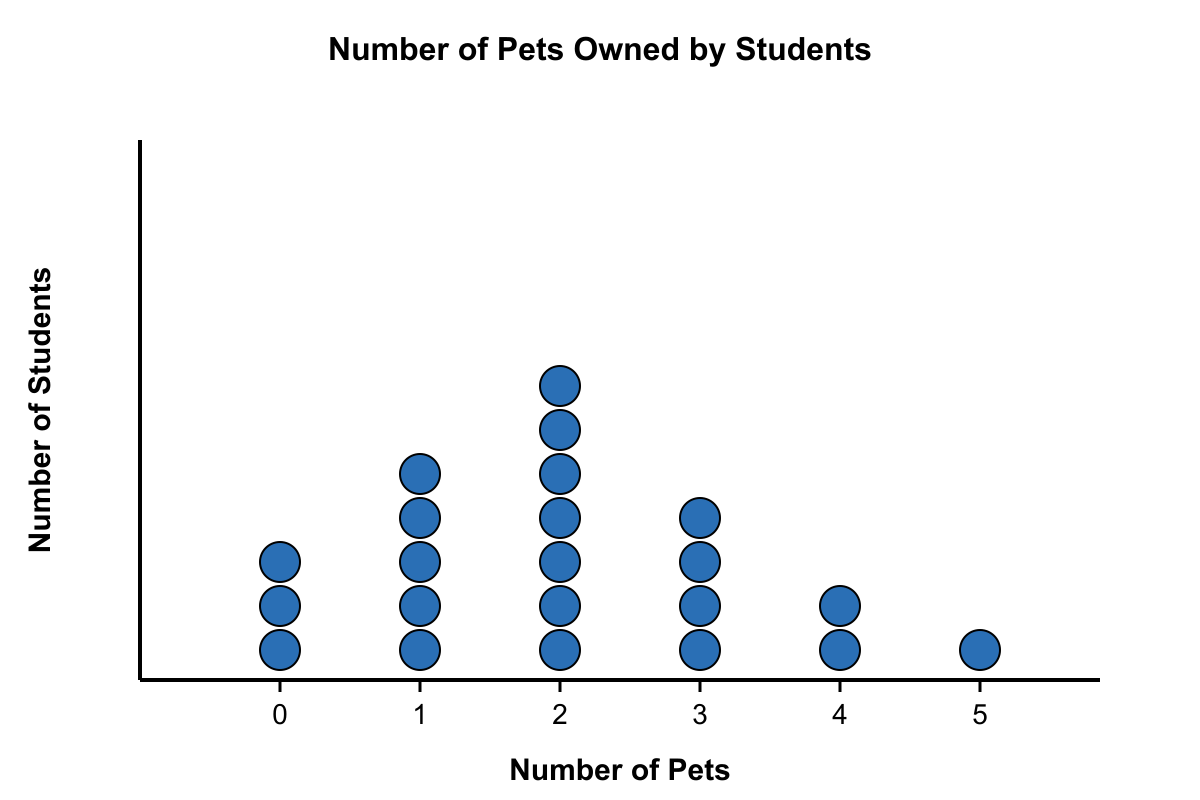
The dot plot shows the number of pets owned by students in Mr. Thompson's class. What is the mode of this data set?
The mode is 2 pets because it appears most frequently
There is no mode because multiple values appear equally often
The mode is 3 pets because it appears most frequently
The mode is 1 pet because it appears most frequently
Explanation
Counting the dots: 0 pets (3 dots), 1 pet (5 dots), 2 pets (7 dots), 3 pets (4 dots), 4 pets (2 dots), 5 pets (1 dot). The value 2 pets appears 7 times, which is more frequent than any other value. Choice A incorrectly identifies 1 pet (5 occurrences). Choice C incorrectly identifies 3 pets (4 occurrences). Choice D is incorrect since there is a clear single mode.
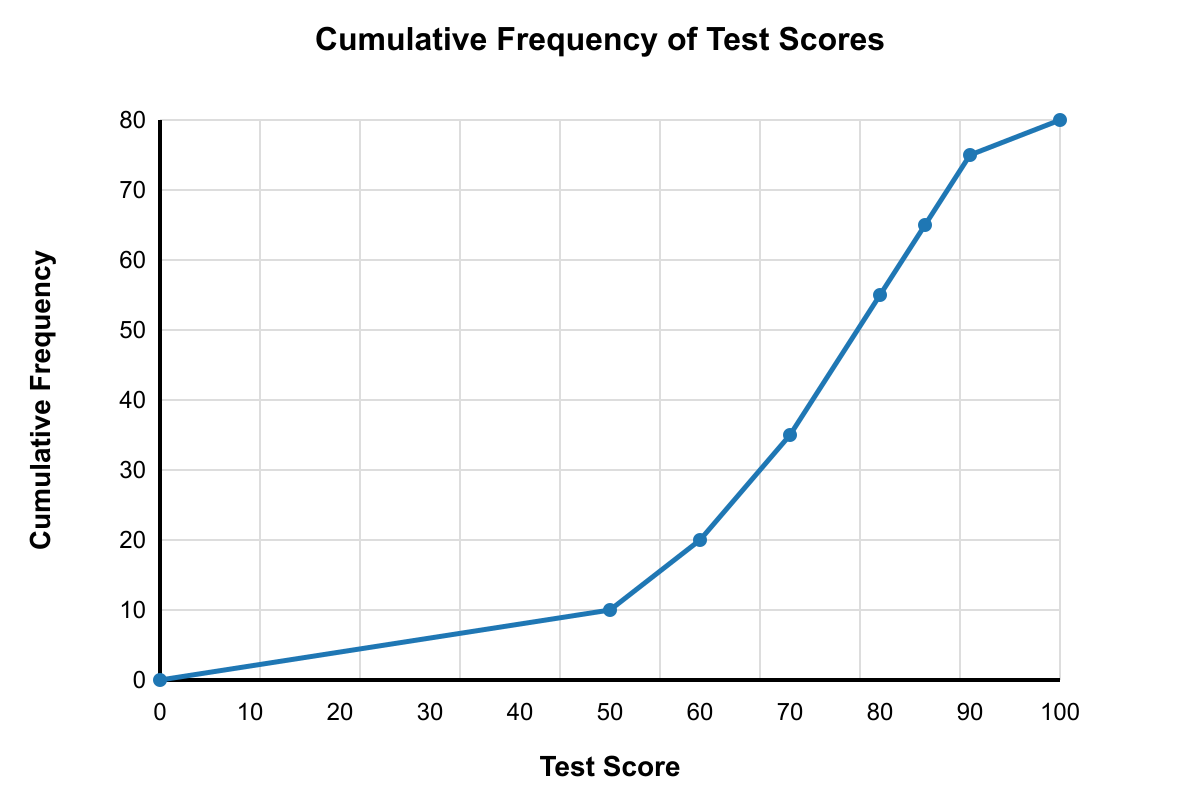
The cumulative frequency graph shows the distribution of test scores for 80 students. How many students scored between 70 and 85 points?
35 students scored between 70 and 85 points
25 students scored between 70 and 85 points
30 students scored between 70 and 85 points
20 students scored between 70 and 85 points
Explanation
From the cumulative frequency graph: at score 85, cumulative frequency is 65; at score 70, cumulative frequency is 35. Students scoring between 70 and 85 = 65 - 35 = 30 students. Choice A (20) would be the difference between other points. Choice B (25) might result from misreading the graph values. Choice D (35) is the cumulative frequency at 70, not the difference.
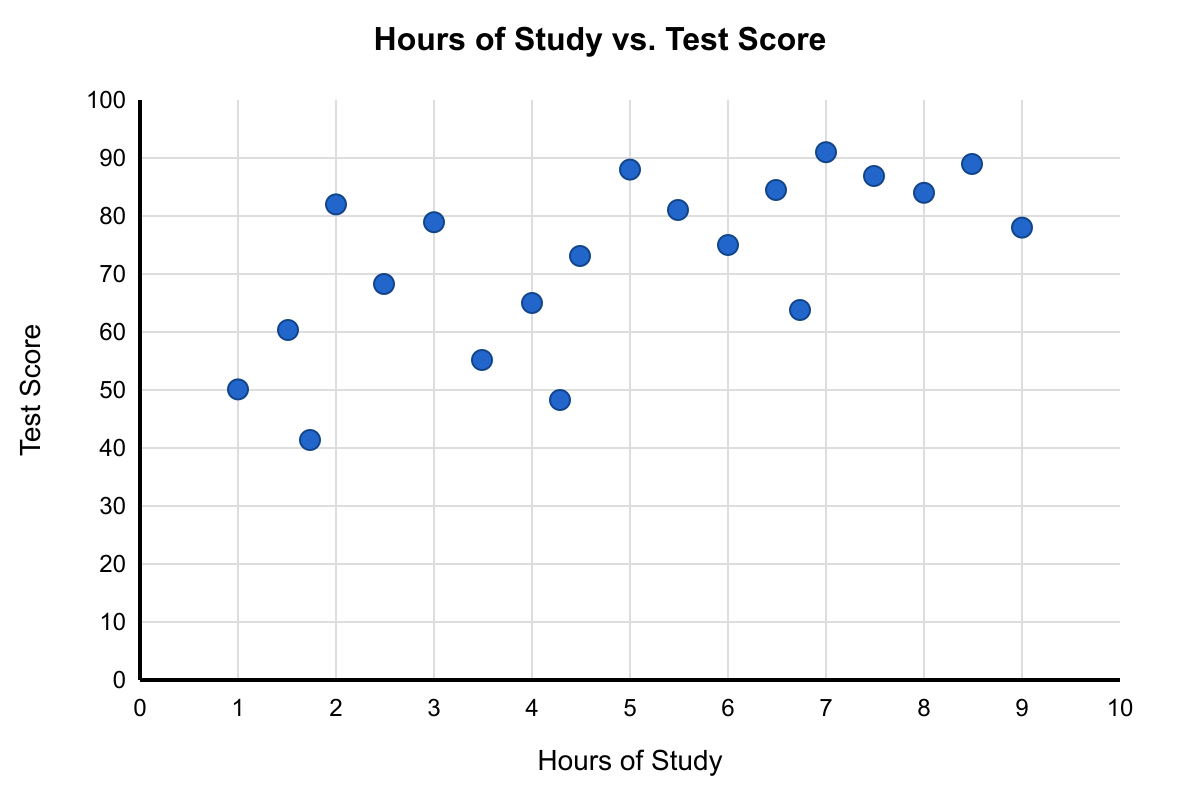
The scatter plot displays the relationship between hours of study time and test scores for 20 students. Which conclusion is best supported by the data?
The correlation coefficient is approximately -0.7, indicating strong negative correlation
There is a moderate positive relationship, but some students score well with minimal study time
The relationship is perfectly linear with no variation around the trend line
Studying for more than 8 hours guarantees a test score above 85
Explanation
The scatter plot shows a general upward trend (positive correlation) between study hours and test scores, but with notable scatter around the trend line. Some students achieve high scores (80+) with only 2-3 hours of study. Choice A is incorrect because one student studied 9 hours but scored only 78. Choice B is wrong because the correlation is positive, not negative. Choice D is incorrect because there is considerable variation around any potential trend line.
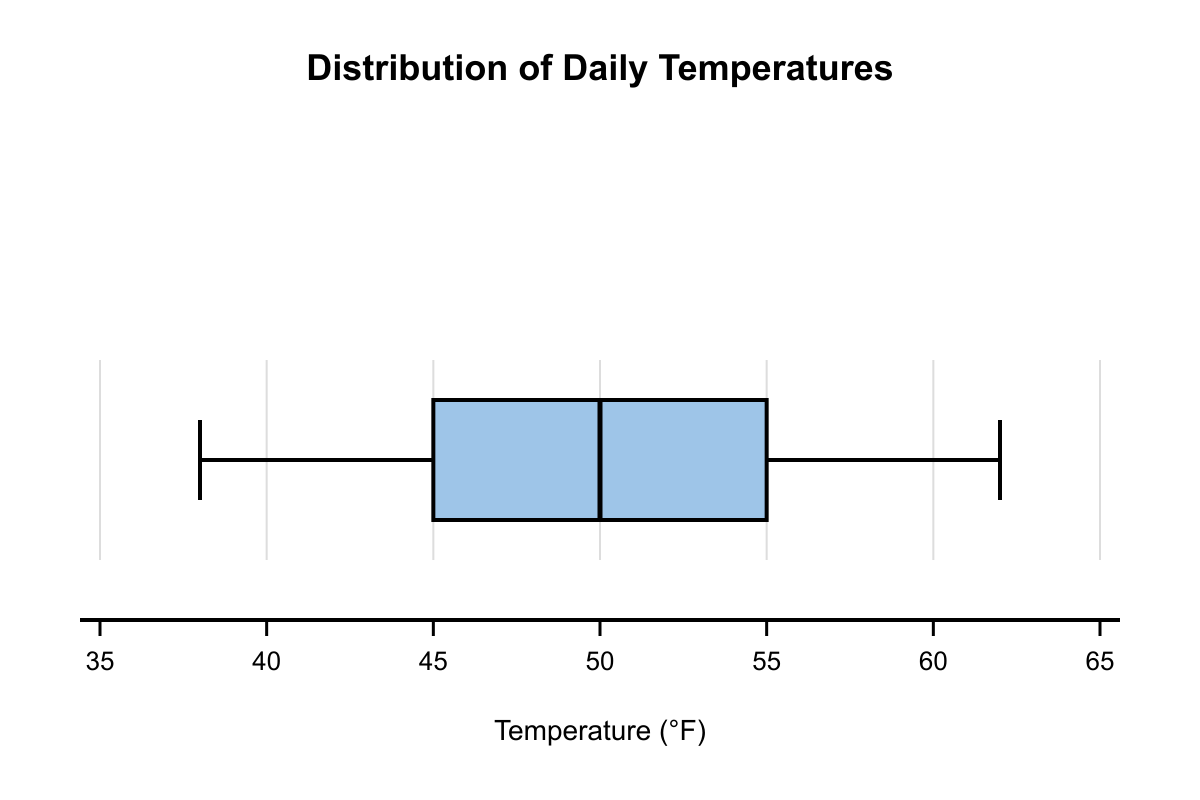
The box plot shown represents the distribution of daily temperatures (in °F) for a city during March. Based on this plot, approximately what percentage of days had temperatures between 45°F and 55°F?
25% of the days had temperatures in this range
75% of the days had temperatures in this range
50% of the days had temperatures in this range
Cannot be determined from the box plot alone
Explanation
Box plots show the five-number summary (minimum, Q1, median, Q3, maximum) but do not provide information about the distribution of data within the quartiles. We can see that Q1 is at 45°F and Q3 is at 55°F, meaning 50% of data falls between these values, but we cannot determine what percentage falls in any subinterval without knowing the actual data distribution within the interquartile range.
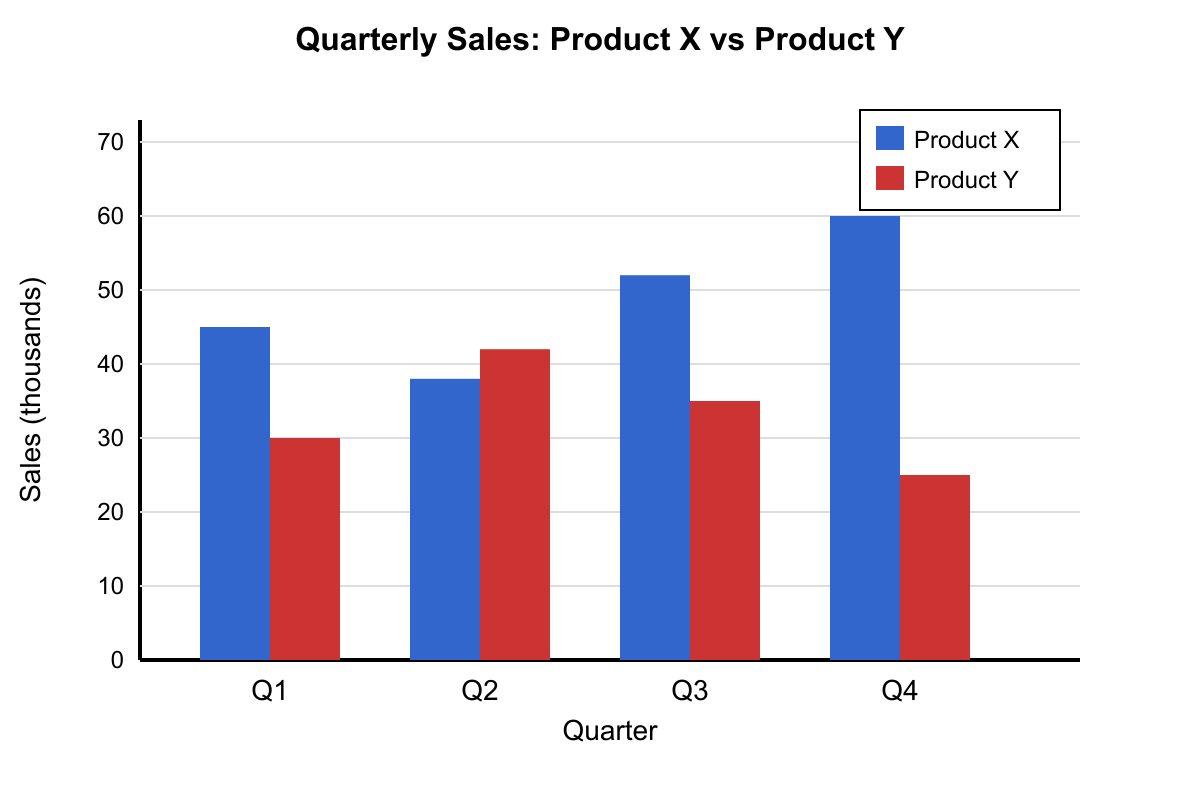
The bar chart displays quarterly sales data for two products over one year. In which quarter was the difference between Product X and Product Y sales the greatest?
Quarter 1 had the greatest difference in sales between products
Quarter 3 had the greatest difference in sales between products
Quarter 4 had the greatest difference in sales between products
Quarter 2 had the greatest difference in sales between products
Explanation
Calculating differences: Q1: |45-30| = 15, Q2: |38-42| = 4, Q3: |52-35| = 17, Q4: |60-25| = 35. Quarter 4 has the largest difference of 35 units. Choice A (Q1) has difference of 15. Choice B (Q2) has the smallest difference of 4. Choice C (Q3) has difference of 17.
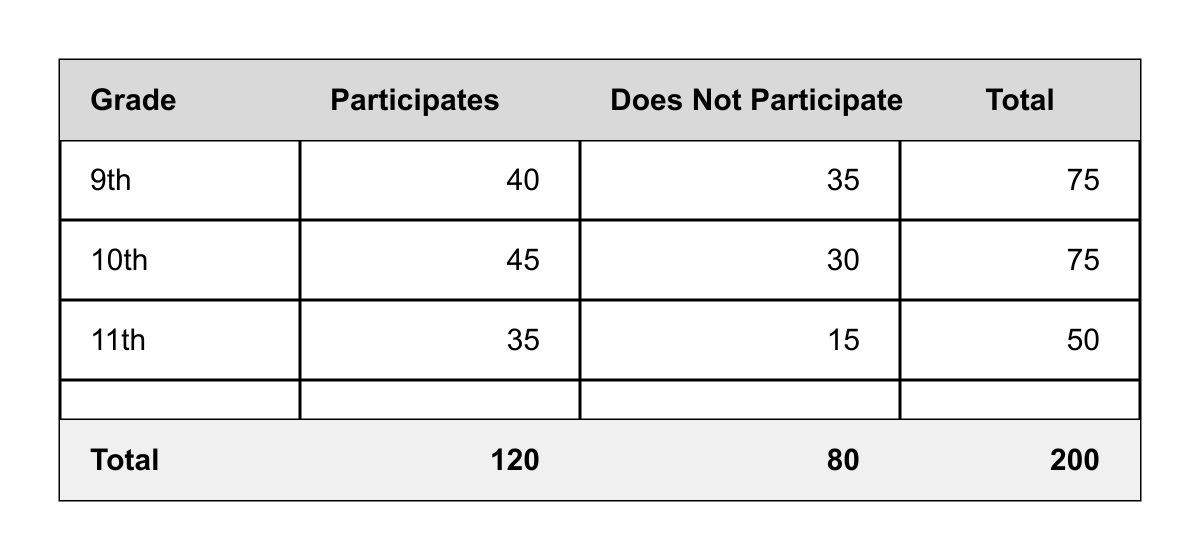
The two-way table shows the relationship between grade level and participation in extracurricular activities. What is the probability that a randomly selected 10th grader participates in extracurricular activities?
The probability is $$\frac{30}{75}$$ for a 10th grader to participate
The probability is $$\frac{45}{200}$$ for a 10th grader to participate
The probability is $$\frac{45}{120}$$ for a 10th grader to participate
The probability is $$\frac{45}{75}$$ for a 10th grader to participate
Explanation
Among 10th graders, 45 participate in activities out of 75 total 10th graders. The probability is 45/75 = 3/5. Choice A uses total participants (120) instead of total 10th graders. Choice C uses non-participants (30) as numerator. Choice D uses the total student population (200) as denominator.
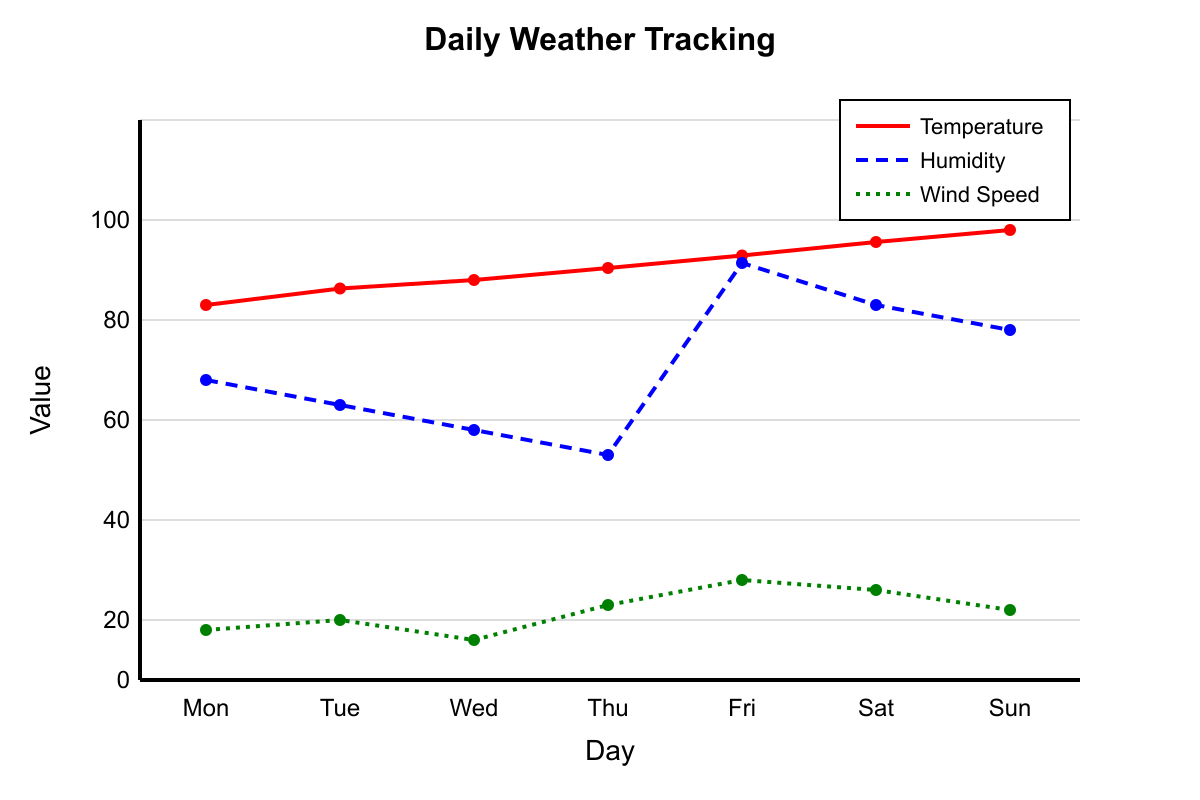
The multiple line graph tracks the daily temperature, humidity, and wind speed for one week. On which day was the difference between temperature and humidity the smallest?
Sunday had the smallest difference between temperature and humidity
Friday had the smallest difference between temperature and humidity
Wednesday had the smallest difference between temperature and humidity
Monday had the smallest difference between temperature and humidity
Explanation
Calculating differences (Temperature - Humidity): Monday: 75-60=15, Tuesday: 78-55=23, Wednesday: 80-50=30, Thursday: 82-45=37, Friday: 85-82=3, Saturday: 88-75=13, Sunday: 90-70=20. Friday has the smallest difference at 3 units. Choice A (Monday) has difference of 15. Choice B (Wednesday) has difference of 30. Choice D (Sunday) has difference of 20.
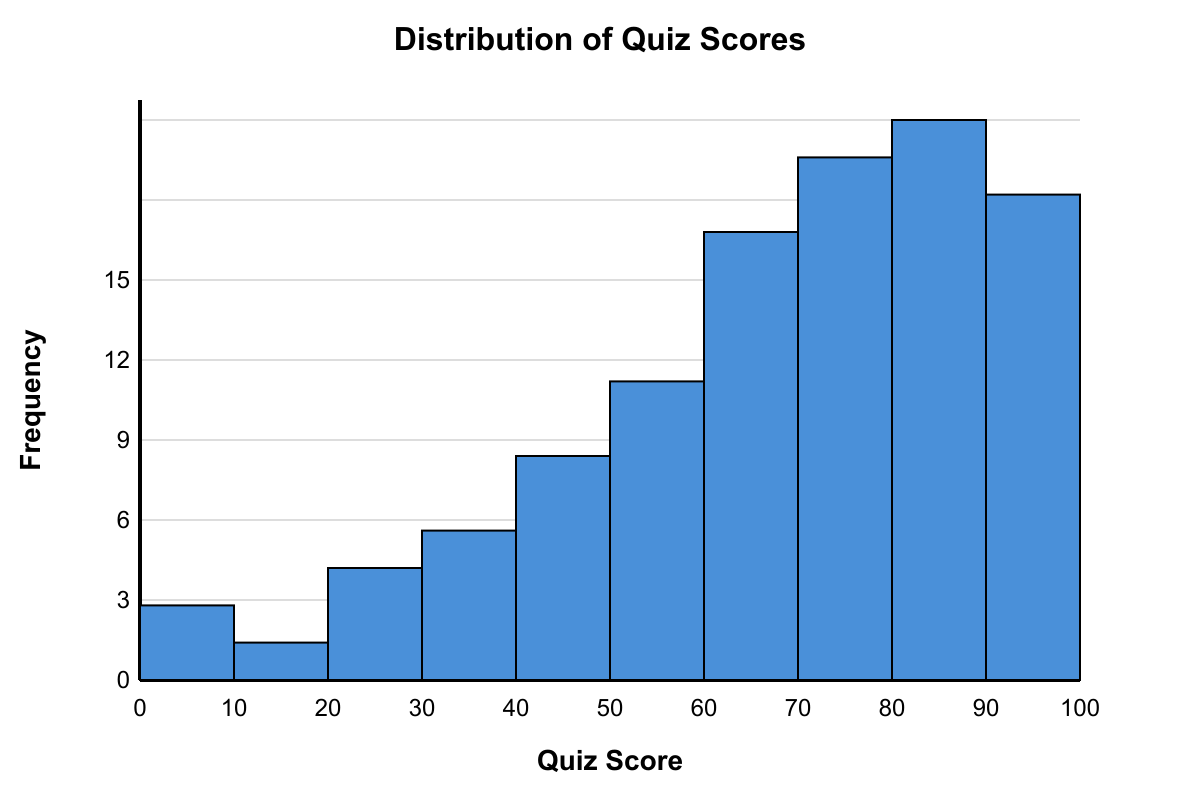
The histogram displays the distribution of quiz scores for a statistics class. Based on the shape of the distribution, which measure of central tendency would be most appropriate to report?
The mean would be most appropriate because the distribution is symmetric
The median would be most appropriate because the distribution is skewed right
The mode would be most appropriate because it shows the most common score
The median would be most appropriate because the distribution is skewed left
Explanation
The histogram shows higher frequencies on the right side (higher scores) with a tail extending to the left (lower scores), indicating left skew. When data is skewed, the median is more appropriate than the mean because it's less affected by extreme values. Choice A is incorrect because the distribution is not symmetric. Choice C incorrectly identifies the skew direction. Choice D is incorrect because mode is rarely the most appropriate single measure of central tendency.
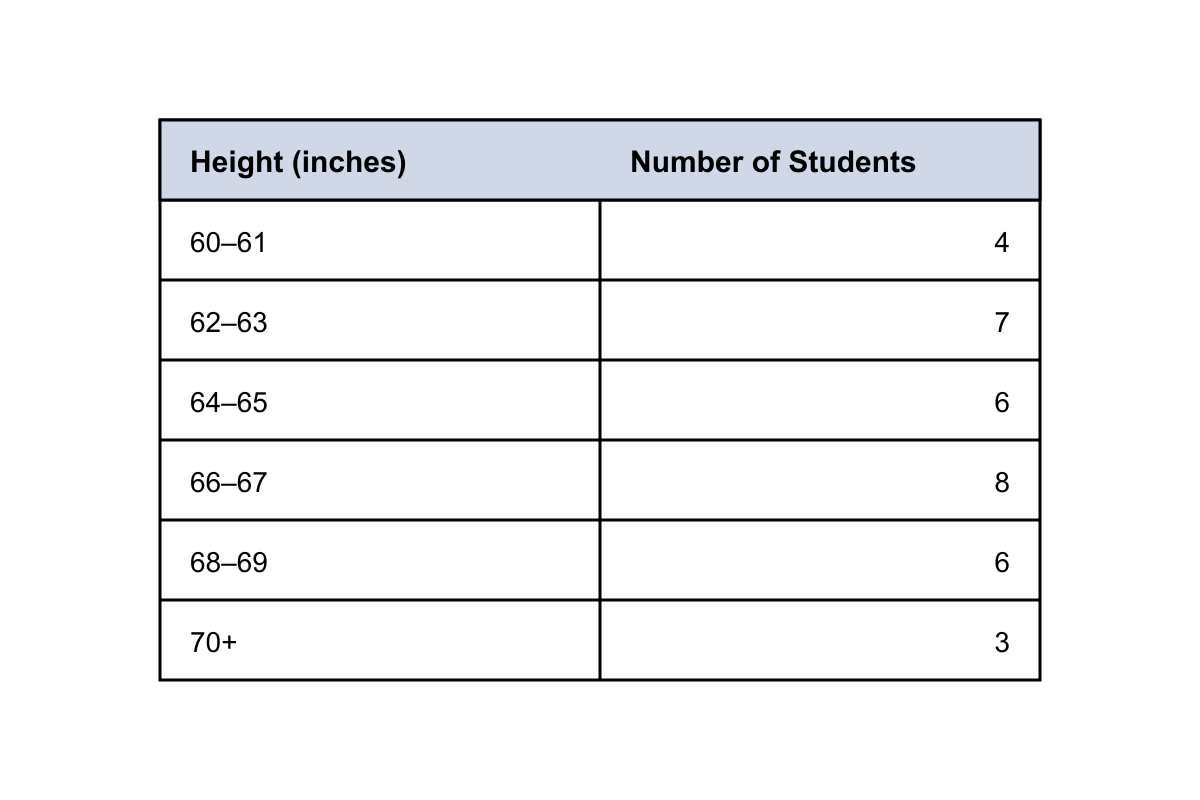
The frequency table shows the distribution of student heights in a physical education class. What percentage of students are 66 inches or taller?
Approximately 57% of students are 66 inches or taller
Approximately 47% of students are 66 inches or taller
Approximately 53% of students are 66 inches or taller
Approximately 43% of students are 66 inches or taller
Explanation
Students 66 inches or taller: 66-67 inches (8 students) + 68-69 inches (6 students) + 70+ inches (3 students) = 17 students. Total students: 4 + 7 + 6 + 8 + 6 + 3 = 34 students. Percentage: 17/34 = 0.47 = 47%. Choice A uses 15/34. Choice C uses 18/34. Choice D uses 19/34.
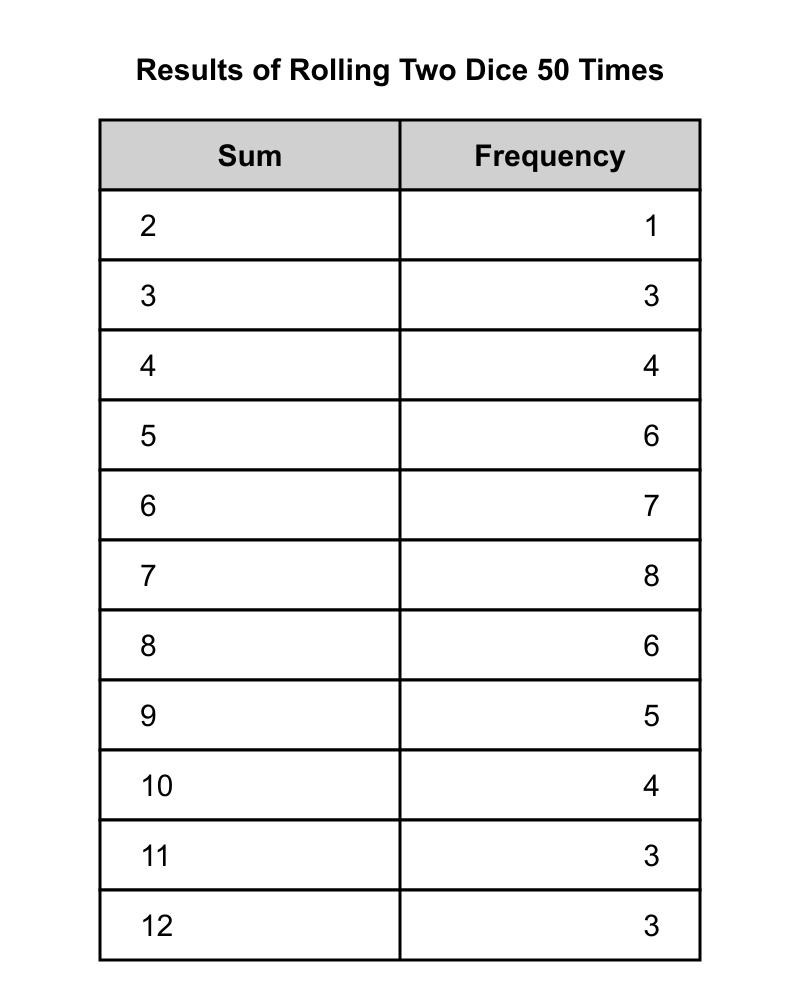
The table shows the results of rolling two dice 50 times and recording the sum. Based on this experimental data, what is the experimental probability of rolling a sum of 7?
The experimental probability of rolling a sum of 7 is $$\frac{8}{50}$$
The experimental probability of rolling a sum of 7 is $$\frac{1}{6}$$ based on theoretical calculations
The experimental probability of rolling a sum of 7 is $$\frac{6}{36}$$ from the sample space
The experimental probability of rolling a sum of 7 is $$\frac{9}{50}$$
Explanation
From the frequency table, a sum of 7 occurred 8 times out of 50 rolls. Experimental probability = 8/50 = 4/25. Choice B uses an incorrect frequency count. Choice C gives the theoretical probability (1/6 ≈ 0.167), not experimental. Choice D gives the theoretical probability in unreduced form (6/36 = 1/6), not experimental.