Plane Geometry
Help Questions
ISEE Upper Level: Quantitative Reasoning › Plane Geometry
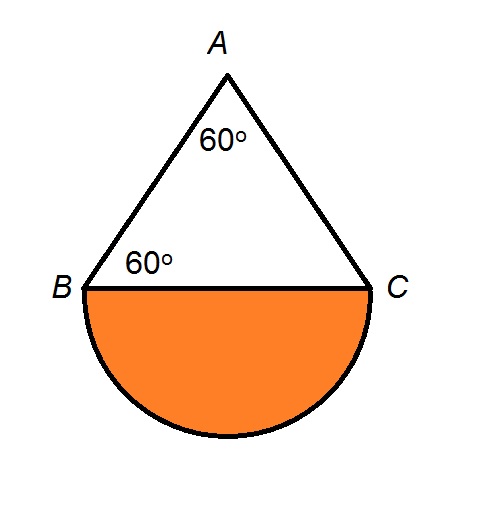
Refer to the above figure. The shaded region is a semicircle with area 


Explanation
Given the radius 

Substituting 

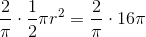


The diameter of this semicircle is twice this, which is 



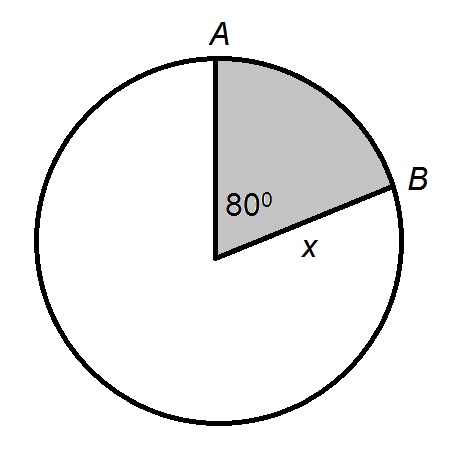
Give the area of the white region of the above circle if 


Explanation
If we let 


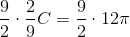

The radius is the circumference divided by 

Use the formula to find the area of the entire circle:

The area of the white region is 
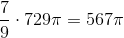
Sector TYP occupies 43% of a circle. Find the degree measure of angle TYP.


Explanation
Sector TYP occupies 43% of a circle. Find the degree measure of angle TYP.
Use the following formula and solve for x:
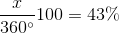
Begin by dividing over the 100

Then multiply by 360

Sector SOW has a central angle of 


Explanation
Sector SOW has a central angle of 
Recall that there is a total of 360 degrees in a circle. SOW occupies 45 of them. To find the percentage, simply do the following:

A square is made into a rectangle by increasing the width by 20% and decreasing the length by 20%. By what percentage has the area of the square changed?
decreased by 4%
increased by 20%
the area remains the same
decreased by 10%
Explanation
The area decreases by 20% of 20%, which is 4%.
The easiest way to see this is to plug in numbers for the sides of the square. If we are using percentages, it is easiest to use factors of 10 or 100. In this case we will say that the square has a side length of 10.
10% of 10 is 1, so 20% is 2. Now we can just increase one of the sides by 2, and decrease another side by 2. So our rectangle has dimensions of 12 x 8 instead of 10 x 10.
The original square had an area of 100, and the new rectangle has an area of 96. So the rectangle is 4 square units smaller, which is 4% smaller than the original square.
Three of the vertices of a parallelogram on the coordinate plane are 

Insufficient information is given to answer the problem.


Explanation
As can be seen in the diagram, there are three possible locations of the fourth point of the parallelogram:
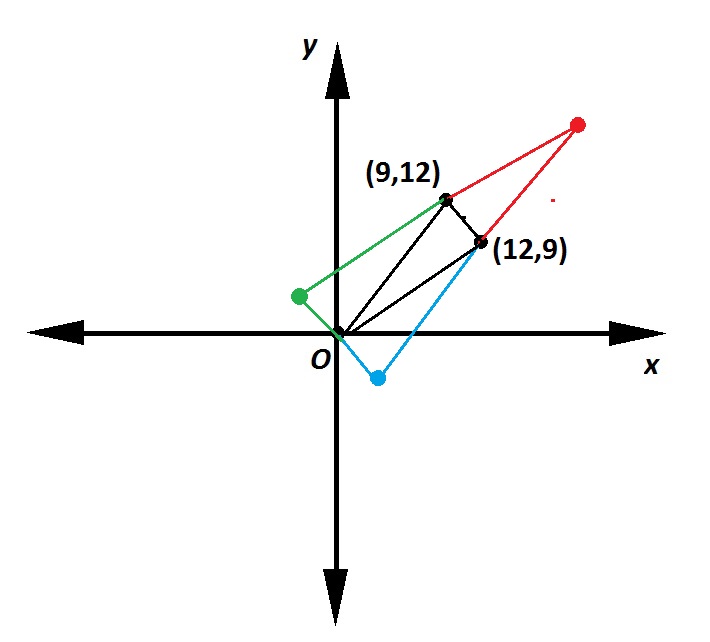
Regardless of the location of the fourth point, however, the triangle with the given three vertices comprises exactly half the parallelogram. Therefore, the parallelogram has double that of the triangle.
The area of the triangle can be computed by noting that the triangle is actually a part of a 12-by-12 square with three additional right triangles cut out:
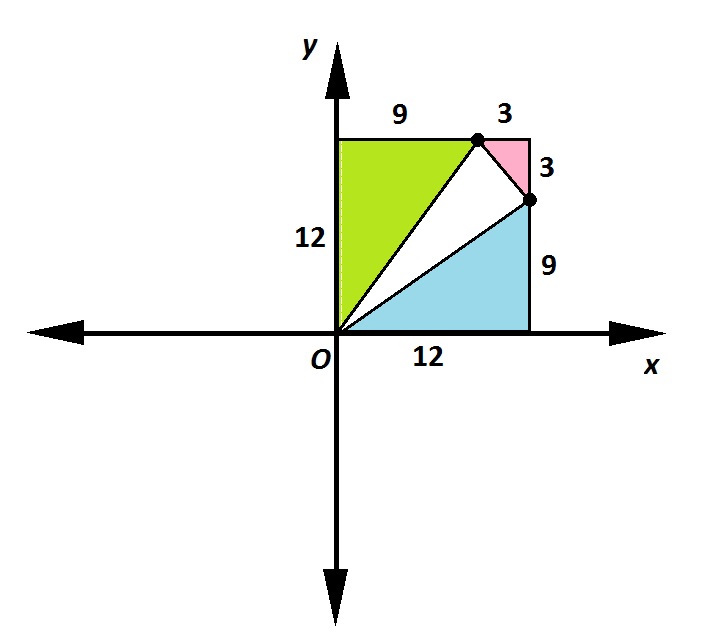
The area of the 12 by 12 square is

The area of the green triangle is 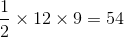
The area of the blue triangle is 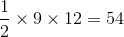
The area of the pink triangle is 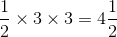
The area of the main triangle is therefore

The parallelogram has area twice this, or 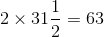
Refer to the above figure. The shaded region is a semicircle with area
Explanation
Given the radius
Substituting
The diameter of this semicircle is twice this, which is
Your new friend has a very small, square-shaped dorm room. She tells you that it is only 225 square feet. Assuming this is true, what is the length of one side of her room?


Explanation
Your new friend has a very small, square-shaped dorm room. She tells you that it is only 225 square feet. Assuming this is true, what is the length of one side of her room?
Let's begin with our formula for the area of a square:

where s is our side length and A is our area.
With this formula, we can solve for our side length by plugging in our area and square rooting both sides.


Refer to the above figure. The shaded region is a semicircle with area
Explanation
Given the radius
Substituting
The diameter of this semicircle is twice this, which is
Find the perimeter of a pentagon with a side of length 12in.


Explanation
To find the perimeter of a pentagon, we will use the following formula:

where a is the length of one side of the pentagon.
Now, we know the length of one side of the pentagon is 12in.
Knowing this, we can substitute into the formula. We get

