Area and Perimeter
Help Questions
ISEE Upper Level: Mathematics Achievement › Area and Perimeter
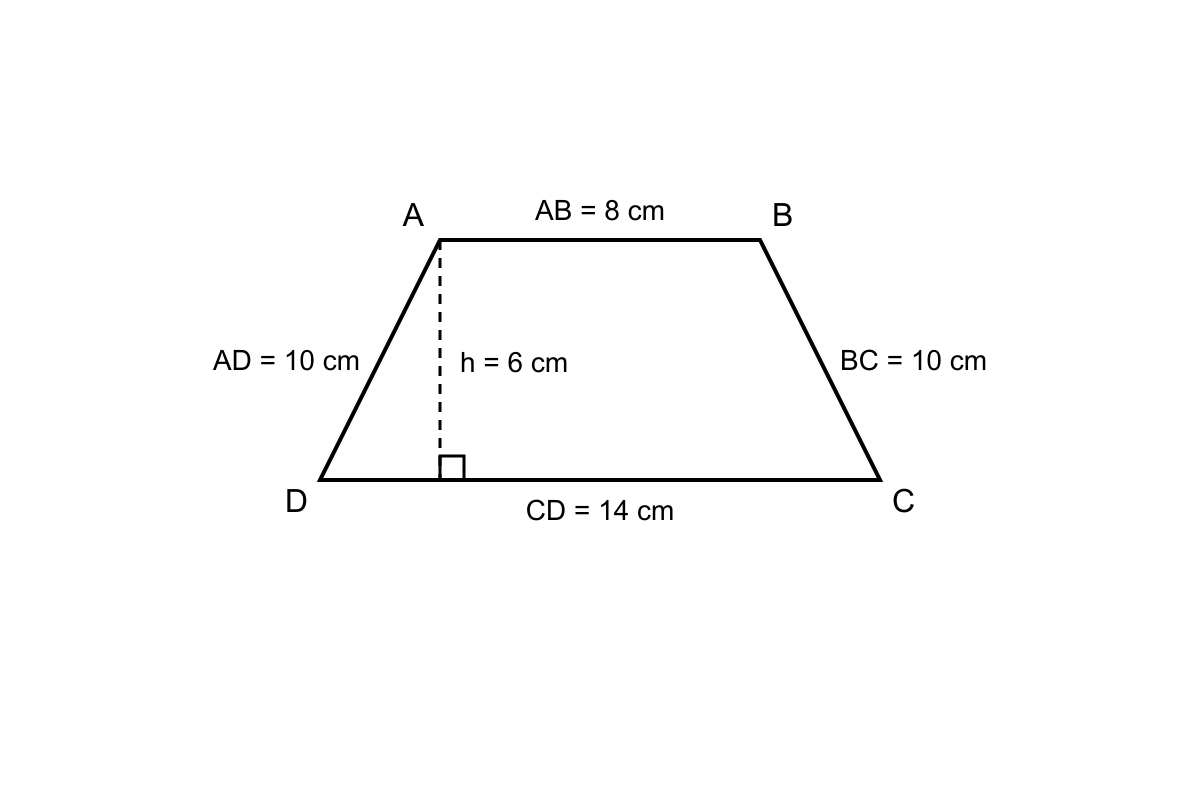
The figure shows a trapezoid ABCD with parallel sides AB and CD. If AB = 8 cm, CD = 14 cm, and the height is 6 cm, what is the perimeter of the trapezoid if the two non-parallel sides each have length 10 cm?
42 cm
52 cm
46 cm
38 cm
Explanation
The perimeter of a trapezoid is the sum of all four sides. We have AB = 8 cm, CD = 14 cm, and both non-parallel sides are 10 cm each. Therefore, perimeter = 8 + 14 + 10 + 10 = 42 cm. The height is given but not needed for perimeter calculation. Choice A omits one side, choice C adds extra length, and choice D incorrectly uses the height in the calculation.
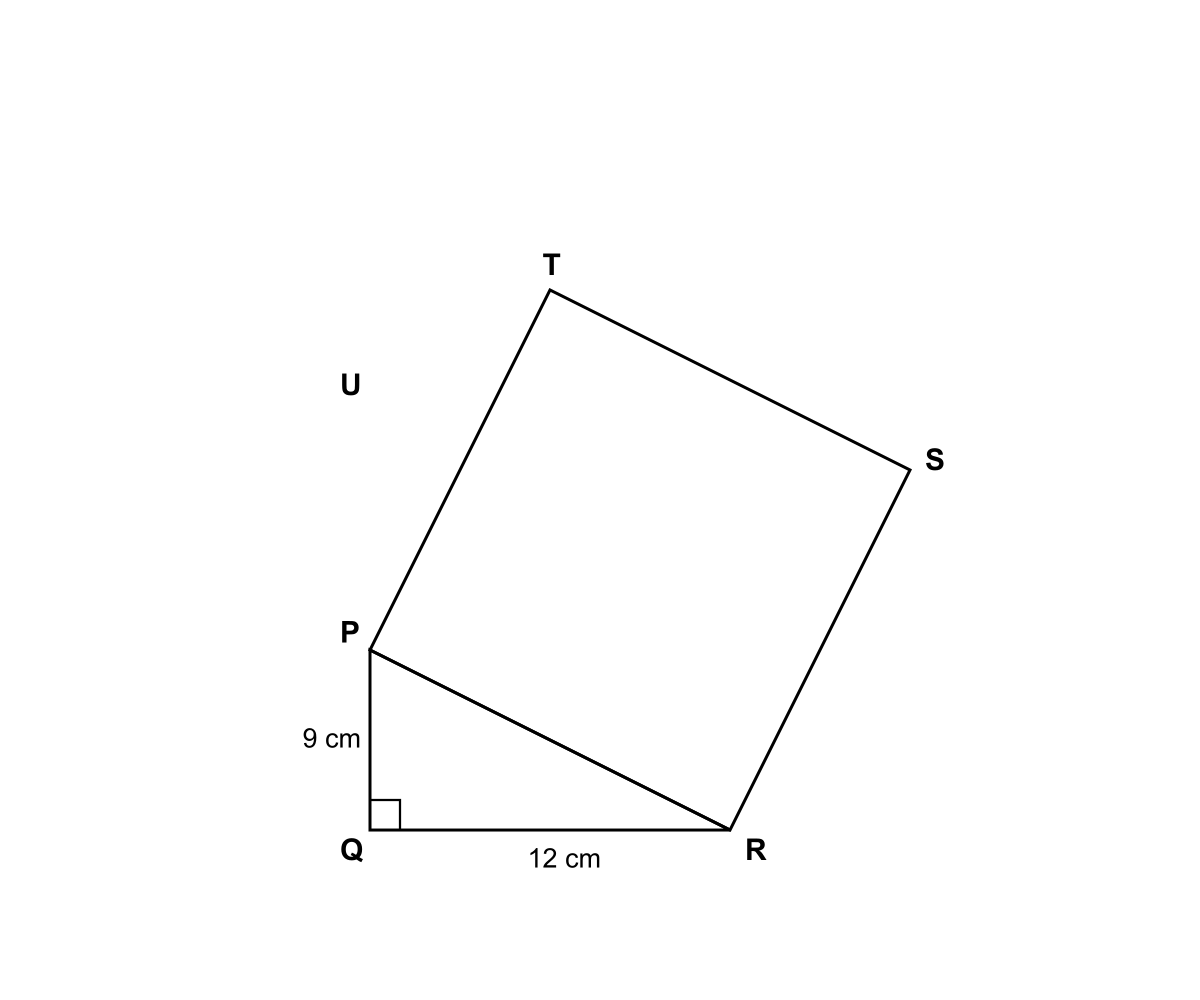
In the figure, triangle PQR is a right triangle with the right angle at Q. If PQ = 9 cm and QR = 12 cm, and square QSTU is constructed on the hypotenuse PR, what is the area of square QSTU?
$$144$$ square cm
$$324$$ square cm
$$400$$ square cm
$$225$$ square cm
Explanation
First, find the hypotenuse PR using the Pythagorean theorem: PR = √(PQ² + QR²) = √(9² + 12²) = √(81 + 144) = √225 = 15 cm. The area of square QSTU with side length 15 cm is 15² = 225 square cm. Choice A uses 12², choice C uses 18², and choice D uses 20².
Triangle ABC has vertices at A(2, 3), B(6, 3), and C(4, 7). What is the area of triangle ABC?
8 square units
6 square units
10 square units
12 square units
Explanation
When you need to find the area of a triangle given coordinates, you have several approaches. The most efficient here is to use the coordinate formula or recognize that you can work with base and height directly.
First, let's plot the points: A(2, 3), B(6, 3), and C(4, 7). Notice that points A and B both have the same y-coordinate (3), meaning they lie on a horizontal line. This gives us a convenient base AB with length $$|6 - 2| = 4$$ units.
For the height, we need the perpendicular distance from C(4, 7) to line AB. Since AB is horizontal at y = 3, the height is simply the vertical distance: $$|7 - 3| = 4$$ units.
Using the formula Area = $$\frac{1}{2} \times \text{base} \times \text{height}$$: Area = $$\frac{1}{2} \times 4 \times 4 = 8$$ square units.
Looking at the wrong answers: (A) 6 likely comes from miscalculating the base or height as 3 instead of 4. (C) 10 might result from forgetting to divide by 2 in the area formula, getting $$4 + 4 + 2 = 10$$ through some confused calculation. (D) 12 comes from calculating $$4 \times 4 = 16$$ but making an error, or possibly $$\frac{1}{2} \times 6 \times 4$$ if you miscalculated the base.
Study tip: When you see coordinate geometry problems involving triangles, first check if any two points share the same x- or y-coordinate—this often creates a convenient base for area calculations and avoids more complex formulas.
A rhombus has diagonals of lengths 16 cm and 12 cm. What is the perimeter of the rhombus?
40 cm
28 cm
80 cm
56 cm
Explanation
When you encounter a rhombus problem involving diagonals, remember that a rhombus is a special parallelogram where all sides are equal length. The key insight is that the diagonals of a rhombus are perpendicular and bisect each other, creating four congruent right triangles.
To find the perimeter, you need the length of one side, then multiply by 4. Each diagonal is split in half at the intersection point, so you have segments of 8 cm and 6 cm forming the legs of a right triangle. The hypotenuse of this triangle is one side of the rhombus.
Using the Pythagorean theorem: $$\text{side}^2 = 8^2 + 6^2 = 64 + 36 = 100$$
Therefore, each side is $$\sqrt{100} = 10$$ cm, and the perimeter is $$4 \times 10 = 40$$ cm.
Looking at the wrong answers: Choice A (28 cm) is the sum of the diagonal lengths, which is a common trap—you can't just add the diagonals to find perimeter. Choice C (56 cm) appears to come from incorrectly calculating $$4 \times 14$$, possibly from adding the half-diagonals (8 + 6 = 14) instead of using the Pythagorean theorem. Choice D (80 cm) doubles the correct answer, suggesting a calculation error where someone might have found the correct side length but then multiplied by 8 instead of 4.
Study tip: Always remember that rhombus diagonal problems require the Pythagorean theorem. The diagonals create right triangles, and you need the hypotenuse (the side) to find perimeter.
A circular sector has a central angle of 120° and a radius of 9 cm. What is the perimeter of the sector?
$$(9 + 6\pi)$$ cm
$$(9 + 3\pi)$$ cm
$$(18 + 6\pi)$$ cm
$$(18 + 3\pi)$$ cm
Explanation
When you encounter a sector perimeter problem, remember that a sector's perimeter consists of two radii plus the arc length. Think of it like a slice of pie - you need the two straight edges (radii) plus the curved edge (arc).
To find the arc length, use the formula: $$\text{arc length} = \frac{\theta}{360°} \times 2\pi r$$, where $$\theta$$ is the central angle and $$r$$ is the radius.
With a 120° central angle and radius of 9 cm:
- Arc length = $$\frac{120°}{360°} \times 2\pi \times 9 = \frac{1}{3} \times 18\pi = 6\pi$$ cm
- Two radii = $$9 + 9 = 18$$ cm
- Total perimeter = $$18 + 6\pi$$ cm
This confirms answer A is correct.
Answer B $$(18 + 3\pi)$$ uses the correct radii sum but incorrectly calculates the arc length as $$3\pi$$ instead of $$6\pi$$ - likely from forgetting to multiply by the full $$2\pi r$$ in the arc formula.
Answer C $$(9 + 6\pi)$$ gets the arc length right but only includes one radius instead of two, missing that the perimeter needs both straight edges of the sector.
Answer D $$(9 + 3\pi)$$ combines both errors: using only one radius and calculating the wrong arc length.
Study tip: Always visualize the sector as having three parts in its perimeter: radius + radius + arc. Set up your calculation systematically by finding each component separately, then adding them together.
A trapezoid has parallel sides of lengths 15 cm and 25 cm. If the area of the trapezoid is 160 square cm, what is the height?
10 cm
8 cm
4 cm
6 cm
Explanation
When you encounter a trapezoid area problem, you're working with the formula that relates the parallel sides (called bases) and the height. The area formula for a trapezoid is $$A = \frac{1}{2}(b_1 + b_2)h$$, where $b_1$ and $b_2$ are the lengths of the parallel sides and $h$ is the height.
Given that the parallel sides are 15 cm and 25 cm, and the area is 160 square cm, you can substitute these values: $$160 = \frac{1}{2}(15 + 25)h$$. Simplifying the sum of the bases: $$160 = \frac{1}{2}(40)h = 20h$$. Solving for height: $$h = \frac{160}{20} = 8$$ cm.
Looking at the wrong answers: Choice A (4 cm) would give you an area of only 80 square cm, exactly half of what's needed. Choice B (6 cm) yields 120 square cm, which falls short by 40 square cm. Choice D (10 cm) produces 200 square cm, overshooting the target by 40 square cm. These incorrect values likely result from computational errors in the algebraic manipulation.
The correct answer is C (8 cm).
For trapezoid problems, always write out the area formula first, then substitute your known values systematically. Double-check your arithmetic by plugging your answer back into the original formula—this catches calculation mistakes that are common on timed exams. Remember that the height is always perpendicular to the parallel sides, not along a slanted edge.
A regular pentagon has a side length of 8 cm. If the apothem (distance from center to middle of a side) is 5.5 cm, what is the area of the pentagon?
$$264$$ square cm
$$220$$ square cm
$$132$$ square cm
$$110$$ square cm
Explanation
When you encounter polygon area problems, remember that regular polygons can be broken down into triangular sections radiating from the center. The apothem is crucial because it represents the height of each of these triangles.
For any regular polygon, the area formula is: $$\text{Area} = \frac{1}{2} \times \text{perimeter} \times \text{apothem}$$
First, find the perimeter of the pentagon. Since it's regular with 5 equal sides of 8 cm each: perimeter = $$5 \times 8 = 40$$ cm.
Now apply the formula: $$\text{Area} = \frac{1}{2} \times 40 \times 5.5 = 20 \times 5.5 = 110$$ square cm.
Answer A ($$110$$ square cm) is correct.
Answer B ($$132$$ square cm) likely comes from incorrectly using the full side length as height in some triangular calculation, perhaps $$\frac{1}{2} \times 40 \times 6.6$$.
Answer C ($$220$$ square cm) represents a common error: forgetting the $$\frac{1}{2}$$ in the area formula and calculating $$40 \times 5.5 = 220$$.
Answer D ($$264$$ square cm) might result from misunderstanding the apothem concept and using an incorrect measurement or formula altogether.
The key insight is recognizing that the apothem serves as the "height" when you think of the polygon as triangular sections. Always remember the polygon area formula includes the factor of $$\frac{1}{2}$$, just like the triangle area formula it's derived from.
A kite-shaped quadrilateral has diagonals that intersect at right angles. One diagonal has length 12 cm and the other has length 16 cm. What is the area of the kite?
$$48$$ square cm
$$96$$ square cm
$$144$$ square cm
$$192$$ square cm
Explanation
When you encounter a kite problem involving diagonals, remember that kites have a special property: their diagonals are perpendicular (meet at right angles). This makes finding the area straightforward using the formula for any quadrilateral with perpendicular diagonals.
For any quadrilateral with perpendicular diagonals, the area equals $$\frac{1}{2} \times d_1 \times d_2$$, where $$d_1$$ and $$d_2$$ are the lengths of the diagonals. This formula works because perpendicular diagonals divide the quadrilateral into four right triangles, and this calculation effectively finds the total area of all four triangles.
With diagonals of 12 cm and 16 cm, the area is $$\frac{1}{2} \times 12 \times 16 = \frac{1}{2} \times 192 = 96$$ square cm.
Looking at the wrong answers: Choice A (48) represents a common error where students forget the $$\frac{1}{2}$$ in the formula and instead calculate $$\frac{1}{4} \times 12 \times 16$$. Choice C (144) occurs when students mistakenly use $$12 \times 12$$ or confuse this with a square area formula. Choice D (192) happens when students multiply the diagonals directly without the $$\frac{1}{2}$$ factor, treating this like a rectangle formula.
Study tip: Memorize that for any quadrilateral with perpendicular diagonals (kites, rhombuses, squares), the area formula is always $$\frac{1}{2} \times d_1 \times d_2$$. The key word "perpendicular" or "right angles" should immediately trigger this formula in your mind.
If the garden’s circular pond radius doubles, how does the pond’s area change within the composite plan?
It doubles: $A' = 2A$
It triples: $A' = 3A$
It increases by $\pi r$: $A' = A+\pi r$
It quadruples: $A' = 4A$
Explanation
This question tests understanding of how area scales with linear dimensions, specifically for circles. Area of a circle is πr², where r is the radius. When the radius doubles from r to 2r, the new area becomes π(2r)² = π(4r²) = 4πr² = 4A, where A is the original area. This demonstrates that area scales with the square of linear dimensions. Common misconceptions include thinking area doubles when radius doubles (choice A), confusing with perimeter which does double (related to choice D), or arbitrary scaling (choice B). This quadratic relationship is fundamental in geometry: when all linear dimensions of a shape double, its area quadruples. Students should practice with specific examples to internalize this scaling principle.
An isosceles triangle has a base of 16 cm and equal sides of length 10 cm each. What is the area of the triangle?
$$64$$ square cm
$$96$$ square cm
$$80$$ square cm
$$48$$ square cm
Explanation
When you encounter an isosceles triangle problem, remember that you can use the triangle's line of symmetry to your advantage. An isosceles triangle can be split into two congruent right triangles by drawing a height from the vertex angle perpendicular to the base.
To find the area, you need the base and height. You're given the base (16 cm) and the equal sides (10 cm each), but you need to calculate the height. When you drop a perpendicular from the top vertex to the base, it bisects the base, creating two right triangles. Each right triangle has a hypotenuse of 10 cm and a base of 8 cm (half of 16 cm).
Using the Pythagorean theorem: $$h^2 + 8^2 = 10^2$$, so $$h^2 + 64 = 100$$, which gives $$h^2 = 36$$ and $$h = 6$$ cm.
Now apply the triangle area formula: $$\text{Area} = \frac{1}{2} \times \text{base} \times \text{height} = \frac{1}{2} \times 16 \times 6 = 48$$ square cm.
Looking at the wrong answers: B) 64 likely comes from forgetting to multiply by $$\frac{1}{2}$$ (just $$16 \times 4$$ or similar calculation error). C) 80 might result from using the side length instead of height ($$\frac{1}{2} \times 16 \times 10$$). D) 96 could come from doubling the correct answer or other computational mistakes.
Study tip: For isosceles triangles, always drop a height to the base first—this creates right triangles that make calculations much easier.