Problem-Solving Questions
Help Questions
GMAT Quantitative › Problem-Solving Questions
Sheryl is competing in an archery tournament. She gets to shoot three arrows at a target, and her best one counts.
Sheryl hits the bullseye 42% of the time. What is the probability (two decimal places) that she will hit the bullseye at least once in her three tries?


Explanation
This is most easily solved by finding the probability that she will not hit the bullseye at all in her three tries. If she hits 42% of the time, she misses 58% of the time, and the probability she misses three times will be

The probability of hitting the bullseye at least once in three tries is the complement of this, or 
Given: 


Construct the altitude of 


Explanation


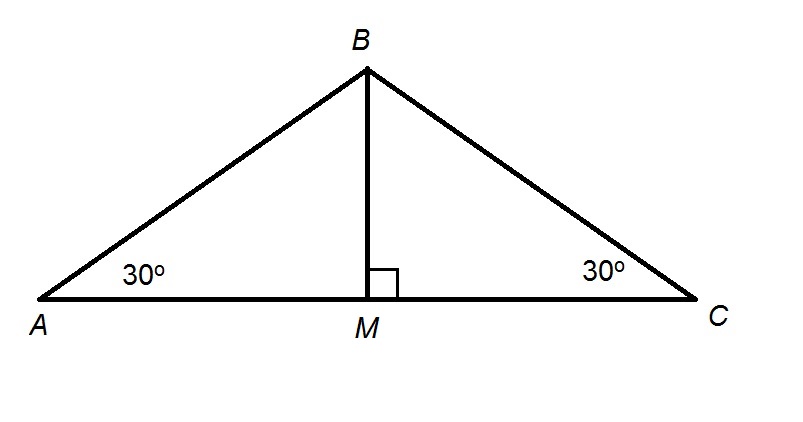
By the Isosceles Triangle Theorem, since 


Also, since 


What is the area of the figure with vertices 


Explanation
This figure can be seen as a composite of two simple shapes: the rectangle with vertices 

The rectangle has length 


The triangle has as its base the length of the horizontal segment connecting 


Add the areas of the rectangle and the triangle to get the total area:

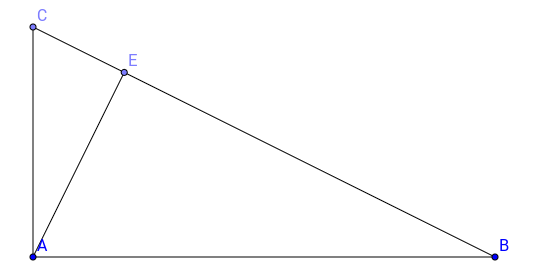
Triangle 



Explanation
The height AE, divides the triangle ABC, in two triangles AEC and AEB with same proportions as the original triangle ABC, this property holds true for any right triangle.
In other words, 
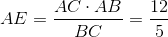
Therefore, we can calculate, the length of AE:
What is the mean of the following data set in terms of 


Explanation
Add the expressions and divide by the number of terms, 8.
The sum of the expressions is:


Divide this by 8:

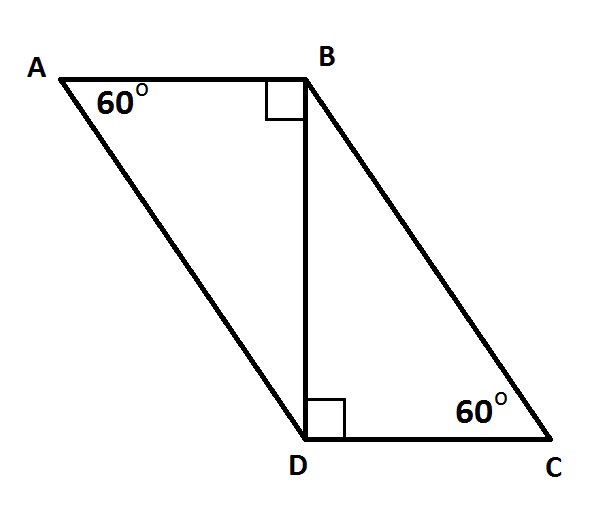
Give the area of the above parallelogram if 


Explanation
Multiply height 

By the 30-60-90 Theorem:


The area is therefore

What is the area of the quadrilateral on the coordinate plane with vertices 


Explanation
The quadrilateral is a parallelogram with two vertical bases, each with length 


Note: Figure NOT drawn to scale.
Refer to the above diagram. Give the area of Quadrilateral 

The correct answer is not among the other choices.


Explanation
Apply the Pythagorean Theorem twice here.


The quadrilateral is a composite of two right triangles, each of whose area is half the product of its legs:
Area of 

Area of 

Add:


The above figure shows a rhombus 


Explanation
Construct the other diagonal of the rhombus, which, along with the first one, form a pair of mutual perpendicular bisectors.

By the Pythagorean Theorem,

The rhombus can be seen as the composite of four congruent right triangles, each with legs 10 and 

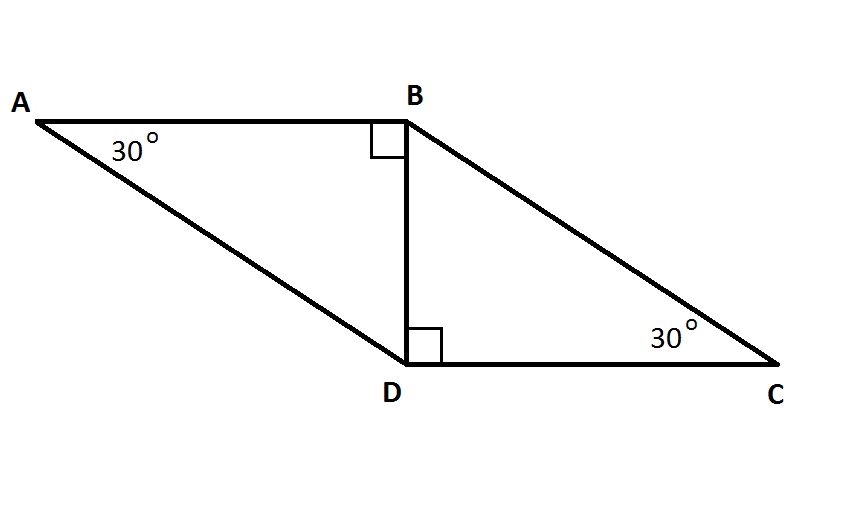
Give the area of the above parallelogram if 


Explanation
Multiply height
By the 30-60-90 Theorem:


The area is therefore
