Subtraction with Fractions - Basic Math
Card 1 of 44
Subtract.

Subtract.
Tap to reveal answer
To subtract two fractions, they need to both share the same denominator. Since 81 is a multiple of 9, we only need to change the 1st fraction.

Now subtract the two fractions.

To subtract two fractions, they need to both share the same denominator. Since 81 is a multiple of 9, we only need to change the 1st fraction.
Now subtract the two fractions.
← Didn't Know|Knew It →

Tap to reveal answer
To subtract fractions, they need to share the same denominator. To find the same denominator, you will need to find the least common multiple of the two given denominators.
The least common denominator of 5 and 7 is 35. Remember, the number you multiply the denominator by to get the least common denominator you must also multiply by the numerator.

So the original equation becomes,

Now, subtract the numerators.

To subtract fractions, they need to share the same denominator. To find the same denominator, you will need to find the least common multiple of the two given denominators.
The least common denominator of 5 and 7 is 35. Remember, the number you multiply the denominator by to get the least common denominator you must also multiply by the numerator.
So the original equation becomes,
Now, subtract the numerators.
← Didn't Know|Knew It →
Please choose the best answer for the question below.
Amanda has  pounds of cake leftover from her birthday. If she eats a third of a pound of cake, how much will she have left over?
Please choose the best answer for the question below.
Amanda has
Tap to reveal answer
To tackle this question, first convert 2 and 3/4ths into a fraction.


Then, you can subtract  from
from  :
:


Then you convert to a mixed number for your final answer.

 .
.
To tackle this question, first convert 2 and 3/4ths into a fraction.
Then, you can subtract
Then you convert to a mixed number for your final answer.
← Didn't Know|Knew It →
Please choose the best answer for the question below.
If you have three pies, and someone eats one quarter of each pie, how much pie do you have left? The answers will be expressed as mixed numbers.
Please choose the best answer for the question below.
If you have three pies, and someone eats one quarter of each pie, how much pie do you have left? The answers will be expressed as mixed numbers.
Tap to reveal answer
To find the answer for this problem, first figure out how much of each pie is left:


Then, because  , you know that you have
  whole pies left, and a quarter besides.

To find the answer for this problem, first figure out how much of each pie is left:
Then, because
← Didn't Know|Knew It →
Determine the answer:

Determine the answer:
Tap to reveal answer
1. Find the least common denominator:
The lowest number that both 4 and 5 both go into is 20, making 20 the least common denominator.
2. Find the equivalent fractions using the least common denominator:


3. Subtract:

1. Find the least common denominator:
The lowest number that both 4 and 5 both go into is 20, making 20 the least common denominator.
2. Find the equivalent fractions using the least common denominator:
3. Subtract:
← Didn't Know|Knew It →

Tap to reveal answer
To subtract fractions, they must have the same number in the denominator. Begin by simplifying  so that its denominator is
  .
.
To simplify, divide the numerator and denominator by 6.


Then, subtract:

To subtract fractions, they must have the same number in the denominator. Begin by simplifying
To simplify, divide the numerator and denominator by 6.
Then, subtract:
← Didn't Know|Knew It →
Subtract these fractions:

Subtract these fractions:
Tap to reveal answer
To solve this we need to first find common denominators. We do that by multiplying the first fraction by 2 over 2 and the second fraction by 3 over 3.


Subtract these fractions to get the final answer.

To solve this we need to first find common denominators. We do that by multiplying the first fraction by 2 over 2 and the second fraction by 3 over 3.
Subtract these fractions to get the final answer.
← Didn't Know|Knew It →
Subtract these fractions:

Subtract these fractions:
Tap to reveal answer
To solve this we need to first find common denominators. We do that by multiplying the first fraction by 3 over 3 and the second fraction by 5 over 5.


Subtract the numerators of the fractions to get the final answer.
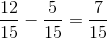
To solve this we need to first find common denominators. We do that by multiplying the first fraction by 3 over 3 and the second fraction by 5 over 5.
Subtract the numerators of the fractions to get the final answer.
← Didn't Know|Knew It →
Subtract these fractions:

Subtract these fractions:
Tap to reveal answer
To solve this we need to first find common denominators. We do that by multiplying the first fraction by 4 over 4 and the second fraction by 7 over 7.


Subtract the numerators of these fractions to get the final answer.

To solve this we need to first find common denominators. We do that by multiplying the first fraction by 4 over 4 and the second fraction by 7 over 7.
Subtract the numerators of these fractions to get the final answer.
← Didn't Know|Knew It →
Subtract these fractions:

Subtract these fractions:
Tap to reveal answer
To solve this we need to first find common denominators. We do that by multiplying the first fraction by 9 over 9 and the second fraction by 8 over 8.


Subtract the numerators of these fractions to get the final answer.

To solve this we need to first find common denominators. We do that by multiplying the first fraction by 9 over 9 and the second fraction by 8 over 8.
Subtract the numerators of these fractions to get the final answer.
← Didn't Know|Knew It →
Subtract these fractions:

Subtract these fractions:
Tap to reveal answer
To solve this we need to first find common denominators. We do that by multiplying the first fraction by 3 over 3 and the second fraction by 7 over 7.


Subtract the numerators of these fractions to get the final answer.

To solve this we need to first find common denominators. We do that by multiplying the first fraction by 3 over 3 and the second fraction by 7 over 7.
Subtract the numerators of these fractions to get the final answer.
← Didn't Know|Knew It →
Tap to reveal answer
To subtract fractions, they need to share the same denominator. To find the same denominator, you will need to find the least common multiple of the two given denominators.
The least common denominator of 5 and 7 is 35. Remember, the number you multiply the denominator by to get the least common denominator you must also multiply by the numerator.
So the original equation becomes,
Now, subtract the numerators.
To subtract fractions, they need to share the same denominator. To find the same denominator, you will need to find the least common multiple of the two given denominators.
The least common denominator of 5 and 7 is 35. Remember, the number you multiply the denominator by to get the least common denominator you must also multiply by the numerator.
So the original equation becomes,
Now, subtract the numerators.
← Didn't Know|Knew It →
Please choose the best answer for the question below.
Amanda has pounds of cake leftover from her birthday. If she eats a third of a pound of cake, how much will she have left over?
Please choose the best answer for the question below.
Amanda has
Tap to reveal answer
To tackle this question, first convert 2 and 3/4ths into a fraction.
Then, you can subtract from :
Then you convert to a mixed number for your final answer.
.
To tackle this question, first convert 2 and 3/4ths into a fraction.
Then, you can subtract
Then you convert to a mixed number for your final answer.
← Didn't Know|Knew It →
Please choose the best answer for the question below.
If you have three pies, and someone eats one quarter of each pie, how much pie do you have left? The answers will be expressed as mixed numbers.
Please choose the best answer for the question below.
If you have three pies, and someone eats one quarter of each pie, how much pie do you have left? The answers will be expressed as mixed numbers.
Tap to reveal answer
To find the answer for this problem, first figure out how much of each pie is left:
Then, because , you know that you have whole pies left, and a quarter besides.
To find the answer for this problem, first figure out how much of each pie is left:
Then, because
← Didn't Know|Knew It →
Subtract.
Subtract.
Tap to reveal answer
To subtract two fractions, they need to both share the same denominator. Since 81 is a multiple of 9, we only need to change the 1st fraction.
Now subtract the two fractions.
To subtract two fractions, they need to both share the same denominator. Since 81 is a multiple of 9, we only need to change the 1st fraction.
Now subtract the two fractions.
← Didn't Know|Knew It →
Determine the answer:
Determine the answer:
Tap to reveal answer
1. Find the least common denominator:
The lowest number that both 4 and 5 both go into is 20, making 20 the least common denominator.
2. Find the equivalent fractions using the least common denominator:
3. Subtract:
1. Find the least common denominator:
The lowest number that both 4 and 5 both go into is 20, making 20 the least common denominator.
2. Find the equivalent fractions using the least common denominator:
3. Subtract:
← Didn't Know|Knew It →
Tap to reveal answer
To subtract fractions, they must have the same number in the denominator. Begin by simplifying so that its denominator is .
To simplify, divide the numerator and denominator by 6.
Then, subtract:
To subtract fractions, they must have the same number in the denominator. Begin by simplifying
To simplify, divide the numerator and denominator by 6.
Then, subtract:
← Didn't Know|Knew It →
Subtract these fractions:
Subtract these fractions:
Tap to reveal answer
To solve this we need to first find common denominators. We do that by multiplying the first fraction by 2 over 2 and the second fraction by 3 over 3.
Subtract these fractions to get the final answer.
To solve this we need to first find common denominators. We do that by multiplying the first fraction by 2 over 2 and the second fraction by 3 over 3.
Subtract these fractions to get the final answer.
← Didn't Know|Knew It →
Subtract these fractions:
Subtract these fractions:
Tap to reveal answer
To solve this we need to first find common denominators. We do that by multiplying the first fraction by 3 over 3 and the second fraction by 5 over 5.
Subtract the numerators of the fractions to get the final answer.
To solve this we need to first find common denominators. We do that by multiplying the first fraction by 3 over 3 and the second fraction by 5 over 5.
Subtract the numerators of the fractions to get the final answer.
← Didn't Know|Knew It →
Subtract these fractions:
Subtract these fractions:
Tap to reveal answer
To solve this we need to first find common denominators. We do that by multiplying the first fraction by 4 over 4 and the second fraction by 7 over 7.
Subtract the numerators of these fractions to get the final answer.
To solve this we need to first find common denominators. We do that by multiplying the first fraction by 4 over 4 and the second fraction by 7 over 7.
Subtract the numerators of these fractions to get the final answer.
← Didn't Know|Knew It →