Read Inverses from Graphs or Tables
Help Questions
Algebra 2 › Read Inverses from Graphs or Tables
The table gives outputs of a function $f$ that has an inverse. Since points swap, $(x, f(x))$ on $f$ corresponds to $(f(x), x)$ on $f^{-1}$. Use the table to find $f^{-1}(13)$.
| $x$ | $f(x)$ |
|---|---|
| 2 | 1 |
| 4 | 6 |
| 6 | 10 |
| 7 | 13 |
| 9 | 18 |
$6$
$9$
$7$
$13$
Explanation
This question tests your ability to read values of an inverse function from a table or graph using the fundamental property that inverses swap inputs and outputs. If f has a table or graph showing its (x, y) pairs, then f⁻¹ has the same pairs but swapped: every (x, y) on f becomes (y, x) on f⁻¹. So to find f⁻¹(a), you don't need the inverse's table or graph—just find where y = a in f's representation and read the corresponding x-value. That x is your answer! For example, if f's table shows x = 3 gives y = 7, then f⁻¹(7) = 3. The inverse reverses the input-output relationship. To find $f^{-1}$(13), look in the f(x) column for the value 13; you'll see it's paired with x=7 in the table. Choice C correctly finds f⁻¹(13) = 7 by reading from the table properly. It's easy to misread and pick a nearby value like 6 or 9, but always verify the exact match in the output column— excellent work persisting through this! Table reading strategy for f⁻¹(a): (1) Look in the f(x) column (the outputs) for the value a, (2) When you find a, look at the x-value in that same row, (3) That x-value is f⁻¹(a). Example: table shows x: 1, 2, 3, 4 and f(x): 5, 9, 13, 17. To find f⁻¹(13), scan the f(x) column for 13 (found in row 3), read x from that row (x = 3), so f⁻¹(13) = 3. The swap happens automatically when you read this way!
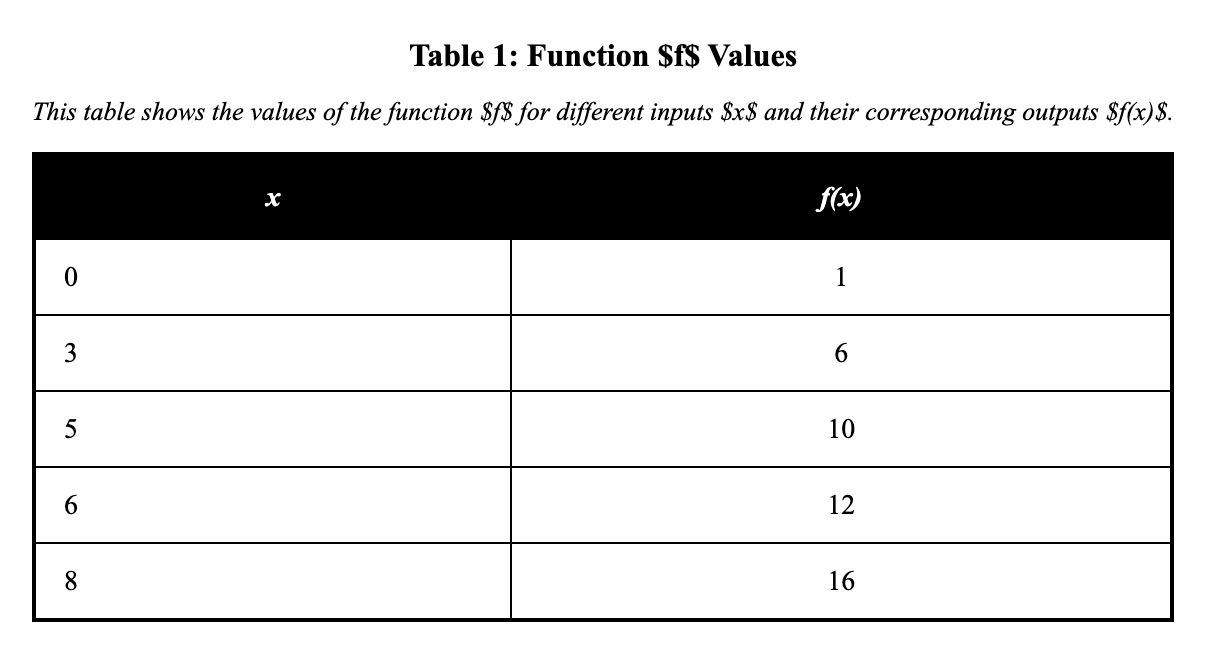
A one-to-one function $f$ is shown by the table, so $f$ has an inverse. Use the table to find $f^{-1}(12)$. (Look for the output 12 in the $f(x)$ column; the corresponding $x$ is the inverse value.)
| $x$ | $f(x)$ |
|---|---|
| 0 | 1 |
| 3 | 6 |
| 5 | 10 |
| 6 | 12 |
| 8 | 16 |
$f^{-1}(12)=5$
$f^{-1}(12)=8$
$f^{-1}(12)=6$
$f^{-1}(12)=12$
Explanation
This question tests your ability to read values of an inverse function from a table or graph using the fundamental property that inverses swap inputs and outputs. If f has a table or graph showing its (x, y) pairs, then f⁻¹ has the same pairs but swapped: every (x, y) on f becomes (y, x) on f⁻¹. So to find f⁻¹(a), you don't need the inverse's table or graph—just find where y = a in f's representation and read the corresponding x-value. That x is your answer! For example, if f's table shows x = 3 gives y = 7, then f⁻¹(7) = 3. The inverse reverses the input-output relationship. Looking for f⁻¹(12), I scan the f(x) column for the value 12: f(0) = 1, f(3) = 6, f(5) = 10, f(6) = 12, f(8) = 16. Found it! When x = 6, f(x) = 12. Therefore, f⁻¹(12) = 6. Choice C correctly finds f⁻¹(12) = 6 by locating the row where f(x) = 12 and reading the corresponding x-value. Choice A incorrectly assumes f⁻¹(12) = 12, which would require f(12) = 12, but 12 isn't even an input in the table. Table reading strategy for f⁻¹(a): (1) Look in the f(x) column (the outputs) for the value a, (2) When you find a, look at the x-value in that same row, (3) That x-value is f⁻¹(a). The process naturally reverses the function's action!
A one-to-one function $f$ is given by the table, so $f$ has an inverse. What is $f^{-1}(14)$?
| $x$ | $f(x)$ |
|---|---|
| $1$ | $-2$ |
| $2$ | $4$ |
| $3$ | $9$ |
| $4$ | $14$ |
| $5$ | $20$ |
$f^{-1}(14)=5$
$f^{-1}(14)=20$
$f^{-1}(14)=14$
$f^{-1}(14)=4$
Explanation
This question tests your ability to read values of an inverse function from a table or graph using the fundamental property that inverses swap inputs and outputs. If f has a table or graph showing its (x, y) pairs, then f⁻¹ has the same pairs but swapped: every (x, y) on f becomes (y, x) on f⁻¹. So to find f⁻¹(a), you don't need the inverse's table or graph—just find where y = a in f's representation and read the corresponding x-value. That x is your answer! For example, if f's table shows x = 3 gives y = 7, then f⁻¹(7) = 3. The inverse reverses the input-output relationship. Looking for f⁻¹(14), I scan the f(x) column and find f(4) = 14. This means when x = 4, the output is 14, so f⁻¹(14) = 4. Choice B correctly finds f⁻¹(14) = 4 by reading from the table that f(4) = 14 and applying the swap principle. Choice D incorrectly reads 20 from the table, which is actually f(5), not related to finding f⁻¹(14). Table reading strategy for f⁻¹(a): (1) Look in the f(x) column (the outputs) for the value a, (2) When you find a, look at the x-value in that same row, (3) That x-value is f⁻¹(a). Remember, you're working backwards—from output to input—which is exactly what an inverse function does!
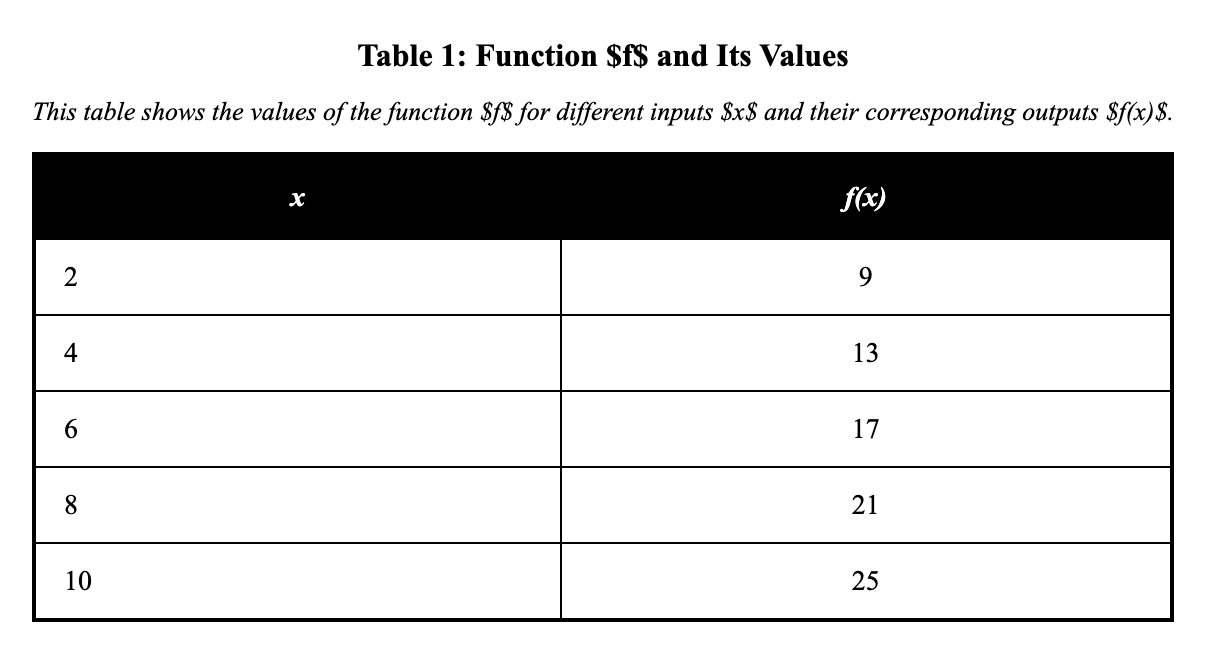
A one-to-one function $f$ is shown by the table, so $f$ has an inverse. Use the table to evaluate $f^{-1}(21)$. (Because inverse pairs swap, if $f(x)=21$ then $f^{-1}(21)=x$.)
| $x$ | $f(x)$ |
|---|---|
| 2 | 9 |
| 4 | 13 |
| 6 | 17 |
| 8 | 21 |
| 10 | 25 |
$f^{-1}(21)=8$
$f^{-1}(21)=10$
$f^{-1}(21)=21$
$f^{-1}(21)=6$
Explanation
This question tests your ability to read values of an inverse function from a table or graph using the fundamental property that inverses swap inputs and outputs. If f has a table or graph showing its (x, y) pairs, then f⁻¹ has the same pairs but swapped: every (x, y) on f becomes (y, x) on f⁻¹. So to find f⁻¹(a), you don't need the inverse's table or graph—just find where y = a in f's representation and read the corresponding x-value. That x is your answer! For example, if f's table shows x = 3 gives y = 7, then f⁻¹(7) = 3. The inverse reverses the input-output relationship. To evaluate f⁻¹(21), I scan the f(x) column for 21: f(2) = 9, f(4) = 13, f(6) = 17, f(8) = 21, f(10) = 25. Found it! When x = 8, f(x) = 21. Therefore, f⁻¹(21) = 8. Choice C correctly finds f⁻¹(21) = 8 by locating where f(x) = 21 in the table. Choice A incorrectly assumes f⁻¹(21) = 21, which would require f(21) = 21, but 21 isn't even an input value in the table. Table reading strategy for f⁻¹(a): (1) Look in the f(x) column (the outputs) for the value a, (2) When you find a, look at the x-value in that same row, (3) That x-value is f⁻¹(a). The swap happens automatically when you read this way!
The table gives values of a one-to-one function $f$, so $f$ has an inverse. Because inverse functions swap inputs and outputs, $(a,b)$ on $f$ corresponds to $(b,a)$ on $f^{-1}$. Use the table to determine $f^{-1}(-2)$.
| $x$ | $f(x)$ |
|---|---|
| $-3$ | 4 |
| $-1$ | 1 |
| 0 | $-2$ |
| 2 | $-5$ |
| 5 | $-9$ |
$f^{-1}(-2)=-2$
$f^{-1}(-2)=-1$
$f^{-1}(-2)=2$
$f^{-1}(-2)=0$
Explanation
This question tests your ability to read values of an inverse function from a table or graph using the fundamental property that inverses swap inputs and outputs. If f has a table or graph showing its (x, y) pairs, then f⁻¹ has the same pairs but swapped: every (x, y) on f becomes (y, x) on f⁻¹. So to find f⁻¹(a), you don't need the inverse's table or graph—just find where y = a in f's representation and read the corresponding x-value. That x is your answer! The inverse reverses the input-output relationship. To find f⁻¹(-2), I need to locate -2 in the f(x) column and read the corresponding x-value. Looking at the table, when x = 0, f(x) = -2. Therefore, f⁻¹(-2) = 0. Choice A correctly finds f⁻¹(-2) = 0 by identifying that f(0) = -2 in the table. Choice B incorrectly suggests f⁻¹(-2) = -2, which is the common mistake of thinking a function's inverse at a point equals that point—but this would only be true if the point lies on the line y = x. Table reading strategy for f⁻¹(a): (1) Look in the f(x) column (the outputs) for the value a, (2) When you find a, look at the x-value in that same row, (3) That x-value is f⁻¹(a). In this case, -2 appears in the f(x) column when x = 0, so f⁻¹(-2) = 0.
The function $f$ is one-to-one and has an inverse. Use the table to find $f^{-1}(0)$.
| $x$ | $f(x)$ |
|---|---|
| $-3$ | $-5$ |
| $-1$ | $-2$ |
| $2$ | $0$ |
| $4$ | $3$ |
| $7$ | $8$ |
$4$
$2$
$0$
$-2$
Explanation
This question tests your ability to read values of an inverse function from a table or graph using the fundamental property that inverses swap inputs and outputs. If f has a table or graph showing its (x, y) pairs, then f⁻¹ has the same pairs but swapped: every (x, y) on f becomes (y, x) on f⁻¹. So to find f⁻¹(a), you don't need the inverse's table or graph—just find where y = a in f's representation and read the corresponding x-value. That x is your answer! For example, if f's table shows x = 3 gives y = 7, then f⁻¹(7) = 3. The inverse reverses the input-output relationship. To find $f^{-1}$(0), look in the f(x) column for the value 0; you'll see it's paired with x=2 in the table. Choice B correctly finds f⁻¹(0) = 2 by reading from the table properly. One might accidentally pick 0 or a negative, but recall we're reversing: find input for that output— you're making fantastic progress! Table reading strategy for f⁻¹(a): (1) Look in the f(x) column (the outputs) for the value a, (2) When you find a, look at the x-value in that same row, (3) That x-value is f⁻¹(a). Example: table shows x: 1, 2, 3, 4 and f(x): 5, 9, 13, 17. To find f⁻¹(13), scan the f(x) column for 13 (found in row 3), read x from that row (x = 3), so f⁻¹(13) = 3. The swap happens automatically when you read this way!
The function $f$ is one-to-one, so it has an inverse. Using the table, find $f^{-1}(2)$.
| $x$ | $f(x)$ |
|---|---|
| $-2$ | $-4$ |
| $0$ | $-1$ |
| $1$ | $2$ |
| $3$ | $5$ |
| $6$ | $9$ |
$2$
$5$
$-1$
$1$
Explanation
This question tests your ability to read values of an inverse function from a table or graph using the fundamental property that inverses swap inputs and outputs. If f has a table or graph showing its (x, y) pairs, then f⁻¹ has the same pairs but swapped: every (x, y) on f becomes (y, x) on f⁻¹. So to find f⁻¹(a), you don't need the inverse's table or graph—just find where y = a in f's representation and read the corresponding x-value. That x is your answer! For example, if f's table shows x = 3 gives y = 7, then f⁻¹(7) = 3. The inverse reverses the input-output relationship. To find $f^{-1}$(2), look in the f(x) column for the value 2; you'll see it's paired with x=1 in the table. Choice C correctly finds f⁻¹(2) = 1 by reading from the table properly. Some students might mistakenly pick 2 itself or confuse with another row, but always focus on locating the output first and grabbing the input— you're doing great, keep going! Table reading strategy for f⁻¹(a): (1) Look in the f(x) column (the outputs) for the value a, (2) When you find a, look at the x-value in that same row, (3) That x-value is f⁻¹(a). Example: table shows x: 1, 2, 3, 4 and f(x): 5, 9, 13, 17. To find f⁻¹(13), scan the f(x) column for 13 (found in row 3), read x from that row (x = 3), so f⁻¹(13) = 3. The swap happens automatically when you read this way!
The table gives values of a one-to-one function $f$, so $f$ has an inverse. Use the table to find $f^{-1}(-4)$. (If $(a,b)$ is on $f$, then $(b,a)$ is on $f^{-1}$.)
| $x$ | $f(x)$ |
|---|---|
| -3 | 5 |
| -1 | 1 |
| 0 | -2 |
| 2 | -4 |
| 4 | -7 |
$f^{-1}(-4)=4$
$f^{-1}(-4)=2$
$f^{-1}(-4)=0$
$f^{-1}(-4)=-4$
Explanation
This question tests your ability to read values of an inverse function from a table or graph using the fundamental property that inverses swap inputs and outputs. If f has a table or graph showing its (x, y) pairs, then f⁻¹ has the same pairs but swapped: every (x, y) on f becomes (y, x) on f⁻¹. So to find f⁻¹(a), you don't need the inverse's table or graph—just find where y = a in f's representation and read the corresponding x-value. That x is your answer! For example, if f's table shows x = 3 gives y = 7, then f⁻¹(7) = 3. The inverse reverses the input-output relationship. To find f⁻¹(-4), I need to locate -4 in the f(x) column. Scanning down: f(-3) = 5, f(-1) = 1, f(0) = -2, f(2) = -4, f(4) = -7. I found it! When x = 2, f(x) = -4. Therefore, f⁻¹(-4) = 2. Choice A correctly finds f⁻¹(-4) = 2 by identifying that f(2) = -4 in the table. Choice B incorrectly assumes f⁻¹(-4) = -4, missing the fundamental swap property of inverses. Table reading strategy for f⁻¹(a): (1) Look in the f(x) column (the outputs) for the value a, (2) When you find a, look at the x-value in that same row, (3) That x-value is f⁻¹(a). Remember: you're working backwards from output to input!
The table gives values of a one-to-one function $f$, so $f$ has an inverse. Use the table to determine $f^{-1}(-4)$.
| $x$ | $f(x)$ |
|---|---|
| $-3$ | $8$ |
| $-1$ | $2$ |
| $1$ | $-1$ |
| $3$ | $-4$ |
| $5$ | $-6$ |
(Recall: if $f(3)=-4$, then $f^{-1}(-4)=3$.)
$f^{-1}(-4)=3$
$f^{-1}(-4)=8$
$f^{-1}(-4)=5$
$f^{-1}(-4)=-4$
Explanation
This question tests your ability to read values of an inverse function from a table or graph using the fundamental property that inverses swap inputs and outputs. If f has a table or graph showing its (x, y) pairs, then f⁻¹ has the same pairs but swapped: every (x, y) on f becomes (y, x) on f⁻¹. So to find f⁻¹(a), you don't need the inverse's table or graph—just find where y = a in f's representation and read the corresponding x-value. That x is your answer! For example, if f's table shows x = 3 gives y = 7, then f⁻¹(7) = 3. The inverse reverses the input-output relationship. To find f⁻¹(-4), I scan the f(x) column for -4. I see that f(3) = -4, which means when x = 3, the output is -4. Therefore, f⁻¹(-4) = 3. Choice A correctly finds f⁻¹(-4) = 3 by recognizing that since f(3) = -4, the inverse must map -4 back to 3. Choice B incorrectly assumes f⁻¹(-4) = -4, which would mean -4 is a fixed point, but the table shows f(-4) is not even defined. Table reading strategy for f⁻¹(a): (1) Look in the f(x) column (the outputs) for the value a, (2) When you find a, look at the x-value in that same row, (3) That x-value is f⁻¹(a). The problem even gives us a helpful reminder: if f(3) = -4, then f⁻¹(-4) = 3, which directly confirms our answer!