Real Numbers - Algebra 2
Card 1 of 84
Identify the property of real numbers represented by the following:

Identify the property of real numbers represented by the following:
Tap to reveal answer
Recall that the Commutative Propery of Addition states:

It follows that:

To help you tell the difference between commutative, associative, and distributive just remember what the words themselves mean.
When you commute you go from one place to another. With commutative properties, numbers are moving from one position to another.
When you associate with someone you are connected or grouped with them. The associative properties involve moving parentheses so that different numbers are grouped together, but they are not changing positions.
When you distribute things you are handing them out. With the distributive property, the number outside the parentheses is being handed out to the numbers inside the parentheses.
Recall that the Commutative Propery of Addition states:
It follows that:
To help you tell the difference between commutative, associative, and distributive just remember what the words themselves mean.
When you commute you go from one place to another. With commutative properties, numbers are moving from one position to another.
When you associate with someone you are connected or grouped with them. The associative properties involve moving parentheses so that different numbers are grouped together, but they are not changing positions.
When you distribute things you are handing them out. With the distributive property, the number outside the parentheses is being handed out to the numbers inside the parentheses.
← Didn't Know|Knew It →
Identify the property of real numbers represented by the following:

Identify the property of real numbers represented by the following:
Tap to reveal answer
Recall that the Distributive Property states:

It follows that:

To help you tell the difference between commutative, associative, and distributive just remember what the words themselves mean.
When you commute you go from one place to another. With commutative properties, numbers are moving from one position to another.
When you associate with someone you are connected or grouped with them. The associative properties involve moving parentheses so that different numbers are grouped together, but they are not changing positions.
When you distribute things you are handing them out. With the distributive property, the number outside the parentheses is being handed out to the numbers inside the parentheses.
Recall that the Distributive Property states:
It follows that:
To help you tell the difference between commutative, associative, and distributive just remember what the words themselves mean.
When you commute you go from one place to another. With commutative properties, numbers are moving from one position to another.
When you associate with someone you are connected or grouped with them. The associative properties involve moving parentheses so that different numbers are grouped together, but they are not changing positions.
When you distribute things you are handing them out. With the distributive property, the number outside the parentheses is being handed out to the numbers inside the parentheses.
← Didn't Know|Knew It →
Identify the property of real numbers represented by the following:

Identify the property of real numbers represented by the following:
Tap to reveal answer
Recall that the Commutative Property of Multiplication states:

It follows that :

To help you tell the difference between commutative, associative, and distributive just remember what the words themselves mean.
When you commute you go from one place to another. With commutative properties, numbers are moving from one position to another.
When you associate with someone you are connected or grouped with them. The associative properties involve moving parentheses so that different numbers are grouped together, but they are not changing positions.
When you distribute things you are handing them out. With the distributive property, the number outside the parentheses is being handed out to the numbers inside the parentheses.
Recall that the Commutative Property of Multiplication states:
It follows that :
To help you tell the difference between commutative, associative, and distributive just remember what the words themselves mean.
When you commute you go from one place to another. With commutative properties, numbers are moving from one position to another.
When you associate with someone you are connected or grouped with them. The associative properties involve moving parentheses so that different numbers are grouped together, but they are not changing positions.
When you distribute things you are handing them out. With the distributive property, the number outside the parentheses is being handed out to the numbers inside the parentheses.
← Didn't Know|Knew It →
Identify the property of real numbers represented by the following:

Identify the property of real numbers represented by the following:
Tap to reveal answer
Recall that the Associative Property of Multiplication states:

It follows that:

To help you tell the difference between commutative, associative, and distributive just remember what the words themselves mean.
When you commute you go from one place to another. With commutative properties, numbers are moving from one position to another.
When you associate with someone you are connected or grouped with them. The associative properties involve moving parentheses so that different numbers are grouped together, but they are not changing positions.
When you distribute things you are handing them out. With the distributive property, the number outside the parentheses is being handed out to the numbers inside the parentheses.
Recall that the Associative Property of Multiplication states:
It follows that:
To help you tell the difference between commutative, associative, and distributive just remember what the words themselves mean.
When you commute you go from one place to another. With commutative properties, numbers are moving from one position to another.
When you associate with someone you are connected or grouped with them. The associative properties involve moving parentheses so that different numbers are grouped together, but they are not changing positions.
When you distribute things you are handing them out. With the distributive property, the number outside the parentheses is being handed out to the numbers inside the parentheses.
← Didn't Know|Knew It →
Identify the property of real numbers represented by the following:

Identify the property of real numbers represented by the following:
Tap to reveal answer
Recall that the Associative Property of Addition states:

It follows that:

To help you tell the difference between commutative, associative, and distributive just remember what the words themselves mean.
When you commute you go from one place to another. With commutative properties, numbers are moving from one position to another.
When you associate with someone you are connected or grouped with them. The associative properties involve moving parentheses so that different numbers are grouped together, but they are not changing positions.
When you distribute things you are handing them out. With the distributive property, the number outside the parentheses is being handed out to the numbers inside the parentheses.
Recall that the Associative Property of Addition states:
It follows that:
To help you tell the difference between commutative, associative, and distributive just remember what the words themselves mean.
When you commute you go from one place to another. With commutative properties, numbers are moving from one position to another.
When you associate with someone you are connected or grouped with them. The associative properties involve moving parentheses so that different numbers are grouped together, but they are not changing positions.
When you distribute things you are handing them out. With the distributive property, the number outside the parentheses is being handed out to the numbers inside the parentheses.
← Didn't Know|Knew It →
Identify the property of real numbers represented by the following:

Identify the property of real numbers represented by the following:
Tap to reveal answer
Recall that the Distributive Property states:

The number outside the parentheses can be on the left or right side of the parentheses, so the following is also true:

It follows that:

To help you tell the difference between commutative, associative, and distributive just remember what the words themselves mean.
When you commute you go from one place to another. With commutative properties, numbers are moving from one position to another.
When you associate with someone you are connected or grouped with them. The associative properties involve moving parentheses so that different numbers are grouped together, but they are not changing positions.
When you distribute things you are handing them out. With the distributive property, the number outside the parentheses is being handed out to the numbers inside the parentheses.
Recall that the Distributive Property states:
The number outside the parentheses can be on the left or right side of the parentheses, so the following is also true:
It follows that:
To help you tell the difference between commutative, associative, and distributive just remember what the words themselves mean.
When you commute you go from one place to another. With commutative properties, numbers are moving from one position to another.
When you associate with someone you are connected or grouped with them. The associative properties involve moving parentheses so that different numbers are grouped together, but they are not changing positions.
When you distribute things you are handing them out. With the distributive property, the number outside the parentheses is being handed out to the numbers inside the parentheses.
← Didn't Know|Knew It →
Using the properties of negative numbers, determine which answer is equivalent to

Using the properties of negative numbers, determine which answer is equivalent to
Tap to reveal answer
Recall the following property of negative numbers:

It follows that:

Recall the following property of negative numbers:
It follows that:
← Didn't Know|Knew It →
Using the properties of negative numbers, determine which answer is equivalent to

Using the properties of negative numbers, determine which answer is equivalent to
Tap to reveal answer
Recall the following property of negative numbers:

It follows that:

Recall the following property of negative numbers:
It follows that:
← Didn't Know|Knew It →
Using the properties of negative numbers, determine which answer is equivalent to

Using the properties of negative numbers, determine which answer is equivalent to
Tap to reveal answer
Recall the following property of negative numbers:

It follows that:

Recall the following property of negative numbers:
It follows that:
← Didn't Know|Knew It →
Using the properties of negative numbers, determine which answer is equivalent to

Using the properties of negative numbers, determine which answer is equivalent to
Tap to reveal answer
Recall the following property of negative numbers:

It follows that:

Recall the following property of negative numbers:
It follows that:
← Didn't Know|Knew It →
Using the properties of negative numbers, determine which answer is equivalent to

Using the properties of negative numbers, determine which answer is equivalent to
Tap to reveal answer
Recall the following property of negative numbers:

It follows that:

Recall the following property of negative numbers:
It follows that:
← Didn't Know|Knew It →
Using the properties of negative numbers, determine which answer is equivalent to

Using the properties of negative numbers, determine which answer is equivalent to
Tap to reveal answer
Recall the following property of negative numbers:

It follows that:

Recall the following property of negative numbers:
It follows that:
← Didn't Know|Knew It →
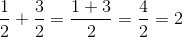
Solve the following using properties of fractions:

Solve the following using properties of fractions:
Tap to reveal answer
← Didn't Know|Knew It →
Solve the following using properties of fractions:

Solve the following using properties of fractions:
Tap to reveal answer

← Didn't Know|Knew It →
Solve the following using properties of fractions:

Solve the following using properties of fractions:
Tap to reveal answer
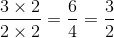
Every answer choice is equivalent to this, so they are all correct.
Every answer choice is equivalent to this, so they are all correct.
← Didn't Know|Knew It →
Solve the following using properties of fractions:

Solve the following using properties of fractions:
Tap to reveal answer
When dividing fractions, remember to multiply the first fraction by the reciprocal of the second, as illustrated by the following identity:
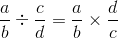

When dividing fractions, remember to multiply the first fraction by the reciprocal of the second, as illustrated by the following identity:
← Didn't Know|Knew It →
Find the equivalent of the following:

Find the equivalent of the following:
Tap to reveal answer
One of the properties of fractions states that if  , then
  .
.
It follows that if  , then
  .
.
One of the properties of fractions states that if
It follows that if
← Didn't Know|Knew It →
Solve the following using properties of fractions:

Solve the following using properties of fractions:
Tap to reveal answer

← Didn't Know|Knew It →
Which of the following is a NOT a real number?
Which of the following is a NOT a real number?
Tap to reveal answer
By definition, a real number is one that is NOT imaginary. Imaginary numbers are numbers that, when squared, give a negative result.
So, the correct answer choice for the above question must be one that is, in fact, an imaginary number.
Using the above defintion, we are able to identify only one of the answer choices as a number that, when squared, gives a negative result. This is  . When we take the square of
  , we get
  , ultimately, satisfying our definition of an imaginary number, and giving us the correct answer choice.
By definition, a real number is one that is NOT imaginary. Imaginary numbers are numbers that, when squared, give a negative result.
So, the correct answer choice for the above question must be one that is, in fact, an imaginary number.
Using the above defintion, we are able to identify only one of the answer choices as a number that, when squared, gives a negative result. This is
← Didn't Know|Knew It →
Which is NOT a real number?

Which is NOT a real number?
Tap to reveal answer
The mathematics a real number is any integer, irrational, or rational number. The set of real numbers does not include imaginary numbers.
If we look at the possible answers we see that three out of the four are real numbers because they are integers.


7, 6, and 9 are all Real Numbers.
The answer is  because when a negative number is under a radical sign it creates an imaginary number which is not included in the set of real numbers.
The mathematics a real number is any integer, irrational, or rational number. The set of real numbers does not include imaginary numbers.
If we look at the possible answers we see that three out of the four are real numbers because they are integers.
7, 6, and 9 are all Real Numbers.
The answer is
← Didn't Know|Knew It →