Other Factorials - Algebra 2
Card 1 of 96
What is the value of  ?
?
What is the value of
Tap to reveal answer
! is the symbol for factorial, which means the product of the whole numbers less than the given number.
Thus,  .
.
! is the symbol for factorial, which means the product of the whole numbers less than the given number.
Thus,
← Didn't Know|Knew It →
What is  ?
?
What is
Tap to reveal answer
Remember that factorial is defined as:

So using this definition, 
And  .
.
So 
The 7, 6, 5, 4, 3, 2, and 1 all cancel from both the numerator and denominator. So we're left with just  on top, which has a value of
  .
.
Remember that factorial is defined as:
So using this definition,
And
So
The 7, 6, 5, 4, 3, 2, and 1 all cancel from both the numerator and denominator. So we're left with just
← Didn't Know|Knew It →
How many  -permutations (without repetition) are there when taking numbers from the set of numbers
  ?
?
How many
Tap to reveal answer
The elements of the set don't matter. Only the size of the set matters when determining permutations.
Our set contains 9 integers, so for the first number in our permutation, we have 9 choices.
After picking that number, because we're not allowed repetition, our second number is from 8 choices.
Our final number is from 7 choices.
Multiplying  gives us
  .
.
The elements of the set don't matter. Only the size of the set matters when determining permutations.
Our set contains 9 integers, so for the first number in our permutation, we have 9 choices.
After picking that number, because we're not allowed repetition, our second number is from 8 choices.
Our final number is from 7 choices.
Multiplying
← Didn't Know|Knew It →
What is the value of  ?
?
What is the value of
Tap to reveal answer
Since the factorial has the property

we can write  as:
as:
 .
.
Thus, our expression can be written as

Since the factorial has the property
we can write
Thus, our expression can be written as
← Didn't Know|Knew It →
Solve the Quadratic Equation.

Solve the Quadratic Equation.
Tap to reveal answer
First, move all terms to the left by subtracting the quantity on the right.


From here, factor the quadractic into two binomials and set each equal to zero.


First, move all terms to the left by subtracting the quantity on the right.
From here, factor the quadractic into two binomials and set each equal to zero.
← Didn't Know|Knew It →
What is the value of  ?
?
What is the value of
Tap to reveal answer
A factorial represents the product of all natural numbers less than a given number. Thus,  which gives us
  .
.
A factorial represents the product of all natural numbers less than a given number. Thus,
← Didn't Know|Knew It →
What is 
 ?
?
What is
Tap to reveal answer
A factorial means you are multiplying the number, with one less than previous number and you keep multiplying until you reach  .
.
So,  is
is  .
.
Multiplying that out, we get  .
.
A factorial means you are multiplying the number, with one less than previous number and you keep multiplying until you reach
So,
Multiplying that out, we get
← Didn't Know|Knew It →
What is  ?
?
What is
Tap to reveal answer
A factorial means you are multiplying the number, with one less than previous number and you keep multiplying until you reach  .
.
So,  is
is  .
.
Multiplying that out, we get  .
.
A factorial means you are multiplying the number, with one less than previous number and you keep multiplying until you reach
So,
Multiplying that out, we get
← Didn't Know|Knew It →
What is  ?
?
What is
Tap to reveal answer
A factorial means you are multiplying the number, with one less than previous number and you keep multiplying until you reach  .
.
So,  is
is  . Multiplying that out, we get
  .
.
We also have  . That is
  or
or  .
.
Since we are multiplying the factorial, we multiply  and
and  to get
  .
.
A factorial means you are multiplying the number, with one less than previous number and you keep multiplying until you reach
So,
We also have
Since we are multiplying the factorial, we multiply
← Didn't Know|Knew It →
What is  ?
?
What is
Tap to reveal answer
A factorial means you are multiplying the number, with one less than previous number and you keep multiplying until you reach  .
.
So,  is
is  . We also have
  . That is
  .
.
Since we are dividing the factorial, we can cancel out some terms.
Both the numerator and denominator have  , and we can cancel those out. We are left with
  or
or 
A factorial means you are multiplying the number, with one less than previous number and you keep multiplying until you reach
So,
Since we are dividing the factorial, we can cancel out some terms.
Both the numerator and denominator have
← Didn't Know|Knew It →
What is  ?
?
What is
Tap to reveal answer
A factorial means you are multiplying the number, with one less than previous number and you keep multiplying until you reach  .
.
So,  is
is  . We are dividing by
  With careful inspection,
  can be broken down to
  .
.
If we cancel that out with the ones in the numerator, we have  or
or  .
.
A factorial means you are multiplying the number, with one less than previous number and you keep multiplying until you reach
So,
If we cancel that out with the ones in the numerator, we have
← Didn't Know|Knew It →
What is  ?
?
What is
Tap to reveal answer
A factorial means you are multiplying the number, with one less than previous number and you keep multiplying until you reach  . Since we are dealing with variables, let's analyze each the numerator and the denominator.
  is definitely greater than
  in this situation because factorials are always positive numbers. If we took the difference between
  and
and  we would get
  . This means that if we were to expand both the numerator and denominator, we cancel everything out except the extra term in the denominator which is
  .
.

So final answer is  .
.
A factorial means you are multiplying the number, with one less than previous number and you keep multiplying until you reach
So final answer is
← Didn't Know|Knew It →
What can  be expressed as?
What can
Tap to reveal answer
A factorial means you are multiplying the number, with one less than previous number and you keep multiplying until you reach  . Since we are dealing with variables, let's analyze them.
  is definitely greater than
  in this situation because factorials are always positive numbers. If we took the difference between
  and
and  we would get
  . This means after
  , the next biggest value is
  . Since we have
  and the next value multiplied is
  , we can conclude that
  will work since it incorporates
  values multiplied and also
  .
.
A factorial means you are multiplying the number, with one less than previous number and you keep multiplying until you reach
← Didn't Know|Knew It →
Simplify.

Simplify.
Tap to reveal answer
A factorial means you are multiplying the number, with one less than previous number and you keep multiplying until you reach  . Since we are dealing with variables, let's analyze each the numerator and the denominator.
  is definitely greater than
  in this situation because factorials are always positive numbers. If we took the difference between
  and
and  we would get
  . This means that if we were to expand both the numerator and denominator, we cancel everything out except the
  extra terms in the numerator which are
  . So final answer is
  .
.
If you need convincing, let  . So we have
  .
.
You can cancel out the  from top and bottom to get
  . We need to express them into expressions.
Since  was
was  , to get
  , you need to add
  to
to  or
or 
To get  , you add
  to
to  or
or 
 To get
  you subtract
  from
from  or
or  .
.
You still get the same answer of  .
.
A factorial means you are multiplying the number, with one less than previous number and you keep multiplying until you reach
If you need convincing, let
You can cancel out the
Since
To get
You still get the same answer of
← Didn't Know|Knew It →
Simplify: 
Simplify:
Tap to reveal answer
Write out the terms of each factorial in expanded form. The only exception is the zero factorial, which is equal to one.

Simplify the terms. The values in the numerator and denominator cannot cancel out!

The correct answer is: 
Write out the terms of each factorial in expanded form. The only exception is the zero factorial, which is equal to one.
Simplify the terms. The values in the numerator and denominator cannot cancel out!
The correct answer is:
← Didn't Know|Knew It →
What is the value of  ?
?
What is the value of
Tap to reveal answer
Step 1: We must define factorial. Factorial is defined as  , where
Step 2: Evaluate 


Step 1: We must define factorial. Factorial is defined as
Step 2: Evaluate
← Didn't Know|Knew It →
Compute: 
Compute:
Tap to reveal answer
Simplify the factorials in the numerator and denominator.

Simplify the terms on the top and bottom.


The answer is: 
Simplify the factorials in the numerator and denominator.
Simplify the terms on the top and bottom.
The answer is:
← Didn't Know|Knew It →
Multiply: 
Multiply:
Tap to reveal answer
Simplify all the terms in the parentheses first.


This indicates that:


The answer is: 
Simplify all the terms in the parentheses first.
This indicates that:
The answer is:
← Didn't Know|Knew It →
Try without a calculator:
 is equal to which expression?
Try without a calculator:
Tap to reveal answer
 - or
- or  factorial - is defined to be the product of the integers from 1 to
  . Therefore,

and


 ,
,
the correct response.
and
the correct response.
← Didn't Know|Knew It →
Evaluate:

Evaluate:
Tap to reveal answer
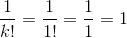
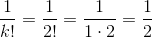
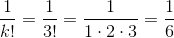
 is equal to the sum of the expressions formed by substituting 1, 2, 3 and 4, in turn, for
  in the expression
  , as follows:
 - or
- or  factorial - is defined to be the product of the integers from 1 to
  . Therefore, each term can be calculated by multiplying the integers from 1 to
  , then taking the reciprocal of the result.
 :
:
 :
:
 :
:
 :
:

Add the terms:
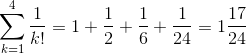
Add the terms:
← Didn't Know|Knew It →