Graphing Functions with Complex Numbers - Algebra 2
Card 1 of 40
Where would  fall on the number line?
Where would
Tap to reveal answer
Imaginary numbers do not fall on the number line-- they are by definition not real numbers.
** If the question asked where  falls on the number line, the answer would be to the left of 0, because
  .
.
Imaginary numbers do not fall on the number line-- they are by definition not real numbers.
** If the question asked where
← Didn't Know|Knew It →
Solve for 

Solve for
Tap to reveal answer
Use the change of base formula for logarithmic functions and incorporate the fact that  and
and 
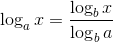
Or
 can be solved using


Use the change of base formula for logarithmic functions and incorporate the fact that
Or
← Didn't Know|Knew It →
Write the complex number  in polar form, where polar form expresses the result in terms of a distance from the origin
  on the complex plane and an angle from the positive
  -axis,
  , measured in radians.
Write the complex number
Tap to reveal answer
To see what the polar form of the number is, it helps to draw it on a graph, where the horizontal axis is the imaginary part and the vertical axis the real part. This is called the complex plane.
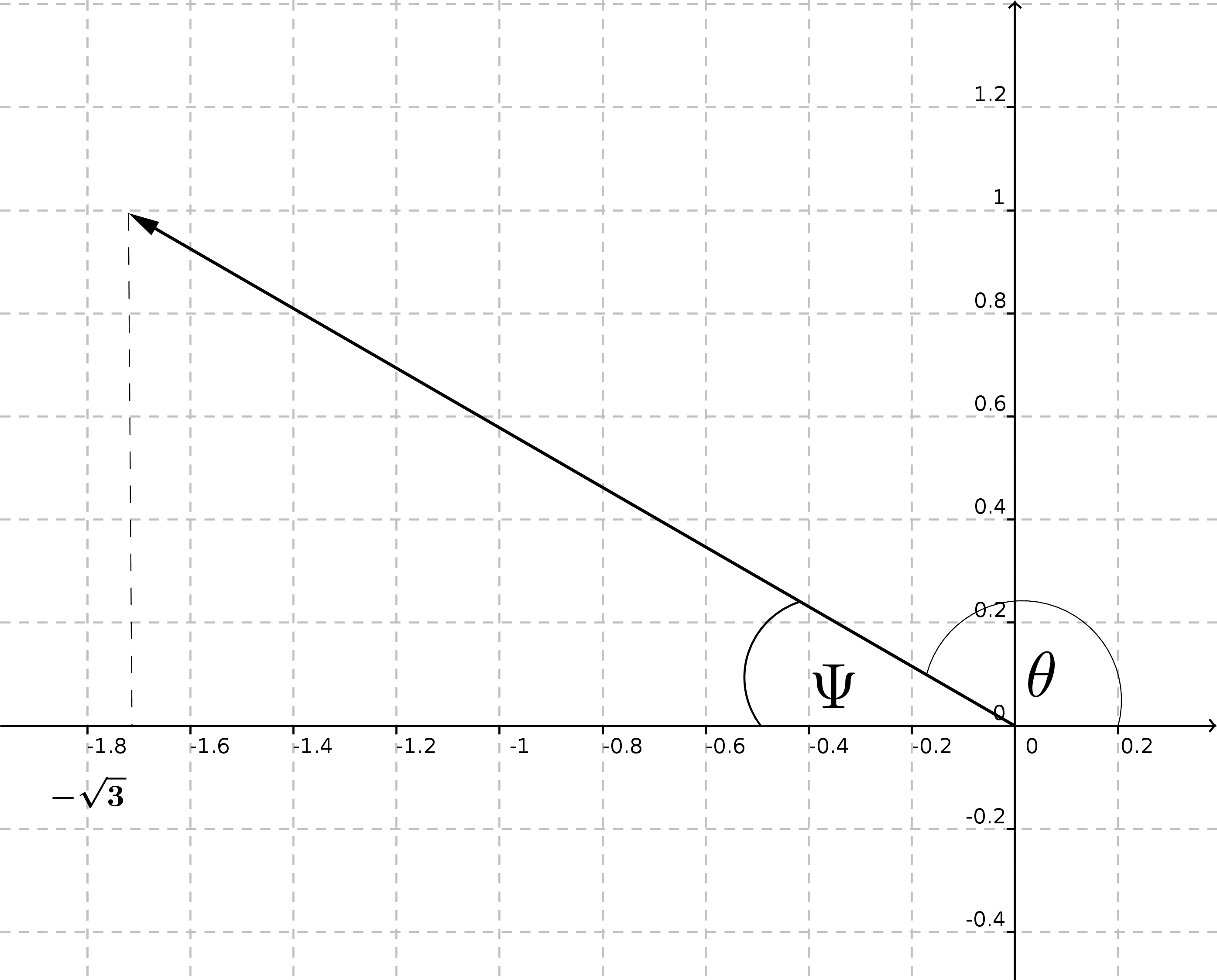
To find the angle  , we can find its supplementary angle
  and subtract it from
  radians, so
  .
.
Using trigonometric ratios,  and
and 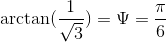 .
.
Then  .
.
To find the distance  , we need to find the distance from the origin to the point
  . Using the Pythagorean Theorem to find the hypotenuse
  ,
, 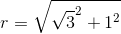 or
or  .
.
To see what the polar form of the number is, it helps to draw it on a graph, where the horizontal axis is the imaginary part and the vertical axis the real part. This is called the complex plane.
To find the angle
Using trigonometric ratios,
Then
To find the distance
← Didn't Know|Knew It →
Where does  fall on the number line?
Where does 
Tap to reveal answer
Imaginary numbers do not fall on the number line by definition, since they are not real numbers. However, although i is an imaginary number equal to the square root of -1,  is a real number since
  . Therefore,
  . Negative numbers fall to the left of 0 on a number line.
Imaginary numbers do not fall on the number line by definition, since they are not real numbers. However, although i is an imaginary number equal to the square root of -1, 


← Didn't Know|Knew It →
Which complex number does this graph represent?

Real numbers are represented by the x-axis, and imaginary numbers are represented by the y-axis.
Which complex number does this graph represent?
Real numbers are represented by the x-axis, and imaginary numbers are represented by the y-axis.
Tap to reveal answer
In complex numbers of the form  , a represents the real portion of the number and b represents the imaginary portion of the number. To graph
  on a plane in which real numbers are represented by the x-axis and imaginary numbers are represented by the y-axis, place a point a units right of the origin and b units above the origin. The graph shows a point 2 units right and 3 units above the origin, so the complex number represented is
  .
.
In complex numbers of the form 


← Didn't Know|Knew It →
Which complex number does this graph represent?

Real numbers are represented by the x-axis, and imaginary numbers are represented by the y-axis.
Which complex number does this graph represent?
Real numbers are represented by the x-axis, and imaginary numbers are represented by the y-axis.
Tap to reveal answer
In complex numbers of the form  , a represents the real portion of the number and b represents the imaginary portion of the number. To graph
  on a plane in which real numbers are represented by the x-axis and imaginary numbers are represented by the y-axis, place a point a units right of the origin and b units above the origin. The graph shows a point 5 units left and 2 units below the origin, so the complex number represented is
  .
.
In complex numbers of the form 


← Didn't Know|Knew It →
Which of the following represents the real component of the complex number  ?
?
Which of the following represents the real component of the complex number 
Tap to reveal answer
In complex numbers of the form  , a represents the real portion of the number and b represents the imaginary portion of the number. In the complex number
  ,
,  and
and  .
.
In complex numbers of the form 


← Didn't Know|Knew It →
Which of the following represents the imaginary component of the complex number -3 + ki, in which k is a constant?
Which of the following represents the imaginary component of the complex number -3 + ki, in which k is a constant?
Tap to reveal answer
In complex numbers of the form  ,
,  represents the real portion of the number and
  represents the imaginary portion of the number. In the complex number
  ,
,  and
and 
In complex numbers of the form 


← Didn't Know|Knew It →
Which complex number does this graph represent?

Real numbers are represented by the x-axis, and imaginary numbers are represented by the y-axis.
Which complex number does this graph represent?
Real numbers are represented by the x-axis, and imaginary numbers are represented by the y-axis.
Tap to reveal answer
In complex numbers of the form  , a represents the real portion of the number and b represents the imaginary portion of the number. To graph
  on a plane in which real numbers are represented by the x-axis and imaginary numbers are represented by the y-axis, place a point a units right of the origin and b units above the origin. The graph shows a point 4 units right and 7 units below the origin, so the complex number represented is
  .
.
In complex numbers of the form 


← Didn't Know|Knew It →
Which complex number does this graph represent?

Real numbers are represented by the x-axis, and imaginary numbers are represented by the y-axis.
Which complex number does this graph represent?
Real numbers are represented by the x-axis, and imaginary numbers are represented by the y-axis.
Tap to reveal answer
In complex numbers of the form  , a represents the real portion of the number and b represents the imaginary portion of the number. To graph
  on a plane in which real numbers are represented by the x-axis and imaginary numbers are represented by the y-axis, place a point a units right of the origin and b units above the origin. The graph shows a point 8 units left and 1 unit above the origin, so the complex number represented is
  .
.
In complex numbers of the form 


← Didn't Know|Knew It →
Where would fall on the number line?
Where would
Tap to reveal answer
Imaginary numbers do not fall on the number line-- they are by definition not real numbers.
** If the question asked where falls on the number line, the answer would be to the left of 0, because .
Imaginary numbers do not fall on the number line-- they are by definition not real numbers.
** If the question asked where
← Didn't Know|Knew It →
Solve for
Solve for
Tap to reveal answer
Use the change of base formula for logarithmic functions and incorporate the fact that and
Or
can be solved using
Use the change of base formula for logarithmic functions and incorporate the fact that
Or
← Didn't Know|Knew It →
Write the complex number in polar form, where polar form expresses the result in terms of a distance from the origin on the complex plane and an angle from the positive -axis, , measured in radians.
Write the complex number
Tap to reveal answer
To see what the polar form of the number is, it helps to draw it on a graph, where the horizontal axis is the imaginary part and the vertical axis the real part. This is called the complex plane.
To find the angle , we can find its supplementary angle and subtract it from radians, so .
Using trigonometric ratios, and .
Then .
To find the distance , we need to find the distance from the origin to the point . Using the Pythagorean Theorem to find the hypotenuse , or .
To see what the polar form of the number is, it helps to draw it on a graph, where the horizontal axis is the imaginary part and the vertical axis the real part. This is called the complex plane.
To find the angle
Using trigonometric ratios,
Then
To find the distance
← Didn't Know|Knew It →
Where does fall on the number line?
Where does
Tap to reveal answer
Imaginary numbers do not fall on the number line by definition, since they are not real numbers. However, although i is an imaginary number equal to the square root of -1, is a real number since . Therefore, . Negative numbers fall to the left of 0 on a number line.
Imaginary numbers do not fall on the number line by definition, since they are not real numbers. However, although i is an imaginary number equal to the square root of -1,
← Didn't Know|Knew It →
Which complex number does this graph represent?
Real numbers are represented by the x-axis, and imaginary numbers are represented by the y-axis.
Which complex number does this graph represent?
Real numbers are represented by the x-axis, and imaginary numbers are represented by the y-axis.
Tap to reveal answer
In complex numbers of the form , a represents the real portion of the number and b represents the imaginary portion of the number. To graph on a plane in which real numbers are represented by the x-axis and imaginary numbers are represented by the y-axis, place a point a units right of the origin and b units above the origin. The graph shows a point 2 units right and 3 units above the origin, so the complex number represented is .
In complex numbers of the form
← Didn't Know|Knew It →
Which complex number does this graph represent?
Real numbers are represented by the x-axis, and imaginary numbers are represented by the y-axis.
Which complex number does this graph represent?
Real numbers are represented by the x-axis, and imaginary numbers are represented by the y-axis.
Tap to reveal answer
In complex numbers of the form , a represents the real portion of the number and b represents the imaginary portion of the number. To graph on a plane in which real numbers are represented by the x-axis and imaginary numbers are represented by the y-axis, place a point a units right of the origin and b units above the origin. The graph shows a point 5 units left and 2 units below the origin, so the complex number represented is .
In complex numbers of the form
← Didn't Know|Knew It →
Which of the following represents the real component of the complex number ?
Which of the following represents the real component of the complex number
Tap to reveal answer
In complex numbers of the form , a represents the real portion of the number and b represents the imaginary portion of the number. In the complex number , and .
In complex numbers of the form
← Didn't Know|Knew It →
Which of the following represents the imaginary component of the complex number -3 + ki, in which k is a constant?
Which of the following represents the imaginary component of the complex number -3 + ki, in which k is a constant?
Tap to reveal answer
In complex numbers of the form , represents the real portion of the number and represents the imaginary portion of the number. In the complex number , and
In complex numbers of the form
← Didn't Know|Knew It →
Which complex number does this graph represent?
Real numbers are represented by the x-axis, and imaginary numbers are represented by the y-axis.
Which complex number does this graph represent?
Real numbers are represented by the x-axis, and imaginary numbers are represented by the y-axis.
Tap to reveal answer
In complex numbers of the form , a represents the real portion of the number and b represents the imaginary portion of the number. To graph on a plane in which real numbers are represented by the x-axis and imaginary numbers are represented by the y-axis, place a point a units right of the origin and b units above the origin. The graph shows a point 4 units right and 7 units below the origin, so the complex number represented is .
In complex numbers of the form
← Didn't Know|Knew It →
Which complex number does this graph represent?
Real numbers are represented by the x-axis, and imaginary numbers are represented by the y-axis.
Which complex number does this graph represent?
Real numbers are represented by the x-axis, and imaginary numbers are represented by the y-axis.
Tap to reveal answer
In complex numbers of the form , a represents the real portion of the number and b represents the imaginary portion of the number. To graph on a plane in which real numbers are represented by the x-axis and imaginary numbers are represented by the y-axis, place a point a units right of the origin and b units above the origin. The graph shows a point 8 units left and 1 unit above the origin, so the complex number represented is .
In complex numbers of the form
← Didn't Know|Knew It →