Create and Analyze Fractional Line Plots - 5th Grade Math
Card 1 of 20
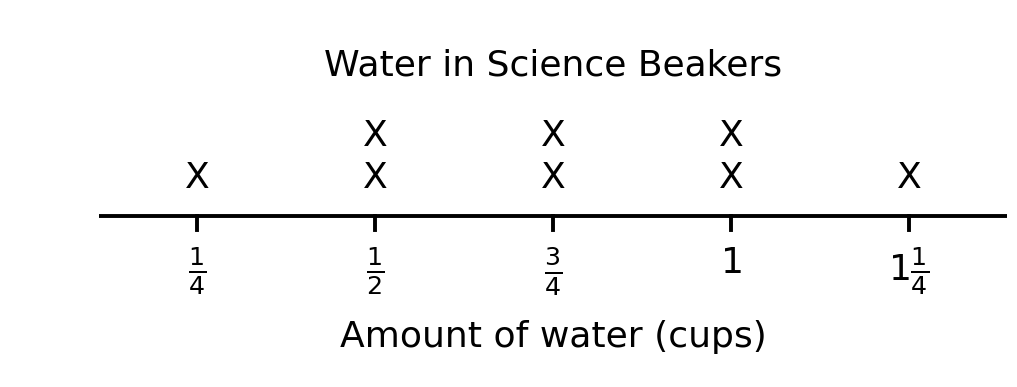
Which type of graph places X marks above a number line to show measurement data?
Tap to reveal answer
A line plot. X marks show frequency of each measurement value on a number line.
← Didn't Know|Knew It →
A line plot has 3 marks at $\frac{3}{8}$. What total measurement do they represent?
Tap to reveal answer
$1\frac{1}{8}$. Calculate: $3 × \frac{3}{8} = \frac{9}{8} = 1\frac{1}{8}$.
← Didn't Know|Knew It →
A line plot shows 6 data points at $\frac{1}{4}$. What is the sum of those values?
Tap to reveal answer
$1\frac{1}{2}$. Multiply: $6 × \frac{1}{4} = \frac{6}{4} = 1\frac{1}{2}$.
← Didn't Know|Knew It →
If 4 beakers total $3$ cups, how much is in each after equal sharing?
Tap to reveal answer
$\frac{3}{4}$ cup. Distribute evenly: $3 ÷ 4 = \frac{3}{4}$ per beaker.
← Didn't Know|Knew It →
What is the purpose of the scale on a line plot number line?
Tap to reveal answer
To show equal-sized measurement intervals. The scale divides the number line into consistent fractional units.
← Didn't Know|Knew It →
What is the range of $\frac{1}{8},\frac{3}{8},\frac{1}{2},\frac{7}{8}$?
Tap to reveal answer
$\frac{3}{4}$. Subtract smallest from largest: $\frac{7}{8} - \frac{1}{8} = \frac{6}{8} = \frac{3}{4}$.
← Didn't Know|Knew It →
Identify the median of $\frac{1}{4},\frac{1}{2},\frac{1}{2},\frac{3}{4},1$.
Tap to reveal answer
$\frac{1}{2}$. Middle value of ordered data with 5 values is the 3rd value.
← Didn't Know|Knew It →
What is the smallest interval when the number line is marked in eighths?
Tap to reveal answer
$\frac{1}{8}$. Each unit divided into 8 parts makes eighths the smallest interval.
← Didn't Know|Knew It →
Identify the mixed number equal to $\frac{10}{8}$ for labeling a line plot.
Tap to reveal answer
$1\frac{1}{4}$. Convert improper fraction: $\frac{10}{8} = \frac{8}{8} + \frac{2}{8} = 1\frac{2}{8} = 1\frac{1}{4}$.
← Didn't Know|Knew It →
What fraction is equivalent to $\frac{2}{8}$ when simplifying line plot tick labels?
Tap to reveal answer
$\frac{1}{4}$. Divide numerator and denominator by 2: $\frac{2÷2}{8÷2} = \frac{1}{4}$.
← Didn't Know|Knew It →
What fraction is equivalent to $\frac{4}{8}$ when simplifying line plot tick labels?
Tap to reveal answer
$\frac{1}{2}$. Simplify by dividing both parts by 4: $\frac{4÷4}{8÷4} = \frac{1}{2}$.
← Didn't Know|Knew It →
Which value is larger on a line plot: $\frac{3}{8}$ or $\frac{1}{2}$?
Tap to reveal answer
$\frac{1}{2}$. Compare: $\frac{3}{8} < \frac{4}{8}$, and $\frac{4}{8} = \frac{1}{2}$.
← Didn't Know|Knew It →
What is the total of two measurements $\frac{1}{4}$ and $\frac{3}{8}$?
Tap to reveal answer
$\frac{5}{8}$. Convert to eighths: $\frac{2}{8} + \frac{3}{8} = \frac{5}{8}$.
← Didn't Know|Knew It →
Find the difference: $1-\frac{5}{8}$.
Tap to reveal answer
$\frac{3}{8}$. Rewrite as $\frac{8}{8} - \frac{5}{8} = \frac{3}{8}$.
← Didn't Know|Knew It →
How many $\frac{1}{8}$ units are in $\frac{3}{4}$?
Tap to reveal answer
$6$. Convert: $\frac{3}{4} = \frac{6}{8}$, so it contains 6 eighths.
← Didn't Know|Knew It →
What is the mean of four measurements totaling $2$ units?
Tap to reveal answer
$\frac{1}{2}$. Divide total by count: $2 ÷ 4 = \frac{1}{2}$.
← Didn't Know|Knew It →
What is the total count of data points if a line plot shows $3$ Xs at $\frac{1}{2}$ and $5$ Xs at $\frac{3}{4}$?
Tap to reveal answer
$8$. Count all Xs: $3 + 5 = 8$ total data points.
← Didn't Know|Knew It →
What is the mean of $3$ measurements totaling $1\frac{1}{2}$ (redistributed equally)?
Tap to reveal answer
$\frac{1}{2}$. Divide total by count: $1\frac{1}{2} \div 3 = \frac{3}{2} \div 3 = \frac{1}{2}$.
← Didn't Know|Knew It →
What is the median of $6$ values: $\frac{1}{8}$, $\frac{1}{4}$, $\frac{1}{2}$, $\frac{1}{2}$, $\frac{3}{4}$, $1$?
Tap to reveal answer
$\frac{1}{2}$. For 6 values, median is average of 3rd and 4th values.
← Didn't Know|Knew It →
What is the median of $5$ values: $\frac{1}{4}$, $\frac{1}{2}$, $\frac{1}{2}$, $\frac{3}{4}$, $1$?
Tap to reveal answer
$\frac{1}{2}$. The middle value of 5 ordered values is the 3rd one.
← Didn't Know|Knew It →