Summer Learning: Bridging the Gap to 7th Grade Math
Heading into 7th grade math doesn't have to feel like a leap in the dark.
4 sessions

Sabrina
4.6
Outcomes, not lecture notes.
Apply prime factorization to find the GCF and LCM of numbers
Evaluate powers and exponents, including powers of ten and negative bases
Distinguish between expressions and equations and translate word problems into algebraic form
Solve one-step and multi-step equations using inverse operations and algebra tiles
Graph two-variable equations on the coordinate plane and identify ordered-pair solutions
Identify and extend arithmetic and geometric sequences by recognizing their patterns
Calculate slope from a graph and from two points using the rise-over-run formula
Meet Sabrina.
Sabrina
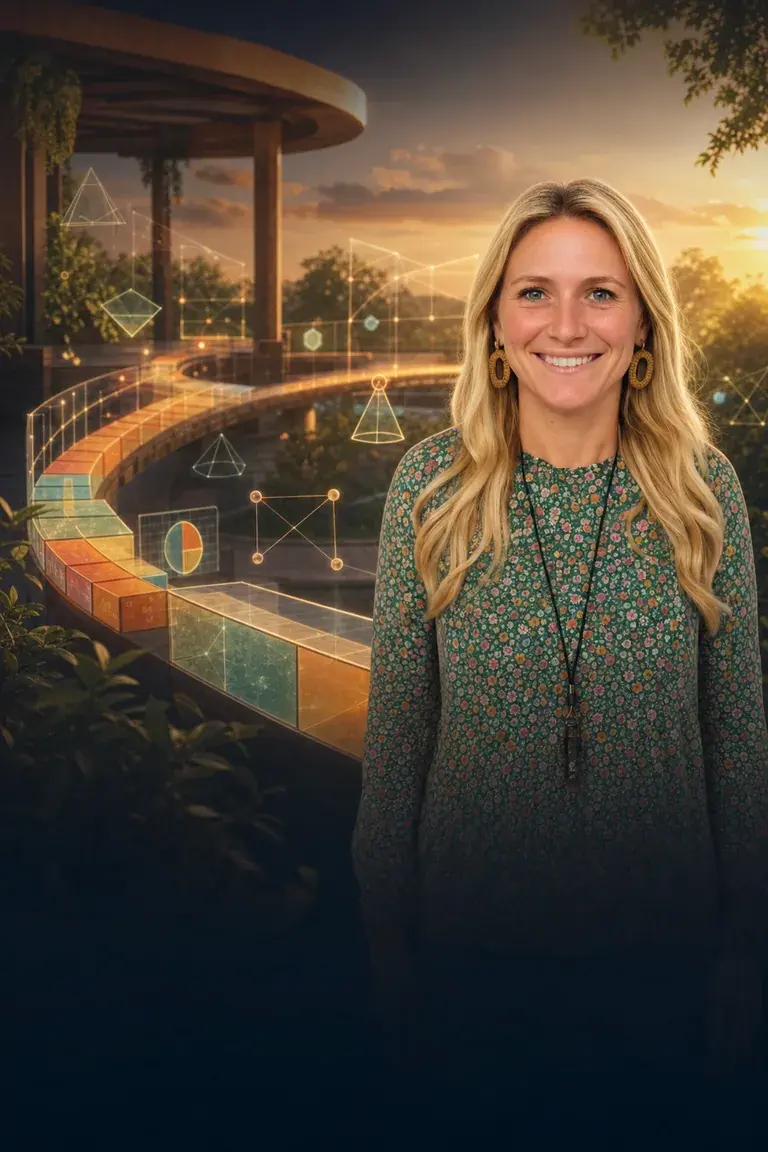
Drawing on a wealth of classroom experience and a passion for modern pedagogy, Sabrina Keller transforms complex content into accessible, engaging lessons. Her innovative approach—characterized by strategic use of digital platforms and interactive assessment techniques—empowers students to excel academically while fostering a supportive and inclusive learning environment. While her primary emphasis is elementary school math, she teaches everything from pre-K number sense to education classes at the university level in her capacity as adjunct professor at BYU-Idaho.
Heading into 7th grade math doesn't have to feel like a leap in the dark. This course gives rising 7th graders a focused, hands-on review of the exact concepts they'll need from day one — prime factorization, exponents, solving equations, graphing on the coordinate plane, and an introduction to slope. Students work through real problems using visual tools like algebra tiles, build fluency with arithmetic and geometric sequences, and learn to think algebraically before the school year demands it. Three sessions of targeted practice mean students arrive in September confident, prepared, and ready to hit the ground running.
Rising 7th graders, this course was built for you. Whether the school year left some gaps or you just want to walk into math class in September feeling truly ready, this three-session course covers every foundational concept you'll need — systematically, clearly, and with plenty of practice built in.
Number Theory and Exponents We start by sharpening your number sense. You'll learn to identify prime and composite numbers, break any number down through prime factorization, and use that skill to find greatest common factors and least common multiples with confidence. From there, we move into exponents — understanding them as shorthand for repeated multiplication, spotting the patterns in powers of ten, writing numbers in exponential form, and working with negative bases. These skills show up everywhere in 7th grade math and beyond.
Algebraic Thinking: Expressions, Equations, and Algebra Tiles One of the biggest conceptual jumps heading into 7th grade is moving from arithmetic to algebra. This course bridges that gap directly. You'll learn the difference between an expression and an equation, practice translating real-world word problems into algebraic form, and then solve one-step and multi-step equations using inverse operations. Algebra tiles give you a concrete, visual way to model what's actually happening when you solve for a variable — making abstract ideas click.
Graphing, Two-Variable Equations, and Slope Next, we bring equations to life on the coordinate plane. You'll build tables of values, plot ordered pairs, and graph two-variable equations — developing an intuition for how equations and their graphs are connected. We also introduce slope: what it means as a measure of steepness, how to read it from a graph using rise over run, and how to calculate it from any two points. This is exactly the foundation 7th and 8th grade math will build on.
Sequences and Pattern Recognition We round out the course with arithmetic and geometric sequences — learning to spot whether a pattern grows by adding a constant or multiplying by one, and using that to predict future terms. Pattern recognition is one of the most transferable math skills there is, and students consistently find this topic both accessible and satisfying.
By the end of these three sessions, students won't just have reviewed the material — they'll have practiced it, asked questions, worked through problems interactively, and built real confidence. The goal isn't to race through topics; it's to make sure the foundations are solid so that 7th grade math feels like the next step forward, not a wall.
Live Q&A
Cameras / mics optional
Recordings
Available within 1 hour, kept 90 days
Materials
No special materials required
Similar classes



free with a Varsity Tutors membership
02
DAYS20
HRS27
MINWed, Sep 9 • 10:00pm UTC
1 class, starts in 2 days
Summer Learning: Bridging the Gap to 7th Grade Math