Spheres
Help Questions
PSAT Math › Spheres
A foam ball has a volume of 2 units and has a diameter of x. If a second foam ball has a radius of 2x, what is its volume?
128 units
16 units
8 units
4 units
2 units
Explanation
Careful not to mix up radius and diameter. First, we need to identify that the second ball has a radius that is 4 times as large as the first ball. The radius of the first ball is (1/2)x and the radius of the second ball is 2x. The volume of the second ball will be 43, or 64 times bigger than the first ball. So the second ball has a volume of 2 * 64 = 128.
A foam ball has a volume of 2 units and has a diameter of x. If a second foam ball has a radius of 2x, what is its volume?
128 units
16 units
8 units
4 units
2 units
Explanation
Careful not to mix up radius and diameter. First, we need to identify that the second ball has a radius that is 4 times as large as the first ball. The radius of the first ball is (1/2)x and the radius of the second ball is 2x. The volume of the second ball will be 43, or 64 times bigger than the first ball. So the second ball has a volume of 2 * 64 = 128.
If a sphere has a volume of 


Explanation
The volume of a sphere is equal to

Therefore,

The surface area of a sphere is 


Explanation


If a sphere has a volume of
Explanation
The volume of a sphere is equal to
Therefore,
The surface area of a sphere is
Explanation
A solid hemisphere has a radius of length r. Let S be the number of square units, in terms of r, of the hemisphere's surface area. Let V be the number of cubic units, in terms of r, of the hemisphere's volume. What is the ratio of S to V?


Explanation
First, let's find the surface area of the hemisphere. Because the hemisphere is basically a full sphere cut in half, we need to find half of the surface area of a full sphere. However, because the hemisphere also has a circular base, we must then add the area of the base.

The surface area of a sphere with radius r is equal to 


The volume of the hemisphere is going to be half of the volume of an entire sphere. The volume for a full sphere is 

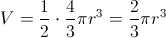
Ultimately, the question asks us to find the ratio of S to V. To do this, we can write S to V as a fraction.

In order to simplify this, let's multiply the numerator and denominator both by 3.


The answer is 
A solid hemisphere has a radius of length r. Let S be the number of square units, in terms of r, of the hemisphere's surface area. Let V be the number of cubic units, in terms of r, of the hemisphere's volume. What is the ratio of S to V?
Explanation
First, let's find the surface area of the hemisphere. Because the hemisphere is basically a full sphere cut in half, we need to find half of the surface area of a full sphere. However, because the hemisphere also has a circular base, we must then add the area of the base.
The surface area of a sphere with radius r is equal to
The volume of the hemisphere is going to be half of the volume of an entire sphere. The volume for a full sphere is
Ultimately, the question asks us to find the ratio of S to V. To do this, we can write S to V as a fraction.
In order to simplify this, let's multiply the numerator and denominator both by 3.
The answer is
A cube with volume 27 cubic inches is inscribed inside a sphere such that each vertex of the cube touches the sphere. What is the radius, in inches, of the sphere?
√3/2 (approximately 1.73)
(3√3)/2 (approximately 2.60)
8.5
9
Explanation
We know that the cube has a volume of 27 cubic inches, so each side of the cube must be ∛27=3 inches. Since the cube is inscribed inside the sphere, the diameter of the sphere is the diagonal length of the cube, so the radius of the sphere is half of the diagonal length of the cube. To find the diagonal length of the cube, we use the distance formula d=√(32+32+32 )=√(3*32 )=3√3, and then divide the result by 2 to find the radius of the sphere, (3√3)/2.
A cube with volume 27 cubic inches is inscribed inside a sphere such that each vertex of the cube touches the sphere. What is the radius, in inches, of the sphere?
√3/2 (approximately 1.73)
(3√3)/2 (approximately 2.60)
8.5
9
Explanation
We know that the cube has a volume of 27 cubic inches, so each side of the cube must be ∛27=3 inches. Since the cube is inscribed inside the sphere, the diameter of the sphere is the diagonal length of the cube, so the radius of the sphere is half of the diagonal length of the cube. To find the diagonal length of the cube, we use the distance formula d=√(32+32+32 )=√(3*32 )=3√3, and then divide the result by 2 to find the radius of the sphere, (3√3)/2.