Similar Triangles
Help Questions
Trigonometry › Similar Triangles
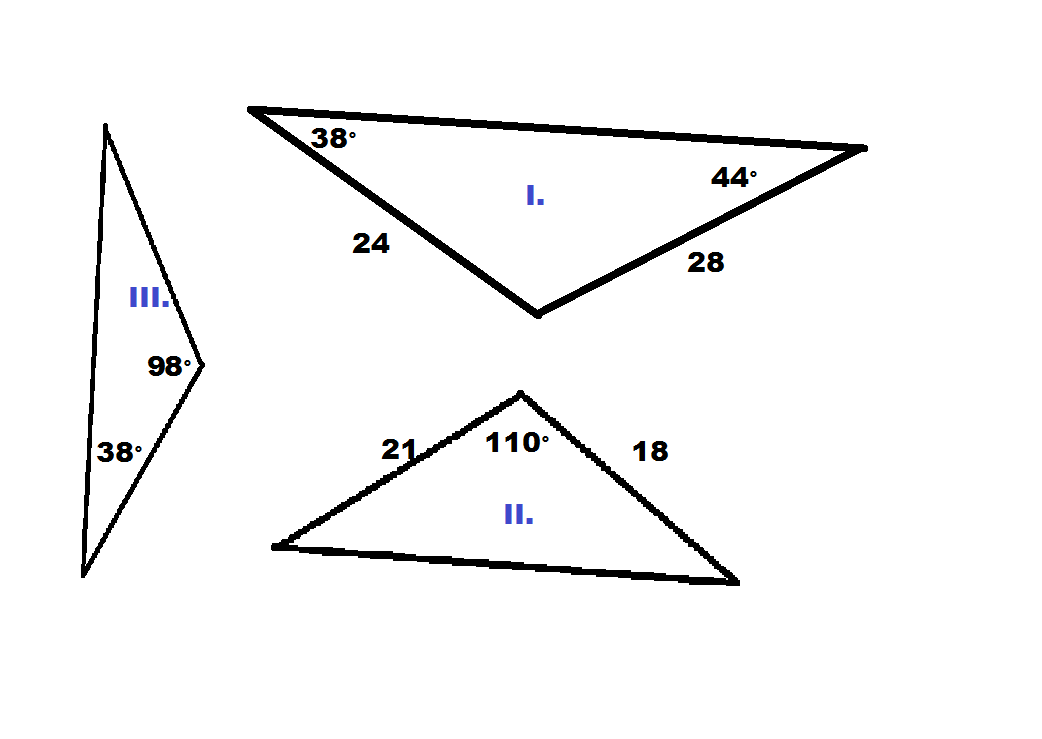
Which of the following triangles are similar?
I and III
I, II, and III
None of the triangles are similar
I and II
II and III
Explanation
We must remember that there are three ways to prove triangles are similar.
- At least two angles in one triangle are congruent to angles in another (AA)
- All three pairs of corresponding sides are proportional (SSS)
- Two pairs of corresponding sides are proportional and the angles between those sides are congruent (SAS)
Comparing triangles I and II, we only have one angle and two sides in trinagle II, so attempting to use either AA or SSS for similarity will not work, leaving SAS as the only option. If we compare the two given sides in each triangle, we notice that the ratio of the longer side in triangle I to the longer side in triangle II is

The ratio of the shorter sides in each triangle are

Notice we have equal ratios and thus a proportion. However, we still must confirm that the included angles are congruent. The measure for this angle is not given in triangle I, but we can calculate since all three angles must add up to 180 degrees. Calculation tells us that the measure is 98 degrees, which unfortunately does not equal the 110 from triangle II. Therefore, we have no SAS and therefore no similarity between I and II.
Transitioning to I and III, we only have angles in triangle III, so we are unable to use either SSS or SAS. However, we previously calculated the measure third angle in triangle I to be 98. Therefore, two of our angles are congruent, meaning we have AA and thus similarity.
Regarding II and III, we can use some logic. Since we know I and III are similar, then if II and III were also similar, then we could use the transitive property to conclude that I and II are also similar. But we know this is false, so II and III cannot be similar.
Therefore, the only two similar triangles are I and III.
Which of the following triangles are similar?
I and III
I, II, and III
None of the triangles are similar
I and II
II and III
Explanation
We must remember that there are three ways to prove triangles are similar.
- At least two angles in one triangle are congruent to angles in another (AA)
- All three pairs of corresponding sides are proportional (SSS)
- Two pairs of corresponding sides are proportional and the angles between those sides are congruent (SAS)
Comparing triangles I and II, we only have one angle and two sides in trinagle II, so attempting to use either AA or SSS for similarity will not work, leaving SAS as the only option. If we compare the two given sides in each triangle, we notice that the ratio of the longer side in triangle I to the longer side in triangle II is
The ratio of the shorter sides in each triangle are
Notice we have equal ratios and thus a proportion. However, we still must confirm that the included angles are congruent. The measure for this angle is not given in triangle I, but we can calculate since all three angles must add up to 180 degrees. Calculation tells us that the measure is 98 degrees, which unfortunately does not equal the 110 from triangle II. Therefore, we have no SAS and therefore no similarity between I and II.
Transitioning to I and III, we only have angles in triangle III, so we are unable to use either SSS or SAS. However, we previously calculated the measure third angle in triangle I to be 98. Therefore, two of our angles are congruent, meaning we have AA and thus similarity.
Regarding II and III, we can use some logic. Since we know I and III are similar, then if II and III were also similar, then we could use the transitive property to conclude that I and II are also similar. But we know this is false, so II and III cannot be similar.
Therefore, the only two similar triangles are I and III.
One triangle has side measures 


No
Yes
There is not enough information given.
Triangles can't be similar!
Those can't be the side lengths of triangles.
Explanation
Two triangles are similar if and only if their side lengths are proportional.
In this case, two of the sides are proportional, leading us to a scale factor of 2.
However, with the last side, 
Thus, these pair of sides are not proportional and therefore our triangles cannot be similar.
One triangle has side measures
No
Yes
There is not enough information given.
Triangles can't be similar!
Those can't be the side lengths of triangles.
Explanation
Two triangles are similar if and only if their side lengths are proportional.
In this case, two of the sides are proportional, leading us to a scale factor of 2.
However, with the last side,
Thus, these pair of sides are not proportional and therefore our triangles cannot be similar.
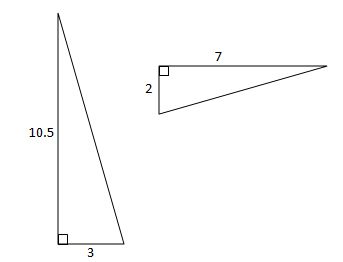
Are these triangles similar? If so, state the scale factor.
Yes - scale factor

No
Yes - scale factor

Yes - scale factor

Yes - scale factor

Explanation
For both triangles, we are given the "legs." Based on their relative lenghts, we can see that 2 corresponds with 3, and 7 corresponds with 10.5. First we need to make sure that these two triangles are similar. We can do this by comparing the ratios of corresponding sides:

There are a couple of ways to go from here. One would be to cross-multiply:



Are these triangles similar? If so, state the scale factor.
Yes - scale factor
No
Yes - scale factor
Yes - scale factor
Yes - scale factor
Explanation
For both triangles, we are given the "legs." Based on their relative lenghts, we can see that 2 corresponds with 3, and 7 corresponds with 10.5. First we need to make sure that these two triangles are similar. We can do this by comparing the ratios of corresponding sides:
There are a couple of ways to go from here. One would be to cross-multiply:
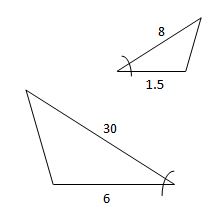
Are these triangles similar? If so, state the scale factor.
No, they are not similar
Not enough information
Yes - scale factor

Yes - scale factor

Yes - scale factor

Explanation
Based on their positions relative to the congruent angles, and their relative lengths, we can see that 1.5 corresponds to 6, and 8 corresponds to 30. If the ratios of corresponding sides are equal, then the triangles are congruent:

We can compare these in a couple different ways. One would be to cross-multiply:

These triangles are not similar.
Are these triangles similar? If so, state the scale factor.
No, they are not similar
Not enough information
Yes - scale factor
Yes - scale factor
Yes - scale factor
Explanation
Based on their positions relative to the congruent angles, and their relative lengths, we can see that 1.5 corresponds to 6, and 8 corresponds to 30. If the ratios of corresponding sides are equal, then the triangles are congruent:
We can compare these in a couple different ways. One would be to cross-multiply:
These triangles are not similar.
Which of the following shifts are incorrect?





Explanation
The actual shift for 

Which of the following shifts are incorrect?
Explanation
The actual shift for