Trigonometric Applications - Trigonometry
Card 1 of 28
Given the accompanying right triangle where  and
and  , determine the measure of
  to the nearest degree.
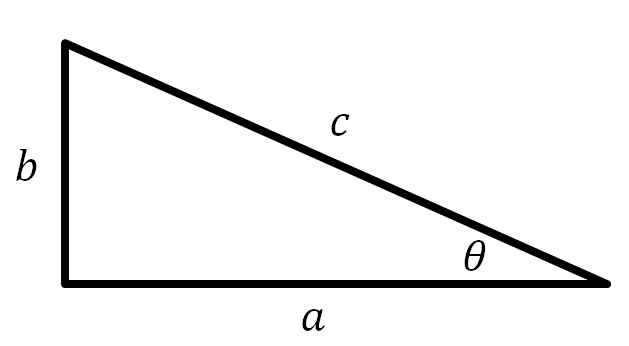
Given the accompanying right triangle where
Tap to reveal answer
We are given two sides of the right triangle, namely the hypotenuse and the opposite side of the angle. Therefore, we simply use the sine function to determine the angle:
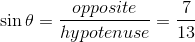
In order to isolate the angle we must apply the inverse sine function to both sides:

We are given two sides of the right triangle, namely the hypotenuse and the opposite side of the angle. Therefore, we simply use the sine function to determine the angle:
In order to isolate the angle we must apply the inverse sine function to both sides:
← Didn't Know|Knew It →
Given a right triangle where  , find the missing side.
Given a right triangle where
Tap to reveal answer
Since the triangle in question is a right triangle we can use the Pythagorean Theorem. First, we must determine which sides we are given. Since the function we are given is sine, we know that we are given the opposite side and the hypotenuse. Therefore, setting up the equation:

Where,  and
and  are given.

Solving the above equation:

We toss out the negative solution since the length of a side must be positive.
Since the triangle in question is a right triangle we can use the Pythagorean Theorem. First, we must determine which sides we are given. Since the function we are given is sine, we know that we are given the opposite side and the hypotenuse. Therefore, setting up the equation:
Where,
Solving the above equation:
We toss out the negative solution since the length of a side must be positive.
← Didn't Know|Knew It →
Given a right triangle where  , find the missing side.
Given a right triangle where
Tap to reveal answer
Since the triangle in question is a right triangle we can use the Pythagorean Theorem. First, we must determine which sides we are give. Since the function we are given is tangent, we know that we are given the opposite and adjacent sides. Therefore, setting up the equation:

Where,  and
and  are given.

Solving the above equation:

We toss out the negative solution since the length of a side must be positive.
Since the triangle in question is a right triangle we can use the Pythagorean Theorem. First, we must determine which sides we are give. Since the function we are given is tangent, we know that we are given the opposite and adjacent sides. Therefore, setting up the equation:
Where,
Solving the above equation:
We toss out the negative solution since the length of a side must be positive.
← Didn't Know|Knew It →
Given a right triangle where  , find the missing side.
Given a right triangle where
Tap to reveal answer
Since the triangle in question is a right triangle we can use the Pythagorean Theorem. First, we must determine which sides we are given. Since the function we are given is cosine, we know that we are given the adjacent side and hypotenuse. Therefore, setting up the equation:

Where,  and
and  are given.

Solving the above equation:

We toss out the negative solution since the length of a side must be positive.
Since the triangle in question is a right triangle we can use the Pythagorean Theorem. First, we must determine which sides we are given. Since the function we are given is cosine, we know that we are given the adjacent side and hypotenuse. Therefore, setting up the equation:
Where,
Solving the above equation:
We toss out the negative solution since the length of a side must be positive.
← Didn't Know|Knew It →
Given the accompanying right triangle where  and
and  , determine the measure of
  to the nearest degree.
Given the accompanying right triangle where
Tap to reveal answer
We are given two sides of the right triangle, namely the hypotenuse and the adjacent side of the angle. Therefore, we simply use the cosine function to determine the angle:
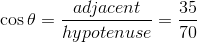
In order to isolate the angle we must apply the inverse cosine function to both sides:

We are given two sides of the right triangle, namely the hypotenuse and the adjacent side of the angle. Therefore, we simply use the cosine function to determine the angle:
In order to isolate the angle we must apply the inverse cosine function to both sides:
← Didn't Know|Knew It →
Given the accompanying triangle where  and
and  , determine the length of the hypotenuse.
Given the accompanying triangle where
Tap to reveal answer
We are given the opposite side, with respect to the angle, along with the angle. Therefore, we utilize the sine function to determine the length of the hypotenuse:
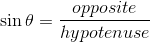
Substituting the given values:

Cross multiplying:

Solving for  :
:
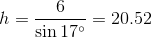
We are given the opposite side, with respect to the angle, along with the angle. Therefore, we utilize the sine function to determine the length of the hypotenuse:
Substituting the given values:
Cross multiplying:
Solving for
← Didn't Know|Knew It →
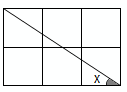
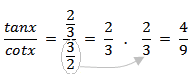
All the squares are equal, and there are 6 squares in the figure.
What is the value of  ?
?
All the squares are equal, and there are 6 squares in the figure.
What is the value of
Tap to reveal answer
← Didn't Know|Knew It →
All the squares are equal, and there are 6 squares in the figure.
What is the value of ?
All the squares are equal, and there are 6 squares in the figure.
What is the value of
Tap to reveal answer
← Didn't Know|Knew It →
Given the accompanying right triangle where and , determine the measure of to the nearest degree.
Given the accompanying right triangle where
Tap to reveal answer
We are given two sides of the right triangle, namely the hypotenuse and the opposite side of the angle. Therefore, we simply use the sine function to determine the angle:
In order to isolate the angle we must apply the inverse sine function to both sides:
We are given two sides of the right triangle, namely the hypotenuse and the opposite side of the angle. Therefore, we simply use the sine function to determine the angle:
In order to isolate the angle we must apply the inverse sine function to both sides:
← Didn't Know|Knew It →
Given a right triangle where , find the missing side.
Given a right triangle where
Tap to reveal answer
Since the triangle in question is a right triangle we can use the Pythagorean Theorem. First, we must determine which sides we are given. Since the function we are given is sine, we know that we are given the opposite side and the hypotenuse. Therefore, setting up the equation:
Where, and are given.
Solving the above equation:
We toss out the negative solution since the length of a side must be positive.
Since the triangle in question is a right triangle we can use the Pythagorean Theorem. First, we must determine which sides we are given. Since the function we are given is sine, we know that we are given the opposite side and the hypotenuse. Therefore, setting up the equation:
Where,
Solving the above equation:
We toss out the negative solution since the length of a side must be positive.
← Didn't Know|Knew It →
Given a right triangle where , find the missing side.
Given a right triangle where
Tap to reveal answer
Since the triangle in question is a right triangle we can use the Pythagorean Theorem. First, we must determine which sides we are give. Since the function we are given is tangent, we know that we are given the opposite and adjacent sides. Therefore, setting up the equation:
Where, and are given.
Solving the above equation:
We toss out the negative solution since the length of a side must be positive.
Since the triangle in question is a right triangle we can use the Pythagorean Theorem. First, we must determine which sides we are give. Since the function we are given is tangent, we know that we are given the opposite and adjacent sides. Therefore, setting up the equation:
Where,
Solving the above equation:
We toss out the negative solution since the length of a side must be positive.
← Didn't Know|Knew It →
Given a right triangle where , find the missing side.
Given a right triangle where
Tap to reveal answer
Since the triangle in question is a right triangle we can use the Pythagorean Theorem. First, we must determine which sides we are given. Since the function we are given is cosine, we know that we are given the adjacent side and hypotenuse. Therefore, setting up the equation:
Where, and are given.
Solving the above equation:
We toss out the negative solution since the length of a side must be positive.
Since the triangle in question is a right triangle we can use the Pythagorean Theorem. First, we must determine which sides we are given. Since the function we are given is cosine, we know that we are given the adjacent side and hypotenuse. Therefore, setting up the equation:
Where,
Solving the above equation:
We toss out the negative solution since the length of a side must be positive.
← Didn't Know|Knew It →
Given the accompanying right triangle where and , determine the measure of to the nearest degree.
Given the accompanying right triangle where
Tap to reveal answer
We are given two sides of the right triangle, namely the hypotenuse and the adjacent side of the angle. Therefore, we simply use the cosine function to determine the angle:
In order to isolate the angle we must apply the inverse cosine function to both sides:
We are given two sides of the right triangle, namely the hypotenuse and the adjacent side of the angle. Therefore, we simply use the cosine function to determine the angle:
In order to isolate the angle we must apply the inverse cosine function to both sides:
← Didn't Know|Knew It →
Given the accompanying triangle where and , determine the length of the hypotenuse.
Given the accompanying triangle where
Tap to reveal answer
We are given the opposite side, with respect to the angle, along with the angle. Therefore, we utilize the sine function to determine the length of the hypotenuse:
Substituting the given values:
Cross multiplying:
Solving for :
We are given the opposite side, with respect to the angle, along with the angle. Therefore, we utilize the sine function to determine the length of the hypotenuse:
Substituting the given values:
Cross multiplying:
Solving for
← Didn't Know|Knew It →
Given the accompanying right triangle where and , determine the measure of to the nearest degree.
Given the accompanying right triangle where
Tap to reveal answer
We are given two sides of the right triangle, namely the hypotenuse and the opposite side of the angle. Therefore, we simply use the sine function to determine the angle:
In order to isolate the angle we must apply the inverse sine function to both sides:
We are given two sides of the right triangle, namely the hypotenuse and the opposite side of the angle. Therefore, we simply use the sine function to determine the angle:
In order to isolate the angle we must apply the inverse sine function to both sides:
← Didn't Know|Knew It →
Given a right triangle where , find the missing side.
Given a right triangle where
Tap to reveal answer
Since the triangle in question is a right triangle we can use the Pythagorean Theorem. First, we must determine which sides we are given. Since the function we are given is sine, we know that we are given the opposite side and the hypotenuse. Therefore, setting up the equation:
Where, and are given.
Solving the above equation:
We toss out the negative solution since the length of a side must be positive.
Since the triangle in question is a right triangle we can use the Pythagorean Theorem. First, we must determine which sides we are given. Since the function we are given is sine, we know that we are given the opposite side and the hypotenuse. Therefore, setting up the equation:
Where,
Solving the above equation:
We toss out the negative solution since the length of a side must be positive.
← Didn't Know|Knew It →
Given a right triangle where , find the missing side.
Given a right triangle where
Tap to reveal answer
Since the triangle in question is a right triangle we can use the Pythagorean Theorem. First, we must determine which sides we are give. Since the function we are given is tangent, we know that we are given the opposite and adjacent sides. Therefore, setting up the equation:
Where, and are given.
Solving the above equation:
We toss out the negative solution since the length of a side must be positive.
Since the triangle in question is a right triangle we can use the Pythagorean Theorem. First, we must determine which sides we are give. Since the function we are given is tangent, we know that we are given the opposite and adjacent sides. Therefore, setting up the equation:
Where,
Solving the above equation:
We toss out the negative solution since the length of a side must be positive.
← Didn't Know|Knew It →
Given a right triangle where , find the missing side.
Given a right triangle where
Tap to reveal answer
Since the triangle in question is a right triangle we can use the Pythagorean Theorem. First, we must determine which sides we are given. Since the function we are given is cosine, we know that we are given the adjacent side and hypotenuse. Therefore, setting up the equation:
Where, and are given.
Solving the above equation:
We toss out the negative solution since the length of a side must be positive.
Since the triangle in question is a right triangle we can use the Pythagorean Theorem. First, we must determine which sides we are given. Since the function we are given is cosine, we know that we are given the adjacent side and hypotenuse. Therefore, setting up the equation:
Where,
Solving the above equation:
We toss out the negative solution since the length of a side must be positive.
← Didn't Know|Knew It →
Given the accompanying right triangle where and , determine the measure of to the nearest degree.
Given the accompanying right triangle where
Tap to reveal answer
We are given two sides of the right triangle, namely the hypotenuse and the adjacent side of the angle. Therefore, we simply use the cosine function to determine the angle:
In order to isolate the angle we must apply the inverse cosine function to both sides:
We are given two sides of the right triangle, namely the hypotenuse and the adjacent side of the angle. Therefore, we simply use the cosine function to determine the angle:
In order to isolate the angle we must apply the inverse cosine function to both sides:
← Didn't Know|Knew It →
Given the accompanying triangle where and , determine the length of the hypotenuse.
Given the accompanying triangle where
Tap to reveal answer
We are given the opposite side, with respect to the angle, along with the angle. Therefore, we utilize the sine function to determine the length of the hypotenuse:
Substituting the given values:
Cross multiplying:
Solving for :
We are given the opposite side, with respect to the angle, along with the angle. Therefore, we utilize the sine function to determine the length of the hypotenuse:
Substituting the given values:
Cross multiplying:
Solving for
← Didn't Know|Knew It →