Sec, Csc, Ctan - Trigonometry
Card 1 of 32
Find the value of the trigonometric function in fraction form for triangle  .
.
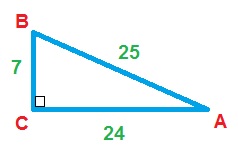
What is the secant of  ?
?
Find the value of the trigonometric function in fraction form for triangle
What is the secant of
Tap to reveal answer
The value of the secant of an angle is the value of the hypotenuse over the adjacent.
Therefore:

The value of the secant of an angle is the value of the hypotenuse over the adjacent.
Therefore:
← Didn't Know|Knew It →
Which of the following is the equivalent to  ?
?
Which of the following is the equivalent to
Tap to reveal answer
Since  :
:

Since
← Didn't Know|Knew It →
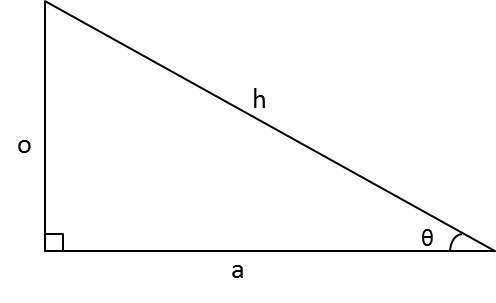
For the above triangle, what is  if
if  ,
,  and
and  ?
?
For the above triangle, what is
Tap to reveal answer
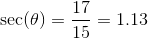
Secant is the reciprocal of cosine.
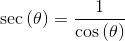
It's formula is:
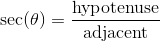
Substituting the values from the problem we get,
Secant is the reciprocal of cosine.
It's formula is:
Substituting the values from the problem we get,
← Didn't Know|Knew It →
For the above triangle, what is  if
if  ,
,  and
and  ?
?
For the above triangle, what is
Tap to reveal answer
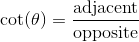
Cotangent is the reciprocal of tangent.
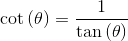
It's formula is:
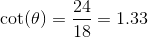
Substituting the values from the problem we get,
Cotangent is the reciprocal of tangent.
It's formula is:
Substituting the values from the problem we get,
← Didn't Know|Knew It →
Evaluate: 
Evaluate:
Tap to reveal answer
Evaluate each term separately.



Evaluate each term separately.
← Didn't Know|Knew It →
Determine the value of  .
.
Determine the value of
Tap to reveal answer
Rewrite  in terms of sine and cosine.
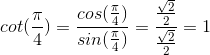
Rewrite
← Didn't Know|Knew It →
Pick the ratio of side lengths that would give sec C.
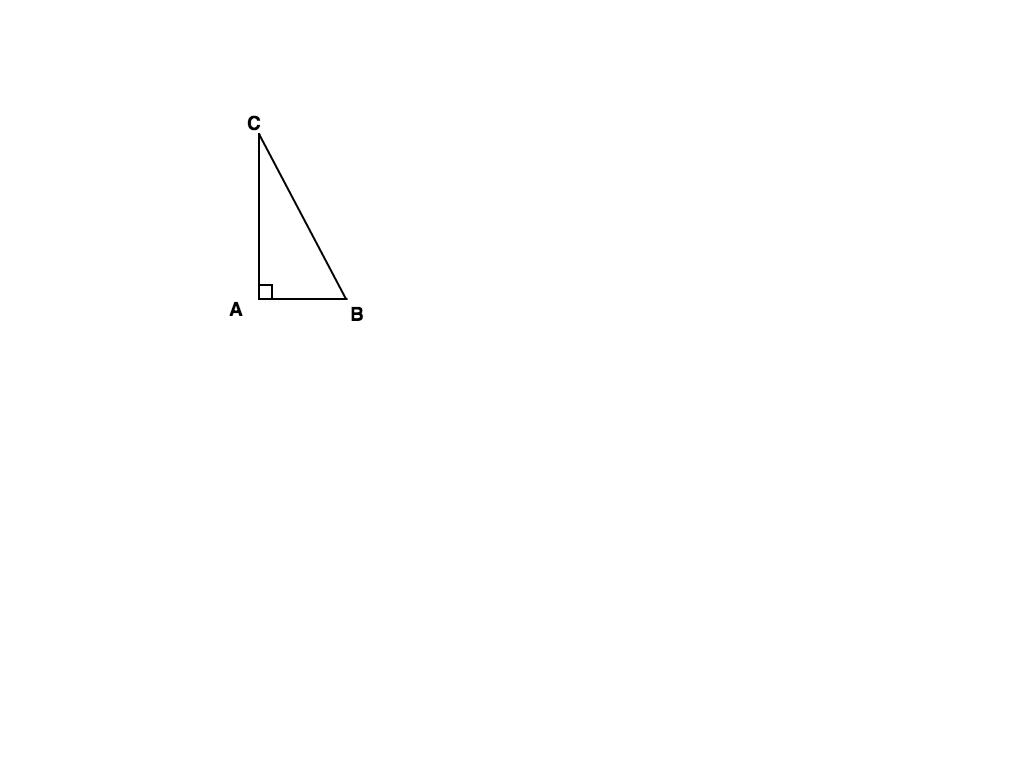
Pick the ratio of side lengths that would give sec C.
Tap to reveal answer

Find the ratio of Cosine and take the reciprocal.

Find the ratio of Cosine and take the reciprocal.
← Didn't Know|Knew It →
If  ,
, 
If
Tap to reveal answer
The sine of an angle in a right triangle (that is not the right angle) can be found by dividing the length of the side opposite the angle by the length of the hypotenuse of the triangle.
From this, the length of the side opposite the angle  is proportional to 28, and the length of the hypotenuse is proportional to 53.
Without loss of generality, we'll assume that the sides are actually of length 28 and 53, respectively.
We'll use the Pythagorean theorem to determine the length of the adjacent side, which we'll refer to as  .
.

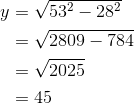
The cotangent of an angle in a right triangle (that is not the right angle) is can be found by dividing the length of the adjacent side by the length of the opposite side.

The sine of an angle in a right triangle (that is not the right angle) can be found by dividing the length of the side opposite the angle by the length of the hypotenuse of the triangle.
From this, the length of the side opposite the angle
Without loss of generality, we'll assume that the sides are actually of length 28 and 53, respectively.
We'll use the Pythagorean theorem to determine the length of the adjacent side, which we'll refer to as
The cotangent of an angle in a right triangle (that is not the right angle) is can be found by dividing the length of the adjacent side by the length of the opposite side.
← Didn't Know|Knew It →
Find the value of the trigonometric function in fraction form for triangle .
What is the secant of ?
Find the value of the trigonometric function in fraction form for triangle
What is the secant of
Tap to reveal answer
The value of the secant of an angle is the value of the hypotenuse over the adjacent.
Therefore:
The value of the secant of an angle is the value of the hypotenuse over the adjacent.
Therefore:
← Didn't Know|Knew It →
Which of the following is the equivalent to ?
Which of the following is the equivalent to
Tap to reveal answer
Since :
Since
← Didn't Know|Knew It →
For the above triangle, what is if , and ?
For the above triangle, what is
Tap to reveal answer
Secant is the reciprocal of cosine.
It's formula is:
Substituting the values from the problem we get,
Secant is the reciprocal of cosine.
It's formula is:
Substituting the values from the problem we get,
← Didn't Know|Knew It →
For the above triangle, what is if , and ?
For the above triangle, what is
Tap to reveal answer
Cotangent is the reciprocal of tangent.
It's formula is:
Substituting the values from the problem we get,
Cotangent is the reciprocal of tangent.
It's formula is:
Substituting the values from the problem we get,
← Didn't Know|Knew It →
Evaluate:
Evaluate:
Tap to reveal answer
Evaluate each term separately.
Evaluate each term separately.
← Didn't Know|Knew It →
Determine the value of .
Determine the value of
Tap to reveal answer
Rewrite in terms of sine and cosine.
Rewrite
← Didn't Know|Knew It →
Pick the ratio of side lengths that would give sec C.
Pick the ratio of side lengths that would give sec C.
Tap to reveal answer
Find the ratio of Cosine and take the reciprocal.
Find the ratio of Cosine and take the reciprocal.
← Didn't Know|Knew It →
If ,
If
Tap to reveal answer
The sine of an angle in a right triangle (that is not the right angle) can be found by dividing the length of the side opposite the angle by the length of the hypotenuse of the triangle.
From this, the length of the side opposite the angle is proportional to 28, and the length of the hypotenuse is proportional to 53.
Without loss of generality, we'll assume that the sides are actually of length 28 and 53, respectively.
We'll use the Pythagorean theorem to determine the length of the adjacent side, which we'll refer to as .
The cotangent of an angle in a right triangle (that is not the right angle) is can be found by dividing the length of the adjacent side by the length of the opposite side.
The sine of an angle in a right triangle (that is not the right angle) can be found by dividing the length of the side opposite the angle by the length of the hypotenuse of the triangle.
From this, the length of the side opposite the angle
Without loss of generality, we'll assume that the sides are actually of length 28 and 53, respectively.
We'll use the Pythagorean theorem to determine the length of the adjacent side, which we'll refer to as
The cotangent of an angle in a right triangle (that is not the right angle) is can be found by dividing the length of the adjacent side by the length of the opposite side.
← Didn't Know|Knew It →
Find the value of the trigonometric function in fraction form for triangle .
What is the secant of ?
Find the value of the trigonometric function in fraction form for triangle
What is the secant of
Tap to reveal answer
The value of the secant of an angle is the value of the hypotenuse over the adjacent.
Therefore:
The value of the secant of an angle is the value of the hypotenuse over the adjacent.
Therefore:
← Didn't Know|Knew It →
Which of the following is the equivalent to ?
Which of the following is the equivalent to
Tap to reveal answer
Since :
Since
← Didn't Know|Knew It →
For the above triangle, what is if , and ?
For the above triangle, what is
Tap to reveal answer
Secant is the reciprocal of cosine.
It's formula is:
Substituting the values from the problem we get,
Secant is the reciprocal of cosine.
It's formula is:
Substituting the values from the problem we get,
← Didn't Know|Knew It →
For the above triangle, what is if , and ?
For the above triangle, what is
Tap to reveal answer
Cotangent is the reciprocal of tangent.
It's formula is:
Substituting the values from the problem we get,
Cotangent is the reciprocal of tangent.
It's formula is:
Substituting the values from the problem we get,
← Didn't Know|Knew It →