Finding Sides - Trigonometry
Card 1 of 56
If the height of the stair is 2 ft, and the length of the stair is 3 ft, how long must the ramp be to cover the stair?
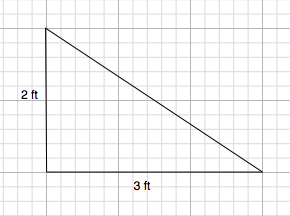
If the height of the stair is 2 ft, and the length of the stair is 3 ft, how long must the ramp be to cover the stair?
Tap to reveal answer
Use the Pythagorean triangle to solve for the third side of the triangle.


Simplify and you have the answer:

Use the Pythagorean triangle to solve for the third side of the triangle.
Simplify and you have the answer:
← Didn't Know|Knew It →
A surveyor looks up to the top of a mountain at an angle of 35 degrees. If the surveyor is 2400 feet from the base of the mountain, how tall is the mountain (to the nearest tenth of a foot)?
A surveyor looks up to the top of a mountain at an angle of 35 degrees. If the surveyor is 2400 feet from the base of the mountain, how tall is the mountain (to the nearest tenth of a foot)?
Tap to reveal answer
This is a typical angle of elevation problem.
From the question, we can infer that the ratio of the mountain height to the surveyor's horizontal distance from the mountain is equal to the tangent of 35 degrees - the mountain height is the "opposite side", while the horizontal distance is the "adjacent side". In other words:

Solving for the mountain height gives a vertical distance of 1680.5 feet.
This is a typical angle of elevation problem.
From the question, we can infer that the ratio of the mountain height to the surveyor's horizontal distance from the mountain is equal to the tangent of 35 degrees - the mountain height is the "opposite side", while the horizontal distance is the "adjacent side". In other words:
Solving for the mountain height gives a vertical distance of 1680.5 feet.
← Didn't Know|Knew It →
In a right triangle, the legs are  and
and  . What is the length of the hypotenuse?
In a right triangle, the legs are
Tap to reveal answer
Here, we can use the Pythagorean Theorem.
This states that the sum of the squares of the legs is equal to the square of the hypotenuse.
Thus, we plug into the formula to get our hypotenuse.


Here, we can use the Pythagorean Theorem.
This states that the sum of the squares of the legs is equal to the square of the hypotenuse.
Thus, we plug into the formula to get our hypotenuse.
← Didn't Know|Knew It →
If the altitude of a triangle has a height of 5, and also bisects a 60 degree angle, what must be the perimeter of the full triangle?
If the altitude of a triangle has a height of 5, and also bisects a 60 degree angle, what must be the perimeter of the full triangle?
Tap to reveal answer
The altitude of the triangle splits the 60 degree angle into two 30 degree angles. Notice that this will create two right triangles with 30-60-90 angles. This indicates that the full triangle is an equilateral triangle.
The altitude represents the adjacent side of the split triangles. The bisected angle is 30 degrees. Find the hypotenuse of either split triangle. This is the side length of the equilateral triangle.


Rationalize the denominator.
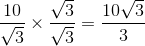
Since the full triangle has three sides, multiply this value by three for the perimeter.
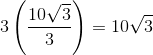
The altitude of the triangle splits the 60 degree angle into two 30 degree angles. Notice that this will create two right triangles with 30-60-90 angles. This indicates that the full triangle is an equilateral triangle.
The altitude represents the adjacent side of the split triangles. The bisected angle is 30 degrees. Find the hypotenuse of either split triangle. This is the side length of the equilateral triangle.
Rationalize the denominator.
Since the full triangle has three sides, multiply this value by three for the perimeter.
← Didn't Know|Knew It →
A horizontal ramp of unknown length meets the ground at angle of 20°. The height of the ramp is 6 feet and makes a right angle with the ground. What is the length of the ramp?
A horizontal ramp of unknown length meets the ground at angle of 20°. The height of the ramp is 6 feet and makes a right angle with the ground. What is the length of the ramp?
Tap to reveal answer
The question is looking for the length of the ramp which would be the length of the part one would walk on and is also synonymous with the hypotenuse of our right triangle. With the given angle and opposite side we can use the sine function to solve for the length of the ramp because
 .
.
We have all but the length of the hypotenuse.
Solve for the hypotenuse:

Plug in the angles and sides given:
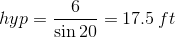
The question is looking for the length of the ramp which would be the length of the part one would walk on and is also synonymous with the hypotenuse of our right triangle. With the given angle and opposite side we can use the sine function to solve for the length of the ramp because
We have all but the length of the hypotenuse.
Solve for the hypotenuse:
Plug in the angles and sides given:
← Didn't Know|Knew It →
A zipline is attached from the edge of the roof of a 23 foot high building and meets the ground 23 feet from the base of the building. Find the angle  of elevation the cable makes with the ground.
A zipline is attached from the edge of the roof of a 23 foot high building and meets the ground 23 feet from the base of the building. Find the angle
Tap to reveal answer
Concerning the angle of elevation which we are to find, we know the side length opposite this angle and the side length adjacent to it.
We use
 .
.
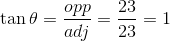
Take the inverse of tan to find the corresponding angle:

A short cut for solving is to realize right triangles with equal sides must have two 45° angles!
Concerning the angle of elevation which we are to find, we know the side length opposite this angle and the side length adjacent to it.
We use
Take the inverse of tan to find the corresponding angle:
A short cut for solving is to realize right triangles with equal sides must have two 45° angles!
← Didn't Know|Knew It →
In a right triangle, one of the legs has a length of  and a hypotenuse of
  . Find the length of the other side...
In a right triangle, one of the legs has a length of
Tap to reveal answer
Step 1: To find the missing side of a right triangle using the Pythagorean Theorem:
 .
.
Step 2: Substitute in the known values.
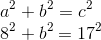
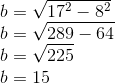
Step 3: Solve for the missing variable by manipulating the equation to isolate the variable.
Step 1: To find the missing side of a right triangle using the Pythagorean Theorem:
Step 2: Substitute in the known values.
Step 3: Solve for the missing variable by manipulating the equation to isolate the variable.
← Didn't Know|Knew It →
If the two legs of a right triangle are 5 and 7 respectively, what is the length of the hypotenuse?
If the two legs of a right triangle are 5 and 7 respectively, what is the length of the hypotenuse?
Tap to reveal answer
Step 1: Recall the Pythagorean Theorem:
 , where
  are the legs of the triangle.
Step 2: Plug in the values that are given for the legs into the theorem:

Evaluate:

Add:

Step 3: To find  , take the square root of both sides:

Reduce (if possible):

The length of the hypotenuse is  .
.
Step 1: Recall the Pythagorean Theorem:
Step 2: Plug in the values that are given for the legs into the theorem:
Evaluate:
Add:
Step 3: To find
Reduce (if possible):
The length of the hypotenuse is
← Didn't Know|Knew It →
If  is between
  and
and  degrees, and
  , what is
  ?
?
If
Tap to reveal answer

Using Pythagoras theory, you can see that  is
is  . If
. If  is
is  , than
  is
is  , because
  is
is 
Using Pythagoras theory, you can see that
← Didn't Know|Knew It →
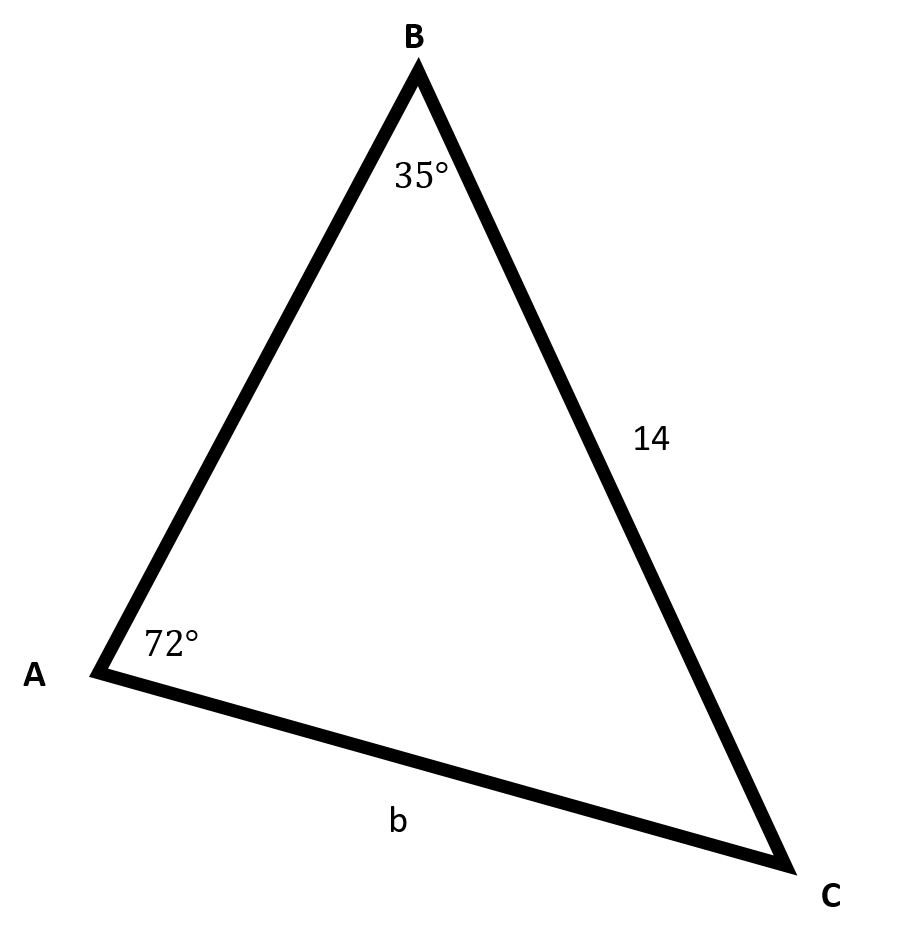
Find the length of  .
.
Find the length of
Tap to reveal answer

Recall the Law of Sines for a generic triangle, as shown above:
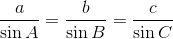
Plug in the given values into the Law of Sines:
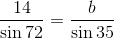
Rearrange the equation to solve for  :
:

Make sure to round to two places after the decimal.
Recall the Law of Sines for a generic triangle, as shown above:
Plug in the given values into the Law of Sines:
Rearrange the equation to solve for
Make sure to round to two places after the decimal.
← Didn't Know|Knew It →
Find the length of side  .
.
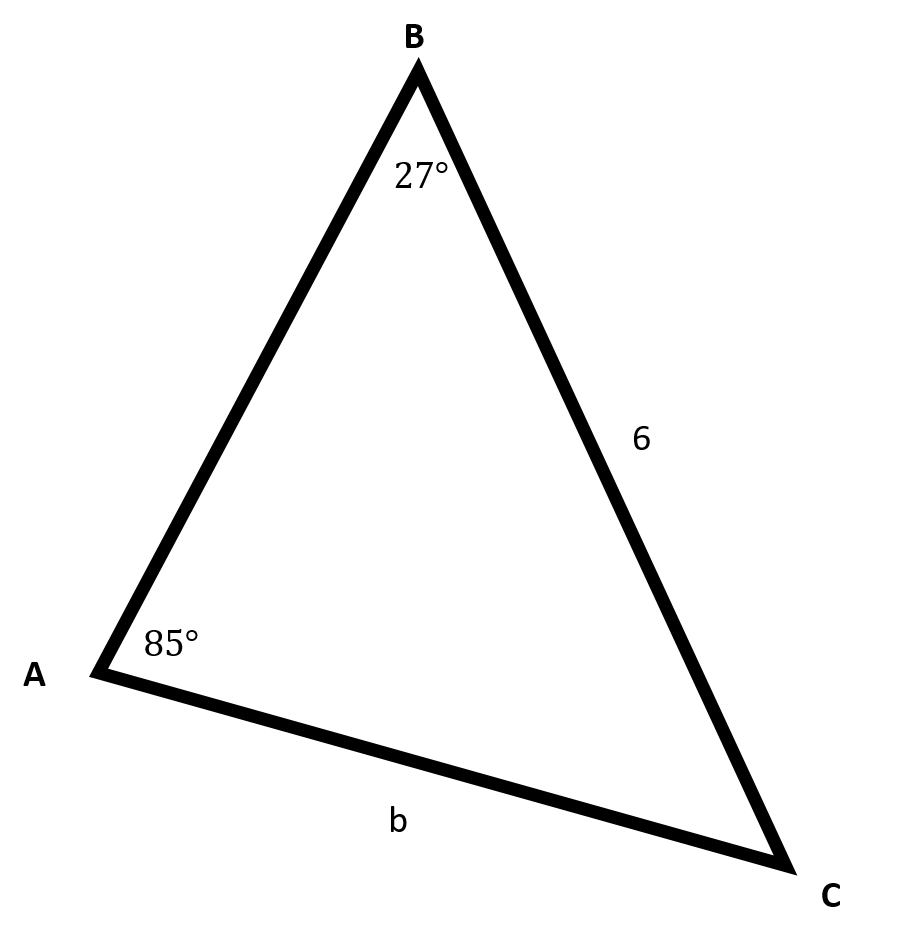
Find the length of side
Tap to reveal answer
Recall the Law of Sines:
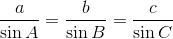
Plug in the given values into the Law of Sines:
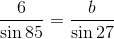
Rearrange the equation to solve for  :
:

Make sure to round to two places after the decimal.
Recall the Law of Sines:
Plug in the given values into the Law of Sines:
Rearrange the equation to solve for
Make sure to round to two places after the decimal.
← Didn't Know|Knew It →
Find the length of side  .
.

Find the length of side
Tap to reveal answer
Recall the Law of Sines:

Plug in the given values into the Law of Sines:

Rearrange the equation to solve for  :
:

Make sure to round to two places after the decimal.
Recall the Law of Sines:
Plug in the given values into the Law of Sines:
Rearrange the equation to solve for
Make sure to round to two places after the decimal.
← Didn't Know|Knew It →
Find the length of side  .
.

Find the length of side
Tap to reveal answer
Recall the Law of Sines:

Plug in the given values into the Law of Sines:

Rearrange the equation to solve for  :
:

Make sure to round to two places after the decimal.
Recall the Law of Sines:
Plug in the given values into the Law of Sines:
Rearrange the equation to solve for
Make sure to round to two places after the decimal.
← Didn't Know|Knew It →
Find the length of side  .
.

Find the length of side
Tap to reveal answer
Recall the Law of Sines:

Start by finding the value of angle  :
:


Plug in the given values into the Law of Sines:

Rearrange the equation to solve for  :
:

Make sure to round to two places after the decimal.
Recall the Law of Sines:
Start by finding the value of angle
Plug in the given values into the Law of Sines:
Rearrange the equation to solve for
Make sure to round to two places after the decimal.
← Didn't Know|Knew It →
A zipline is attached from the edge of the roof of a 23 foot high building and meets the ground 23 feet from the base of the building. Find the angle of elevation the cable makes with the ground.
A zipline is attached from the edge of the roof of a 23 foot high building and meets the ground 23 feet from the base of the building. Find the angle
Tap to reveal answer
Concerning the angle of elevation which we are to find, we know the side length opposite this angle and the side length adjacent to it.
We use
.
Take the inverse of tan to find the corresponding angle:
A short cut for solving is to realize right triangles with equal sides must have two 45° angles!
Concerning the angle of elevation which we are to find, we know the side length opposite this angle and the side length adjacent to it.
We use
Take the inverse of tan to find the corresponding angle:
A short cut for solving is to realize right triangles with equal sides must have two 45° angles!
← Didn't Know|Knew It →
If the height of the stair is 2 ft, and the length of the stair is 3 ft, how long must the ramp be to cover the stair?
If the height of the stair is 2 ft, and the length of the stair is 3 ft, how long must the ramp be to cover the stair?
Tap to reveal answer
Use the Pythagorean triangle to solve for the third side of the triangle.
Simplify and you have the answer:
Use the Pythagorean triangle to solve for the third side of the triangle.
Simplify and you have the answer:
← Didn't Know|Knew It →
A surveyor looks up to the top of a mountain at an angle of 35 degrees. If the surveyor is 2400 feet from the base of the mountain, how tall is the mountain (to the nearest tenth of a foot)?
A surveyor looks up to the top of a mountain at an angle of 35 degrees. If the surveyor is 2400 feet from the base of the mountain, how tall is the mountain (to the nearest tenth of a foot)?
Tap to reveal answer
This is a typical angle of elevation problem.
From the question, we can infer that the ratio of the mountain height to the surveyor's horizontal distance from the mountain is equal to the tangent of 35 degrees - the mountain height is the "opposite side", while the horizontal distance is the "adjacent side". In other words:
Solving for the mountain height gives a vertical distance of 1680.5 feet.
This is a typical angle of elevation problem.
From the question, we can infer that the ratio of the mountain height to the surveyor's horizontal distance from the mountain is equal to the tangent of 35 degrees - the mountain height is the "opposite side", while the horizontal distance is the "adjacent side". In other words:
Solving for the mountain height gives a vertical distance of 1680.5 feet.
← Didn't Know|Knew It →
In a right triangle, the legs are and . What is the length of the hypotenuse?
In a right triangle, the legs are
Tap to reveal answer
Here, we can use the Pythagorean Theorem.
This states that the sum of the squares of the legs is equal to the square of the hypotenuse.
Thus, we plug into the formula to get our hypotenuse.
Here, we can use the Pythagorean Theorem.
This states that the sum of the squares of the legs is equal to the square of the hypotenuse.
Thus, we plug into the formula to get our hypotenuse.
← Didn't Know|Knew It →
If the altitude of a triangle has a height of 5, and also bisects a 60 degree angle, what must be the perimeter of the full triangle?
If the altitude of a triangle has a height of 5, and also bisects a 60 degree angle, what must be the perimeter of the full triangle?
Tap to reveal answer
The altitude of the triangle splits the 60 degree angle into two 30 degree angles. Notice that this will create two right triangles with 30-60-90 angles. This indicates that the full triangle is an equilateral triangle.
The altitude represents the adjacent side of the split triangles. The bisected angle is 30 degrees. Find the hypotenuse of either split triangle. This is the side length of the equilateral triangle.
Rationalize the denominator.
Since the full triangle has three sides, multiply this value by three for the perimeter.
The altitude of the triangle splits the 60 degree angle into two 30 degree angles. Notice that this will create two right triangles with 30-60-90 angles. This indicates that the full triangle is an equilateral triangle.
The altitude represents the adjacent side of the split triangles. The bisected angle is 30 degrees. Find the hypotenuse of either split triangle. This is the side length of the equilateral triangle.
Rationalize the denominator.
Since the full triangle has three sides, multiply this value by three for the perimeter.
← Didn't Know|Knew It →
A horizontal ramp of unknown length meets the ground at angle of 20°. The height of the ramp is 6 feet and makes a right angle with the ground. What is the length of the ramp?
A horizontal ramp of unknown length meets the ground at angle of 20°. The height of the ramp is 6 feet and makes a right angle with the ground. What is the length of the ramp?
Tap to reveal answer
The question is looking for the length of the ramp which would be the length of the part one would walk on and is also synonymous with the hypotenuse of our right triangle. With the given angle and opposite side we can use the sine function to solve for the length of the ramp because
.
We have all but the length of the hypotenuse.
Solve for the hypotenuse:
Plug in the angles and sides given:
The question is looking for the length of the ramp which would be the length of the part one would walk on and is also synonymous with the hypotenuse of our right triangle. With the given angle and opposite side we can use the sine function to solve for the length of the ramp because
We have all but the length of the hypotenuse.
Solve for the hypotenuse:
Plug in the angles and sides given:
← Didn't Know|Knew It →