Complex Numbers/Polar Form - Trigonometry
Card 1 of 104
Name the real part of this expression and the imaginary part of this expression:  .
.
Name the real part of this expression and the imaginary part of this expression: 
Tap to reveal answer
The real part of this expression includes any terms that do not have  attached to them. Therefore the real part of this expression is 3. The imaginary part of this expression includes any terms with
  that cannot be further reduced; the imaginary part of this expression is
  .
.
The real part of this expression includes any terms that do not have 


← Didn't Know|Knew It →
Find the product of the complex number and its conjugate:

Find the product of the complex number and its conjugate:
Tap to reveal answer
To solve this problem, we must first identify the conjugate of this complex number. The conjugate keeps the real portion of the number the same, but changes the sign of the imaginary part of the number. Therefore the conjugate of is  . Now, we need to multiply these together using distribution, combining like terms, and substituting
  .
.


To solve this problem, we must first identify the conjugate of this complex number. The conjugate keeps the real portion of the number the same, but changes the sign of the imaginary part of the number. Therefore the conjugate of 

← Didn't Know|Knew It →
What is the complex conjugate of  ?
?
What is the complex conjugate of 
Tap to reveal answer
To solve this problem, we must understand what a complex conjugate is and how it relates to a complex number. The conjugate of a number  is
is  . Therefore the conjugate of
  is
is  .
.
To solve this problem, we must understand what a complex conjugate is and how it relates to a complex number. The conjugate of a number 


← Didn't Know|Knew It →
Simplify  .
.
Simplify 
Tap to reveal answer
To add complex numbers, we must combine like terms: real with real, and imaginary with imaginary.


To add complex numbers, we must combine like terms: real with real, and imaginary with imaginary.


← Didn't Know|Knew It →
Simplify  .
.
Simplify 
Tap to reveal answer
In order to solve this problem, we must combine real numbers with real numbers and imaginary numbers with imaginary numbers. Be careful to distribute the subtraction sign to all terms in the second set of parentheses.


In order to solve this problem, we must combine real numbers with real numbers and imaginary numbers with imaginary numbers. Be careful to distribute the subtraction sign to all terms in the second set of parentheses.


← Didn't Know|Knew It →
Simplify  .
.
Simplify 
Tap to reveal answer
To solve this problem, make sure you set it up to multiply the entire parentheses by itself (a common mistake it to try to simply distribute the exponent 2 to each of the terms in the parentheses.)


 (recall that
  )
)

Please note that while the answer choice  is not incorrect, it is not fully simplified and therefore not the correct choice.
To solve this problem, make sure you set it up to multiply the entire parentheses by itself (a common mistake it to try to simply distribute the exponent 2 to each of the terms in the parentheses.)


Please note that while the answer choice 
← Didn't Know|Knew It →
What is the complex conjugate of 5? What is the complex conjugate of 3i?
What is the complex conjugate of 5? What is the complex conjugate of 3i?
Tap to reveal answer
While these terms may not look like they follow the typical format of  , don't let them fool you! We can read 5 as
  and we can read 3i as
  . Now recalling that the complex conjugate of
  is
is  , we can see that the complex conjugate of
  is just
  and the complex conjugate of
  is
is 
While these terms may not look like they follow the typical format of 


← Didn't Know|Knew It →
Perform division on the following expression by utilizing a complex conjugate:

Perform division on the following expression by utilizing a complex conjugate:

Tap to reveal answer
To perform division on complex numbers, multiple both the numerator and the denominator of the fraction by the complex conjugate of the denominator. This looks like:


To perform division on complex numbers, multiple both the numerator and the denominator of the fraction by the complex conjugate of the denominator. This looks like:


← Didn't Know|Knew It →
Which of the following represents  graphically?
Which of the following represents 
Tap to reveal answer
To represent complex numbers graphically, we treat the x-axis as the "axis of reals" and the y-axis as the "axis of imaginaries." To plot  , we want to move 6 units on the x-axis and -3 units on the y-axis. We can plot the point P to represent
  , but we can also represent it by drawing a vector from the origin to point P. Both representations are in the diagram below.

To represent complex numbers graphically, we treat the x-axis as the "axis of reals" and the y-axis as the "axis of imaginaries." To plot 

← Didn't Know|Knew It →
The following graph represents which one of the following?

The following graph represents which one of the following?
Tap to reveal answer
We can take any complex number  and graph it as a vector, measuring
  units in the x direction and
  units in the y direction. Therefore
  . Likewise,
  . Then, we can add these two vectors together, summing their real parts and their imaginary parts to create their resultant vector
  . Therefore the correct answer is
  .
.
We can take any complex number 


← Didn't Know|Knew It →
The following graph represents which one of the following?

The following graph represents which one of the following?
Tap to reveal answer
The above image is a graphic representation of subtraction of complex numbers (which are represented by vectors  and
and  . We can take any complex number
  and graph it as a vector, measuring
  units in the x direction and
  units in the y direction. Therefore
  . Likewise,
  .
.
To help us visualize subtraction, instead of thinking about taking  , we should instead visualize
  . The below figure shows
  with a dotted line. Visually, the resultant vector
  lies in between the vectors
  and
and  . Algebraically, we get
 or
or 
 . Either way you think about it, the resulting vector is

The above image is a graphic representation of subtraction of complex numbers (which are represented by vectors 


To help us visualize subtraction, instead of thinking about taking 


← Didn't Know|Knew It →
The polar coordinates  of a point are
  . Convert these polar coordinates to rectangular coordinates.
The polar coordinates 
Tap to reveal answer
Given the polar coordinates  , the
, the  -coordinate is
  . We can find this coordinate by substituting
 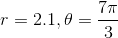 :
:

Likewise, given the polar coordinates  , the
, the  -coordinate is
  . We can find this coordinate by substituting
 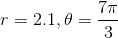 :
:

Therefore the rectangular coordinates of the point are  .
.
Given the polar coordinates
Likewise, given the polar coordinates
Therefore the rectangular coordinates of the point 
← Didn't Know|Knew It →
Express the complex number  in rectangular form.
Express the complex number 
Tap to reveal answer
To convert this number to rectangular form, first think about what  and
and  are equal to. Because
  , we can use a 30-60-90o reference triangle in the 3rd quadrant to determine these values.


Now plug these in and continue solving:


To convert this number to rectangular form, first think about what 


Now plug these in and continue solving:


← Didn't Know|Knew It →
For the complex number  , find the modulus
  and the angle
  . Then, express this number in polar form
  .
.
For the complex number 


Tap to reveal answer
This problem has given us formulas, so we just need to plug in  and
and  and solve.


This problem has given us formulas, so we just need to plug in 


← Didn't Know|Knew It →
Express the complex number  in rectangular form
  .
.
Express the complex number 

Tap to reveal answer
To convert this number to rectangular form, first think about what  and
and  are equal to. We can use a 30-60-90o reference triangle in the 1st quadrant to determine these values.


Next, plug these values in and simplify:


To convert this number to rectangular form, first think about what 


Next, plug these values in and simplify:


← Didn't Know|Knew It →
For the complex number  , find the modulus
  and the angle
  . Then, express this number in polar form
  .
.
For the complex number 


Tap to reveal answer
This problem has given us formulas, so we just need to plug in  and
and  and solve.


This problem has given us formulas, so we just need to plug in 


← Didn't Know|Knew It →
Express the complex number  in polar form.
Express the complex number 
Tap to reveal answer
In order to complete this problem, you must understand three formulas that allow you to convert from the rectangular form of a complex number to the polar form of a complex number. These formulas are  ,
,  , and the polar form
  . Additionally, understand that based on the given info,
  and
and  . Begin by finding the modulus:


Next, let's find the angle  , also referred to as the amplitude of the complex number.


Finally, plug each of these into the polar form of a complex number:


In order to complete this problem, you must understand three formulas that allow you to convert from the rectangular form of a complex number to the polar form of a complex number. These formulas are 


Next, let's find the angle 


Finally, plug each of these into the polar form of a complex number:


← Didn't Know|Knew It →
Multiply the following complex numbers (in polar form), giving the result in both polar and rectangular form.

Multiply the following complex numbers (in polar form), giving the result in both polar and rectangular form.

Tap to reveal answer
The modulus of the product of two complex numbers is the product of their moduli, and the amplitude of the product is the sum of their amplitudes.
Therefore, the new modulus will be  and the new amplitude will be
  . Therefore


We must also express this in rectangular form, which we can do by substituting  and
and  . We get:


The modulus of the product of two complex numbers is the product of their moduli, and the amplitude of the product is the sum of their amplitudes.
Therefore, the new modulus will be 


We must also express this in rectangular form, which we can do by substituting 


← Didn't Know|Knew It →
Find the following quotients, given that  and
and  . Give results in both polar and rectangular forms.
(a) 
(b) 
Find the following quotients, given that 

(a)

(b)

Tap to reveal answer
The modulus of the quotient of two complex numbers is the modulus of the dividend divided by the modulus of the divisor. The amplitude of the quotient is the amplitude of the dividend minus the amplitude of hte divisor.
(a) The modulus for  is equal to
  . The amplitude for
  is equal to
  . (We have chosen to represent this as the coterminal angle
  rather than
  as it is more conventional to represent angle measures as a positive angle between
  and
and  .) Putting this together, we get
  . To represent this in rectangular form, substitute
  and
and  to get
  .
.
(b) The modulus for  is equal to
  . The amplitude for
  is equal to
  . Putting this together, we get
  . To represent this in rectangular form, substitute
  and
and  to get
  .
.
The modulus of the quotient of two complex numbers is the modulus of the dividend divided by the modulus of the divisor. The amplitude of the quotient is the amplitude of the dividend minus the amplitude of hte divisor.
(a) The modulus for 


(b) The modulus for 


← Didn't Know|Knew It →
The polar coordinates of a point are . Convert these polar coordinates to rectangular coordinates.
The polar coordinates
Tap to reveal answer
Given the polar coordinates , the -coordinate is . We can find this coordinate by substituting :
Likewise, given the polar coordinates , the -coordinate is . We can find this coordinate by substituting :
Therefore the rectangular coordinates of the point are .
Given the polar coordinates
Likewise, given the polar coordinates
Therefore the rectangular coordinates of the point
← Didn't Know|Knew It →