Right Triangles - SSAT Upper Level Quantitative
Card 1 of 236
The base and height of a right triangle are each 1 inch. What is the hypotenuse?
The base and height of a right triangle are each 1 inch. What is the hypotenuse?
Tap to reveal answer
You need to use the Pythagorean Theorem, which is  .
.
Add the first two values and you get  . Take the square root of both sides and you get
  .
.
You need to use the Pythagorean Theorem, which is
Add the first two values and you get
← Didn't Know|Knew It →
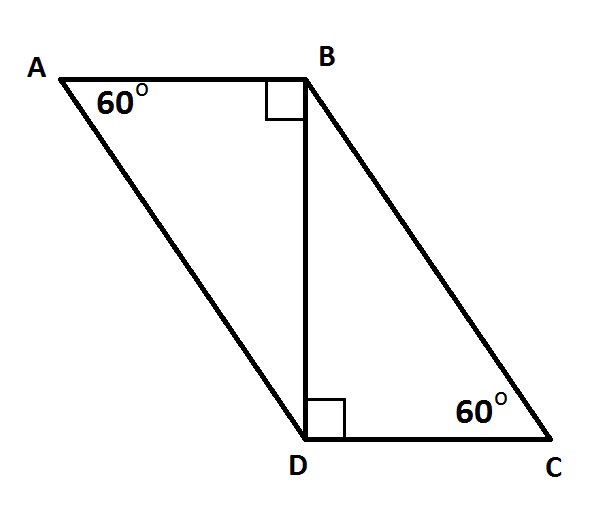
Give the perimeter of the above parallelogram if  .
.
Give the perimeter of the above parallelogram if
Tap to reveal answer
By the  Theorem:
 , and
, and

The perimeter of the parallelogram is

By the
The perimeter of the parallelogram is
← Didn't Know|Knew It →
A right triangle has legs with lengths of  units and
  units. What is the length of the hypotenuse?
A right triangle has legs with lengths of
Tap to reveal answer

Using the numbers given to us by the question,
 units
units
Using the numbers given to us by the question,
← Didn't Know|Knew It →
A right triangle has legs with the lengths  and
and  . Find the length of the hypotenuse.
A right triangle has legs with the lengths
Tap to reveal answer
Use the Pythagorean Theorem to find the length of the hypotenuse.


Use the Pythagorean Theorem to find the length of the hypotenuse.
← Didn't Know|Knew It →
Find the length of the hypotenuse in the right triangle below.
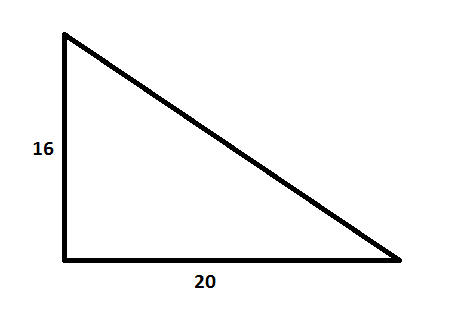
Find the length of the hypotenuse in the right triangle below.
Tap to reveal answer
Use the Pythagorean Theorem to find the hypotenuse.



Use the Pythagorean Theorem to find the hypotenuse.
← Didn't Know|Knew It →
If James traveled north  and John traveled
  west from the same town, how many miles away will they be from each other when they reach their destinations?
If James traveled north
Tap to reveal answer
The distances when put together create a right triangle.
The distance between them will be the hypotenuse or the diagonal side.
You use Pythagorean Theorem or  to find the length.
So you plug  and
and  for
for  and
and  which gives you,
 or
or  .
.
Then you find the square root of each side and that gives you your answer of  .
.
The distances when put together create a right triangle.
The distance between them will be the hypotenuse or the diagonal side.
You use Pythagorean Theorem or
So you plug
Then you find the square root of each side and that gives you your answer of
← Didn't Know|Knew It →
One angle of a right triangle has measure  . Give the measures of the other two angles.
One angle of a right triangle has measure
Tap to reveal answer
One of the angles of a right triangle is by definition a right, or  , angle, so this is the measure of one of the missing angles. Since the measures of the angles of a triangle total
  , if we let the measure of the third angle be
  , then:




The other two angles measure  .
.
One of the angles of a right triangle is by definition a right, or
The other two angles measure
← Didn't Know|Knew It →
One angle of a right triangle has measure  . Give the measures of the other two angles.
One angle of a right triangle has measure
Tap to reveal answer
A right triangle must have one right angle and two acute angles; this means that no angle of a right triangle can be obtuse. But since  , it is obtuse. This makes it impossible for a right triangle to have a
  angle.
A right triangle must have one right angle and two acute angles; this means that no angle of a right triangle can be obtuse. But since
← Didn't Know|Knew It →
Find the degree measure of  in the right triangle below.
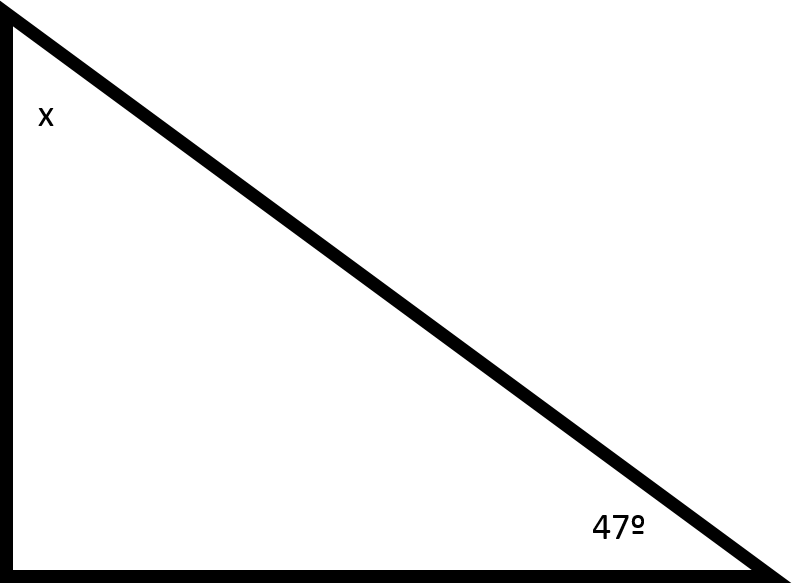
Find the degree measure of
Tap to reveal answer
The total number of degrees in a triangle is  .
.
While  is provided as the measure of one of the angles in the diagram, you are also told that the triangle is a right triangle, meaning that it must contain a
  angle as well. To find the value of
  , subtract the other two degree measures from
  .
.

The total number of degrees in a triangle is
While
← Didn't Know|Knew It →
Find the angle value of  .
.

Find the angle value of
Tap to reveal answer
All the angles in a triangle must add up to 180 degrees.




All the angles in a triangle must add up to 180 degrees.
← Didn't Know|Knew It →
Find the angle value of  .
.

Find the angle value of
Tap to reveal answer
All the angles in a triangle adds up to  .
.




All the angles in a triangle adds up to
← Didn't Know|Knew It →
Find the angle value of  .
.

Find the angle value of
Tap to reveal answer
All the angles in a triangle add up to  degrees.




All the angles in a triangle add up to
← Didn't Know|Knew It →
Find the angle measure of  .
.

Find the angle measure of
Tap to reveal answer
All the angles in a triangle add up to  .
.




All the angles in a triangle add up to
← Didn't Know|Knew It →
If a  right triangle is similar to a
  right triangle, which of the other triangles must also be a similar triangle?
If a
Tap to reveal answer
For the triangles to be similar, the dimensions of all sides must have the same ratio by dividing the 3-4-5 triangle.
The 6-8-10 triangle will have a scale factor of 2 since all dimensions are doubled the original 3-4-5 triangle.
The only correct answer that will yield similar ratios is the  triangle with a scale factor of 4 from the 3-4-5 triangle.
The other answers will yield different ratios.
For the triangles to be similar, the dimensions of all sides must have the same ratio by dividing the 3-4-5 triangle.
The 6-8-10 triangle will have a scale factor of 2 since all dimensions are doubled the original 3-4-5 triangle.
The only correct answer that will yield similar ratios is the
The other answers will yield different ratios.
← Didn't Know|Knew It →
What is the main difference between a right triangle and an isosceles triangle?
What is the main difference between a right triangle and an isosceles triangle?
Tap to reveal answer
By definition, a right triangle has to have one right angle, or a  angle, and an isosceles triangle has
  equal base angles and two equal side lengths.
By definition, a right triangle has to have one right angle, or a
← Didn't Know|Knew It →
 , where
  is a right angle,
  , and
, and  .
.
Which of the following is true?
Which of the following is true?
Tap to reveal answer
, and corresponding parts of congruent triangles are congruent.
Since is a right angle, so is  .
.  and
and  ; since , it follows that
  .
.  is an isosceles right triangle; consequently,
  .
.
 is a 45-45-90 triangle with hypotenuse of length
  . By the 45-45-90 Triangle Theorem, the length of each leg is equal to that of the hypotenuse divided by
  ; therefore,

 is eliminated as the correct choice.
Also, the perimeter of  is
is
 .
.
This eliminates the perimeter of  being 40 as the correct choice.
Also,  is eliminated as the correct choice, since the triangle is 45-45-90.
The area of  is half the product of the lengths of its legs:
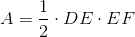
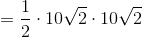
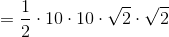
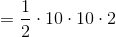

The correct choice is the statement that  has area 100.
Since
Also, the perimeter of
This eliminates the perimeter of
Also,
The area of
The correct choice is the statement that
← Didn't Know|Knew It →
Given:  and
and  with right angles
  and
and  ;
;  .
.
Which of the following statements alone, along with this given information, would prove that  ?
?
I) 
II) 
III) 
Given:
Which of the following statements alone, along with this given information, would prove that
I)
II)
III)
Tap to reveal answer
 ;
;  since both are right angles.
Given that two pairs of corresponding angles are congruent and any one side of corresponding sides is congruent, it follows that the triangles are congruent. In the case of Statement I, the included sides are congruent, so by the Angle-Side-Angle Congruence Postulate,  . In the case of the other two statements, a pair of nonincluded sides are congruent, so by the Angle-Angle-Side Congruence Theorem,
  . Therefore, the correct choice is I, II, or III.
Given that two pairs of corresponding angles are congruent and any one side of corresponding sides is congruent, it follows that the triangles are congruent. In the case of Statement I, the included sides are congruent, so by the Angle-Side-Angle Congruence Postulate,
← Didn't Know|Knew It →
Given:
 , where
  is a right angle;
  ;
;
 , where
  is a right angle and
  ;
;
 , where
  is a right angle and
  has perimeter 60;
 , where
  is a right angle and
  has area 120;
 , where
  is a right triangle and
Which of the following must be a false statement?
Given:
Which of the following must be a false statement?
Tap to reveal answer
 has as its leg lengths 10 and 24, so the length of its hypotenuse,
  , is
, is

Its perimeter is the sum of its sidelengths:

Its area is half the product of the lengths of its legs:
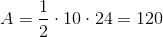
 and
and  have the same perimeter and area, respectively, as
  ; also, between
  and
and  , corresponding angles are congruent. In the absence of other information, none of these three triangles can be eliminated as being congruent to
  .
.
However,  and
and  . Therefore,
  . Since a pair of corresponding sides is noncongruent, it follows that
  .
.
Its perimeter is the sum of its sidelengths:
Its area is half the product of the lengths of its legs:
However,
← Didn't Know|Knew It →
A right triangle has a hypotenuse of 39 and one leg is 36. What is the length of the other leg?
A right triangle has a hypotenuse of 39 and one leg is 36. What is the length of the other leg?
Tap to reveal answer
You may recognize these numbers as multiples of 13 and 12 (each by a factor of 3) and remember that sides of length 5, 12 and 13 make a special right triangle. So the other leg would be 15  .
.
If you don't remember this, you can use Pythagorean theorem:


You may recognize these numbers as multiples of 13 and 12 (each by a factor of 3) and remember that sides of length 5, 12 and 13 make a special right triangle. So the other leg would be 15
If you don't remember this, you can use Pythagorean theorem:
← Didn't Know|Knew It →
A right triangle has a hypotenuse of  and one leg has a length of
  . What is the length of the other leg?
A right triangle has a hypotenuse of
Tap to reveal answer
When calculating the lengths of sides of a right triangle, we can use the Pythagorean Theorem as follows:
 , where
  and
and  are legs of the triangle and
  is the hypotenuse.
Plugging in our given values:

Subtracting  from each side of the equation:


Taking the square root of each side of the equation:

Simplifying the square root:


When calculating the lengths of sides of a right triangle, we can use the Pythagorean Theorem as follows:
Plugging in our given values:
Subtracting
Taking the square root of each side of the equation:
Simplifying the square root:
← Didn't Know|Knew It →