Decimals with Fractions - SSAT Upper Level Quantitative
Card 0 of 192
Rewrite as a fraction with whole numerator and denominator in lowest terms:

Rewrite as a fraction with whole numerator and denominator in lowest terms:
Tap to see back →
Simplify as follows:

Simplify as follows:
Rewrite as a fraction with whole numerator and denominator in lowest terms:

Rewrite as a fraction with whole numerator and denominator in lowest terms:
Tap to see back →
Simplify:

Simplify:
Tap to see back →
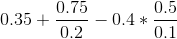
Begin by multiplying all of your decimal fractions by
:

Simplify:

Now perform the multiplication:

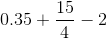
The easiest thing to do next is to subtract
from
:

Next, convert
into the fraction
:

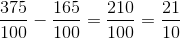
Now, the common denominator can be
:

Simplify:

Begin by multiplying all of your decimal fractions by :
Simplify:
Now perform the multiplication:
The easiest thing to do next is to subtract from
:
Next, convert into the fraction
:
Now, the common denominator can be :
Simplify:
Rewrite the following fraction in simplest form: 
Rewrite the following fraction in simplest form:
Tap to see back →
In order to rewrite
in simplest form, multiply by a form of
that makes the fraction easier to reduce - in this case ,
:

In order to rewrite in simplest form, multiply by a form of
that makes the fraction easier to reduce - in this case ,
:
What is the decimal fraction of

What is the decimal fraction of
Tap to see back →
To find the decimal equivalent of a fraction, we just apply long division. We divide the numerator by the denominator.
So

divided by

This results in

To find the decimal equivalent of a fraction, we just apply long division. We divide the numerator by the denominator.
So
divided by
This results in
Convert
to a decimal to three decimal places.
Convert to a decimal to three decimal places.
Tap to see back →
To convert any fraction to a decimal, the numerator is in the dividend and the denominator is the divisor. Then divide as you would normally. Just remember that since
can't divide into
, add a decimal point after the
and however many
s needed.
To convert any fraction to a decimal, the numerator is in the dividend and the denominator is the divisor. Then divide as you would normally. Just remember that since can't divide into
, add a decimal point after the
and however many
s needed.
Convert
to a decimal. Answer to 3 decimal places.
Convert to a decimal. Answer to 3 decimal places.
Tap to see back →
See if you can reduce the fraction before converting to a decimal. They both are divisible by
, so the new fraction becomes
. To convert any fraction to a decimal, the numerator is in the dividend and the denominator is the divisor. Then divide as you would normally. Just remember that since
can't divide into
, add a decimal point after the
and however many
s needed.
See if you can reduce the fraction before converting to a decimal. They both are divisible by , so the new fraction becomes
. To convert any fraction to a decimal, the numerator is in the dividend and the denominator is the divisor. Then divide as you would normally. Just remember that since
can't divide into
, add a decimal point after the
and however many
s needed.
Which of the following is the smallest?
I. 
II.
III. 
IV. 
V. 
Which of the following is the smallest?
I.
II.
III.
IV.
V.
Tap to see back →
There is no other way but to analyze each answer choice. We do have a decimal choice so lets compare the decimal to all of the fractions. Choice I. is
. Even if you don't see that, first divide the numerator and denominator by
, then
, and you will see that it's
Choice I is wrong**.** Choice II is definitely bigger than
. Reason is because if you look at the numerator, if I double it, that number is
. Because this value is bigger than the denominator, this means the overall fraction is bigger than
Remember, the bigger the denominator, the smaller the fraction. (
is greater than
even though
is bigger than
) The converse is the same. If apply this reasoning to both Choice III and V, only choice Vcan be eliminated. Choice III is hard to figure out the exact decimal value but if we didn't have a calculator, we can surely compare their values. Let's force choice IV into a fraction. The only way to compare these fractions easily is by having the same denominator. So, lets multiply
with
which gives us
. So we are comparing
with
. Since
is greater than
this makes choice III bigger than
and therefore makes choice IV the smallest value.
There is no other way but to analyze each answer choice. We do have a decimal choice so lets compare the decimal to all of the fractions. Choice I. is . Even if you don't see that, first divide the numerator and denominator by
, then
, and you will see that it's
Choice I is wrong**.** Choice II is definitely bigger than
. Reason is because if you look at the numerator, if I double it, that number is
. Because this value is bigger than the denominator, this means the overall fraction is bigger than
Remember, the bigger the denominator, the smaller the fraction. (
is greater than
even though
is bigger than
) The converse is the same. If apply this reasoning to both Choice III and V, only choice Vcan be eliminated. Choice III is hard to figure out the exact decimal value but if we didn't have a calculator, we can surely compare their values. Let's force choice IV into a fraction. The only way to compare these fractions easily is by having the same denominator. So, lets multiply
with
which gives us
. So we are comparing
with
. Since
is greater than
this makes choice III bigger than
and therefore makes choice IV the smallest value.
Which of the following is the biggest?
I. 
II. 
III.
IV. 
v. 
Which of the following is the biggest?
I.
II.
III.
IV.
v.
Tap to see back →
Convert the easy fractions to a decimal. Only choice IV is simple and that value is
. Lets compare to choice III which also has a decimal. Choice III is greater than choice IV so thats elminated. Lets apply a techique to determine the strengths of fractions. Lets compare choice I and II. We will cross-multiply these values but when we cross-multiply, multiply the denominator of the left fraction with the numerator of the right fraction and the product will be written next to the numerator of the right fraction. Same is done with multiplying the denominator of the right fraction with the numerator of the left fraction and the product will be written next to the numerator of the left fraction. Whichever product is greater means that fraction is greater than the other. So with choice I and II, we have products of 10200 versus 10201. Clearly 10201 is greater and that corresponds to choice II so choice I is eliminated. Lets compare now choice II and choice V. Applying this method, gives choice II the edge here. So now lets compare choice III and II. Lets convert the decimal to a fraction with a denominator of
. This gives us a comparison of
to
which means choice III is clearly the biggest.
Convert the easy fractions to a decimal. Only choice IV is simple and that value is . Lets compare to choice III which also has a decimal. Choice III is greater than choice IV so thats elminated. Lets apply a techique to determine the strengths of fractions. Lets compare choice I and II. We will cross-multiply these values but when we cross-multiply, multiply the denominator of the left fraction with the numerator of the right fraction and the product will be written next to the numerator of the right fraction. Same is done with multiplying the denominator of the right fraction with the numerator of the left fraction and the product will be written next to the numerator of the left fraction. Whichever product is greater means that fraction is greater than the other. So with choice I and II, we have products of 10200 versus 10201. Clearly 10201 is greater and that corresponds to choice II so choice I is eliminated. Lets compare now choice II and choice V. Applying this method, gives choice II the edge here. So now lets compare choice III and II. Lets convert the decimal to a fraction with a denominator of
. This gives us a comparison of
to
which means choice III is clearly the biggest.
Which fraction is equivalent to the decimal of
?
Which fraction is equivalent to the decimal of ?
Tap to see back →
By inspection, each answer choice has a denominator of
with the exception of the fraction of
. This can be fixed by dividing the fraction by
which will be
. To find the correct numerator value, just multiply
by
which is
.
By inspection, each answer choice has a denominator of with the exception of the fraction of
. This can be fixed by dividing the fraction by
which will be
. To find the correct numerator value, just multiply
by
which is
.
Convert
to a fraction.
Convert to a fraction.
Tap to see back →
Lets try to get these values into whole numbers. To do that, we need to make sure both numerator and denominator are whole numbers and we will look for the number with the most decimal places. This is found in the numerator. To get it into a whole number, we will multiply by
or move the decimal places
to the right. When you do that for the numerator, the same applies for the denominator. The new fraction is
. Just reduce the fraction by factoring out a
and the answer is shown.
Lets try to get these values into whole numbers. To do that, we need to make sure both numerator and denominator are whole numbers and we will look for the number with the most decimal places. This is found in the numerator. To get it into a whole number, we will multiply by or move the decimal places
to the right. When you do that for the numerator, the same applies for the denominator. The new fraction is
. Just reduce the fraction by factoring out a
and the answer is shown.
What's the answer in decimal form?

What's the answer in decimal form?
Tap to see back →
Convert each fraction to decimal. We have
and
. Add these values. Remember when adding decimals, make sure the decimal places are all lined up.
Convert each fraction to decimal. We have and
. Add these values. Remember when adding decimals, make sure the decimal places are all lined up.
Convert
into a simplified fraction.
Convert into a simplified fraction.
Tap to see back →
Lets place a
under the decimal. We are going to make a fraction. Essentially, it's still the same value. Now, we want a whole number in the numerator and what we do to the numerator is done to the denominator as well. Lets multiply the top by
or move the decimal place
spots to the right. Now we have
. This needs to be reduced, so divide by
twice until it can't be reduced any further. The answer should be
.
Lets place a under the decimal. We are going to make a fraction. Essentially, it's still the same value. Now, we want a whole number in the numerator and what we do to the numerator is done to the denominator as well. Lets multiply the top by
or move the decimal place
spots to the right. Now we have
. This needs to be reduced, so divide by
twice until it can't be reduced any further. The answer should be
.
Convert to a fraction.

Convert to a fraction.
Tap to see back →
First, lets convert the exponent into a fraction. Any negative exponent means it's the reciprocal of the positive exponent. So
means
. Now lets multiply it with the
. This means
or
or
.
First, lets convert the exponent into a fraction. Any negative exponent means it's the reciprocal of the positive exponent. So means
. Now lets multiply it with the
. This means
or
or
.
Give the decimal equivalent of
.
Give the decimal equivalent of .
Tap to see back →
Divide 5 by 27:

The group "185" repeats infinitely, so this can be written as
.
Divide 5 by 27:
The group "185" repeats infinitely, so this can be written as .
Convert
into a fraction.
Convert into a fraction.
Tap to see back →
Let
be
. 
Lets multiply
by
. Now we have:

Lets subtract this equation with the first one and we get:
We do this because we want to get rid of the repeating decimals and now we have a simple equation, isolate
and we arrive at the final answer.
Let be
.
Lets multiply by
. Now we have:
Lets subtract this equation with the first one and we get:
We do this because we want to get rid of the repeating decimals and now we have a simple equation, isolate
and we arrive at the final answer.
Convert
into a fraction.
Convert into a fraction.
Tap to see back →
Let
be
. 
Lets multiply
by
. I chose
, because there is a set of
numbers that make the repeating decimal. To determine the value to multiply the repeating decimal, we do
to the power of number in a set before it repeats.
Now we have:

Lets subtract this equation with the first one and we get:
We do this because we want to get rid of the repeating decimals and now we have a simple equation, isolate
and we arrive at the final answer.
Let be
.
Lets multiply by
. I chose
, because there is a set of
numbers that make the repeating decimal. To determine the value to multiply the repeating decimal, we do
to the power of number in a set before it repeats.
Now we have:
Lets subtract this equation with the first one and we get:
We do this because we want to get rid of the repeating decimals and now we have a simple equation, isolate
and we arrive at the final answer.
Which of the following fractions is closest to 0.6?
Tap to see back →
For each fraction, divide each numerator by its denominator to get its decimal representation, then subtract to find its difference from 0.6.


is the closest to 0.6 of the five.
For each fraction, divide each numerator by its denominator to get its decimal representation, then subtract to find its difference from 0.6.
is the closest to 0.6 of the five.
Express
as a decimal.
Express as a decimal.
Tap to see back →
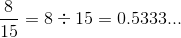
Divide 8 by 15:

The 3 repeats, so the correct choice is
.
Divide 8 by 15:
The 3 repeats, so the correct choice is .
Give the decimal equivalent of
.
Give the decimal equivalent of .
Tap to see back →
Divide 11 by 18:

The 1 repeats infinitely, so this can be rewritten as
.
Divide 11 by 18:
The 1 repeats infinitely, so this can be rewritten as .