Equations of Lines - SSAT Upper Level Quantitative
Card 1 of 124
Given the graph of the line below, find the equation of the line.
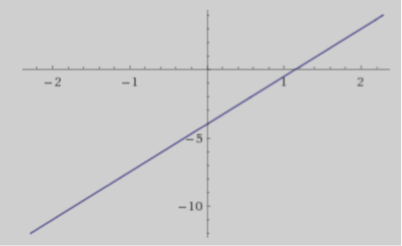
Given the graph of the line below, find the equation of the line.
Tap to reveal answer
To solve this question, you could use two points such as (1.2,0) and (0,-4) to calculate the slope which is 10/3 and then read the y-intercept off the graph, which is -4.
To solve this question, you could use two points such as (1.2,0) and (0,-4) to calculate the slope which is 10/3 and then read the y-intercept off the graph, which is -4.
← Didn't Know|Knew It →
A line is defined by the following equation:

What is the slope of that line?
A line is defined by the following equation:
What is the slope of that line?
Tap to reveal answer
The equation of a line is
y=mx + b where m is the slope
Rearrange the equation to match this:
7x + 28y = 84
28y = -7x + 84
y = -(7/28)x + 84/28
y = -(1/4)x + 3
m = -1/4
The equation of a line is
y=mx + b where m is the slope
Rearrange the equation to match this:
7x + 28y = 84
28y = -7x + 84
y = -(7/28)x + 84/28
y = -(1/4)x + 3
m = -1/4
← Didn't Know|Knew It →
If the coordinates (3, 14) and (_–_5, 15) are on the same line, what is the equation of the line?
If the coordinates (3, 14) and (_–_5, 15) are on the same line, what is the equation of the line?
Tap to reveal answer
First solve for the slope of the line, m using y=mx+b
m = (y2 – y1) / (x2 – x1)
= (15 – 14) / (_–_5 _–_3)
= (1 )/( _–_8)
=_–_1/8
y = –(1/8)x + b
Now, choose one of the coordinates and solve for b:
14 = –(1/8)3 + b
14 = _–_3/8 + b
b = 14 + (3/8)
b = 14.375
y = –(1/8)x + 14.375
First solve for the slope of the line, m using y=mx+b
m = (y2 – y1) / (x2 – x1)
= (15 – 14) / (_–_5 _–_3)
= (1 )/( _–_8)
=_–_1/8
y = –(1/8)x + b
Now, choose one of the coordinates and solve for b:
14 = –(1/8)3 + b
14 = _–_3/8 + b
b = 14 + (3/8)
b = 14.375
y = –(1/8)x + 14.375
← Didn't Know|Knew It →
Which line passes through the points (0, 6) and (4, 0)?
Which line passes through the points (0, 6) and (4, 0)?
Tap to reveal answer
P1 (0, 6) and P2 (4, 0)
First, calculate the slope: m = rise ÷ run = (y2 – y1)/(x2 – x1), so m = –3/2
Second, plug the slope and one point into the slope-intercept formula:
y = mx + b, so 0 = –3/2(4) + b and b = 6
Thus, y = –3/2x + 6
P1 (0, 6) and P2 (4, 0)
First, calculate the slope: m = rise ÷ run = (y2 – y1)/(x2 – x1), so m = –3/2
Second, plug the slope and one point into the slope-intercept formula:
y = mx + b, so 0 = –3/2(4) + b and b = 6
Thus, y = –3/2x + 6
← Didn't Know|Knew It →
What line goes through the points (1, 3) and (3, 6)?
What line goes through the points (1, 3) and (3, 6)?
Tap to reveal answer
If P1(1, 3) and P2(3, 6), then calculate the slope by m = rise/run = (y2 – y1)/(x2 – x1) = 3/2
Use the slope and one point to calculate the intercept using y = mx + b
Then convert the slope-intercept form into standard form.
If P1(1, 3) and P2(3, 6), then calculate the slope by m = rise/run = (y2 – y1)/(x2 – x1) = 3/2
Use the slope and one point to calculate the intercept using y = mx + b
Then convert the slope-intercept form into standard form.
← Didn't Know|Knew It →
Let y = 3_x_ – 6.
At what point does the line above intersect the following:

Let y = 3_x_ – 6.
At what point does the line above intersect the following:
Tap to reveal answer
If we rearrange the second equation it is the same as the first equation. They are the same line.
If we rearrange the second equation it is the same as the first equation. They are the same line.
← Didn't Know|Knew It →
What is the equation of a line that passes through coordinates (2,6) and (3,5)?
What is the equation of a line that passes through coordinates (2,6) and (3,5)?
Tap to reveal answer
Our first step will be to determing the slope of the line that connects the given points.

Our slope will be  . Using slope-intercept form, our equation will be
  . Use one of the give points in this equation to solve for the y-intercept. We will use (2,6).



Now that we know the y-intercept, we can plug it back into the slope-intercept formula with the slope that we found earlier.


This is our final answer.
Our first step will be to determing the slope of the line that connects the given points.
Our slope will be
Now that we know the y-intercept, we can plug it back into the slope-intercept formula with the slope that we found earlier.
This is our final answer.
← Didn't Know|Knew It →
What is the slope-intercept form of 8x-2y-12=0?
What is the slope-intercept form of 8x-2y-12=0?
Tap to reveal answer
The slope intercept form states that y=mx+b. In order to convert the equation to the slope intercept form, isolate y on the left side:
8x-2y=12
-2y=-8x+12
y=4x-6
The slope intercept form states that y=mx+b. In order to convert the equation to the slope intercept form, isolate y on the left side:
8x-2y=12
-2y=-8x+12
y=4x-6
← Didn't Know|Knew It →
Which of the following equations does NOT represent a line?
Which of the following equations does NOT represent a line?
Tap to reveal answer
The answer is  .
.
A line can only be represented in the form  or
or  , for appropriate constants
  ,
,  , and
, and  . A graph must have an equation that can be put into one of these forms to be a line.
 represents a parabola, not a line. Lines will never contain an
  term.
term.
The answer is
A line can only be represented in the form
← Didn't Know|Knew It →
A line has a slope of  and passes through the point
  . Find the equation of the line.
A line has a slope of
Tap to reveal answer
In finding the equation of the line given its slope and a point through which it passes, we can use the slope-intercept form of the equation of a line:
 , where
  is the slope of the line and
  is its
  -intercept.
Plug the given conditions into the equation to find the  -intercept.

Multiply:

Subtract  from each side of the equation:

Now that you have solved for  , you can write out the full equation of the line:

In finding the equation of the line given its slope and a point through which it passes, we can use the slope-intercept form of the equation of a line:
Plug the given conditions into the equation to find the
Multiply:
Subtract
Now that you have solved for
← Didn't Know|Knew It →
Find the equation of a line that has a slope of  and passes through the points
  .
.
Find the equation of a line that has a slope of
Tap to reveal answer
In finding the equation of the line given its slope and a point through which it passes, we can use the slope-intercept form of the equation of a line:
, where is the slope of the line and is its -intercept.
Since the problem gives us the slope of the line  , we just need to use the point that is given to us to find the
  -intercept. Plug in known values for
  and
and  taken from the given point into the
  equation to find the
  -intercept:

Multiply:

Subtract  from each side of the equation:

Now that you've solved for  , you can plug the given slope
  and the
  -intercept
  into the slope-intercept form of the equation of a line to figure out the answer:

In finding the equation of the line given its slope and a point through which it passes, we can use the slope-intercept form of the equation of a line:
Since the problem gives us the slope of the line
Multiply:
Subtract
Now that you've solved for
← Didn't Know|Knew It →
Find the equation of a line that has a slope of  and passes through the points
  .
.
Find the equation of a line that has a slope of
Tap to reveal answer
In finding the equation of the line given its slope and a point through which it passes, we can use the slope-intercept form of the equation of a line:
, where is the slope of the line and is its -intercept.
Since the problem gives us the slope of the line , we just need to use the point that is given to us to find the -intercept. Plug in known values for and taken from the given point into the equation and solve for  to find the -intercept:

Multiply:

Subtract  from both sides of the equation:

Now, we can write the final equation by plugging in the given slope  and the
  -intercept
  :
:

In finding the equation of the line given its slope and a point through which it passes, we can use the slope-intercept form of the equation of a line:
Since the problem gives us the slope of the line
Multiply:
Subtract
Now, we can write the final equation by plugging in the given slope
← Didn't Know|Knew It →
Find the equation of the line that has a slope of  and passes through the point
  .
.
Find the equation of the line that has a slope of
Tap to reveal answer
In finding the equation of the line given its slope and a point through which it passes, we can use the slope-intercept form of the equation of a line:
, where is the slope of the line and is its -intercept.
Since the problem gives us the slope of the line , we just need to use the point that is given to us to find the -intercept. Plug in known values for and taken from the given point into the equation and solve for to find the -intercept:

Multiply:

Add  to each side of the equation:

Now, we can write the final equation by plugging in the given slope and the -intercept :

In finding the equation of the line given its slope and a point through which it passes, we can use the slope-intercept form of the equation of a line:
Since the problem gives us the slope of the line
Multiply:
Add
Now, we can write the final equation by plugging in the given slope
← Didn't Know|Knew It →
Find the equation of the line that has a slope of  and passes through the point
  .
.
Find the equation of the line that has a slope of
Tap to reveal answer
In finding the equation of the line given its slope and a point through which it passes, we can use the slope-intercept form of the equation of a line:
, where is the slope of the line and is its -intercept.
Since the problem gives us the slope of the line , we just need to use the point that is given to us to find the -intercept. Plug in known values for and taken from the given point into the equation and solve for to find the -intercept:

Multiply:

Subtract  from each side of the equation:

Now, we can write the final equation by plugging in the given slope and the -intercept :

In finding the equation of the line given its slope and a point through which it passes, we can use the slope-intercept form of the equation of a line:
Since the problem gives us the slope of the line
Multiply:
Subtract
Now, we can write the final equation by plugging in the given slope
← Didn't Know|Knew It →
Find the equation of a line that has a slope of  and passes through the point
  .
.
Find the equation of a line that has a slope of
Tap to reveal answer
The question gives us both the slope and the  -intercept of the line. Remember that
  represents the slope, and
  represents the
  -intercept to write the following equation:

Alternatively, if you did not realize that the problem gives you the  -intercept, you could solve it by using the slope-intercept form of the equation of a line:
, where is the slope of the line and is its -intercept.
Since the problem gives us the slope of the line , we would just need to use the point that is given to us to find the -intercept. We could plug in the known values for and taken from the given point into the equation and solve for to find the -intercept:

Multiplying leaves us with:
 .
.
We could then substitute in the given slope and the  -intercept into the
  equation to arrive at the correct answer:

The question gives us both the slope and the
Alternatively, if you did not realize that the problem gives you the
Since the problem gives us the slope of the line
Multiplying leaves us with:
We could then substitute in the given slope and the
← Didn't Know|Knew It →
Find the equation of the line that has a slope of  and passes through the point
  .
.
Find the equation of the line that has a slope of
Tap to reveal answer
The question gives us both the slope and the  -intercept of the line, allowing us to write the following equation by inserting those values into the slope-intercept form of the equation of a line,
  :
:

Alternatively, if you did not realize that the problem gives you the -intercept, you could solve it by using the slope-intercept form of the equation of a line. Since the problem gives us the slope of the line , we would just need to use the point that is given to us to find the -intercept. We could plug in the known values for and taken from the given point into the equation and solve for to find the -intercept:

Multiplying leaves us with:

We could then substitute in the given slope and the -intercept into the equation to arrive at the correct answer:
The question gives us both the slope and the
Alternatively, if you did not realize that the problem gives you the
Multiplying leaves us with:
We could then substitute in the given slope and the
← Didn't Know|Knew It →
Find the equation of the line that passes through  and
and  .
.
Find the equation of the line that passes through
Tap to reveal answer
First, notice that our  -intercept for this line is
  ; we can tell this because one of the points,
  , is on the
  -axis since it has a value of
  for
for  .
.
Now, we need to find the slope of the line. We can do that by using the slope equation:

We can substitute in the values of the provided points— ,
, ,
,  and
and  —and then solve for the slope of the line that connects them:

Now, put the two pieces of information together and substitute them into the  equation to solve the problem:

First, notice that our
Now, we need to find the slope of the line. We can do that by using the slope equation:
We can substitute in the values of the provided points—
Now, put the two pieces of information together and substitute them into the
← Didn't Know|Knew It →
Find the equation of the line that passes through the points  and
and  .
.
Find the equation of the line that passes through the points
Tap to reveal answer
First, notice that our  -intercept for this line is
  ; we can tell this because one of the points,
  , is on the
  -axis since it has a value of
  for
for  .
.
Now, we need to find the slope of the line. We can do that by using the slope equation:

We can substitute in the values of the provided points— ,
, ,
,  and
and  —and then solve for the slope of the line that connects them:

Now, put the two pieces of information together and substitute them into the  equation to solve the problem:

First, notice that our
Now, we need to find the slope of the line. We can do that by using the slope equation:
We can substitute in the values of the provided points—
Now, put the two pieces of information together and substitute them into the
← Didn't Know|Knew It →
Find the equation of the line that passes through the points  .
.
Find the equation of the line that passes through the points
Tap to reveal answer
First, notice that our -intercept for this line is  ; we can tell this because one of the points,
  , is on the -axis since it has a value of for .
Now, we need to find the slope of the line. We can do that by using the slope equation:
We can substitute in the values of the provided points—, ,
,  and
and  —and then solve for the slope of the line that connects them:

Now, put the two pieces of information together and substitute them into the equation to solve the problem:

First, notice that our
Now, we need to find the slope of the line. We can do that by using the slope equation:
We can substitute in the values of the provided points—
Now, put the two pieces of information together and substitute them into the
← Didn't Know|Knew It →
Find the equation of the line that passes through  and
and  .
.
Find the equation of the line that passes through
Tap to reveal answer
First, notice that our -intercept for this line is  ; we can tell this because one of the points,
  , is on the -axis since it has a value of for .
Now, we need to find the slope of the line. We can do that by using the slope equation:
We can substitute in the values of the provided points—, ,
,  and
and  —and then solve for the slope of the line that connects them:

Now, put the two pieces of information together and substitute them into the equation to solve the problem:

First, notice that our
Now, we need to find the slope of the line. We can do that by using the slope equation:
We can substitute in the values of the provided points—
Now, put the two pieces of information together and substitute them into the
← Didn't Know|Knew It →