Parallelograms
Help Questions
SSAT Middle Level: Quantitative › Parallelograms
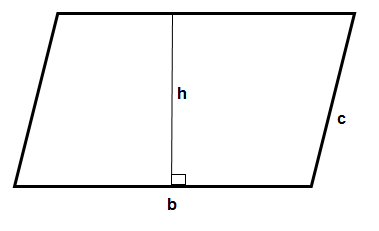
Find the perimeter of the given parallelogram if

36
30
26
23
Explanation
In order to find the perimeter, we need to find the sum of the outer edges:
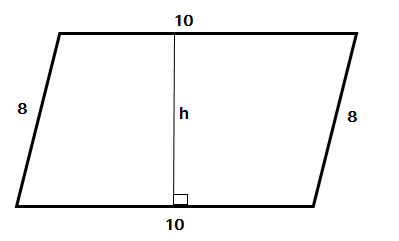

Notice that we didn't use height in our calculation.
Find the perimeter of the given parallelogram if

36
38
22
24
Explanation
In order to find the perimeter of the parallelogram, we must add the OUTER edges:

Notice that we didn't use height in our calculation.
Find the perimeter of the parallelogram if h=


Explanation
In order to find the perimeter, find the sum of each OUTER side:

Notice the height isn't used in this calculation.
Keep in mind that the sides directly opposite of each other are of the same length. This is why we have 

Find the perimeter of the given parallelogram if
36
30
26
23
Explanation
In order to find the perimeter, we need to find the sum of the outer edges:
Notice that we didn't use height in our calculation.
Find the perimeter of the parallelogram if h=
Explanation
In order to find the perimeter, find the sum of each OUTER side:
Notice the height isn't used in this calculation.
Keep in mind that the sides directly opposite of each other are of the same length. This is why we have
Find the perimeter of the given parallelogram if
36
38
22
24
Explanation
In order to find the perimeter of the parallelogram, we must add the OUTER edges:
Notice that we didn't use height in our calculation.
A given parallelogram has a base 


Explanation
The formula for the area of a parallelogram is 


A given parallelogram has a base
Explanation
The formula for the area of a parallelogram is
Find the area of a parallelogram with a height of 


Explanation
The area 


Find the area of a parallelogram with a height of
Explanation
The area