Quadrilaterals - SSAT Middle Level Quantitative
Card 1 of 548
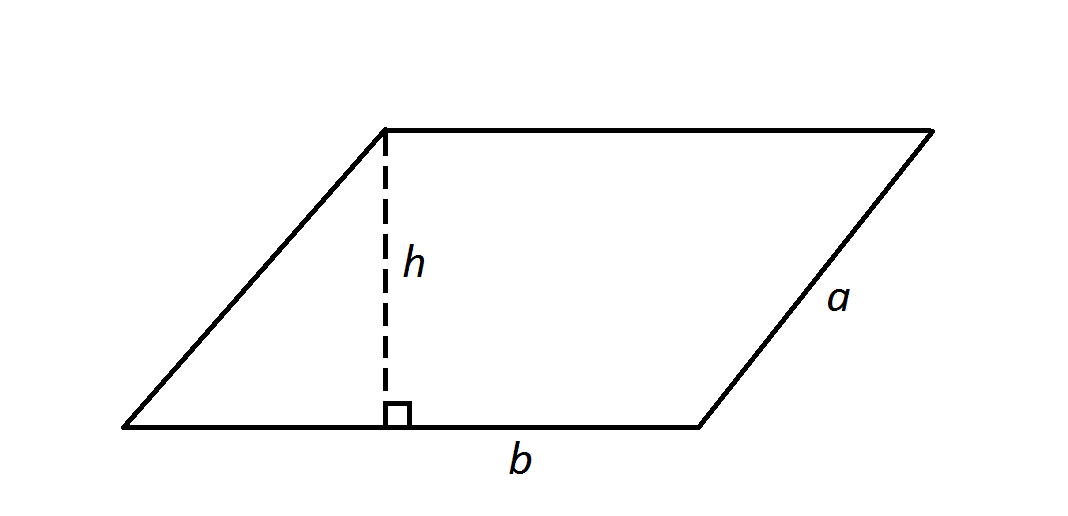
Note: Figure NOT drawn to scale
In the above diagram, 
Give the area of the parallelogram.
Note: Figure NOT drawn to scale
In the above diagram,
Give the area of the parallelogram.
Tap to reveal answer
The area of a parallelogram is its base multiplied by its height - represented by  and
and  here:
here:

Note that the value of  is irrelevant.
The area of a parallelogram is its base multiplied by its height - represented by
Note that the value of
← Didn't Know|Knew It →
Find the area of the following parallelogram:
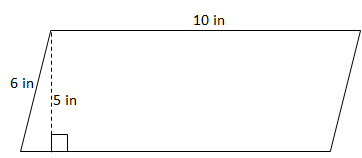
Note: The formula for the area of a parallelogram is  .
.
Find the area of the following parallelogram:
Note: The formula for the area of a parallelogram is
Tap to reveal answer
The base of the parallelogram is 10, while the height is 5.


The base of the parallelogram is 10, while the height is 5.
← Didn't Know|Knew It →
Find the area:
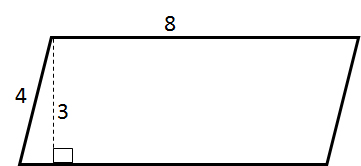
Find the area:
Tap to reveal answer
The area of a parallelogram can be determined using the following equation:

Therefore,

The area of a parallelogram can be determined using the following equation:
Therefore,
← Didn't Know|Knew It →
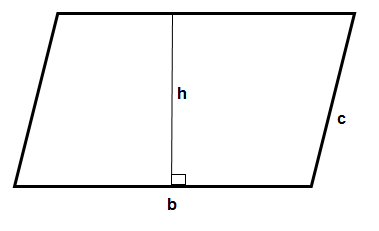
Find the area of the given parallelogram if  .
.
Find the area of the given parallelogram if
Tap to reveal answer
In order to find the area of a parallelogram, we need to find the product of the base length and height.

Notice that only two of the given values were needed to slove this problem.
In order to find the area of a parallelogram, we need to find the product of the base length and height.
Notice that only two of the given values were needed to slove this problem.
← Didn't Know|Knew It →
A given parallelogram has a base  in length, a height
  in length, and a side of length
  opposite the height. What is the area of the parallelogram?
A given parallelogram has a base
Tap to reveal answer
The formula for the area of a parallelogram is  , with base and height represented by
  and
and  , respectively. Substituting values from the question:


The formula for the area of a parallelogram is
← Didn't Know|Knew It →
A parallelogram has a height of  in length, a side of length
  opposite the height, and a base of
  . What is the area of the parallelogram?
A parallelogram has a height of
Tap to reveal answer
Given base  and height
  ,
,  .
.
Substituting the values from our question:


Given base
Substituting the values from our question:
← Didn't Know|Knew It →
A parallelogram has a base of length  , a height of length
  , and a side of length
  . What is the area of the parallelogram?
A parallelogram has a base of length
Tap to reveal answer
Given base and height , .
Substituting the values from our question:


Given base
Substituting the values from our question:
← Didn't Know|Knew It →
Find the area of a parallelogram with a height of  , a base of
  , and a side length of
  .
.
Find the area of a parallelogram with a height of
Tap to reveal answer
The area  of a parallelogram with height
  and base
  can be found with the equation
  . Consequently:


The area
← Didn't Know|Knew It →
Find the area of a parallelogram with a height of  , base of
  , and a side length of
  .
.
Find the area of a parallelogram with a height of
Tap to reveal answer
The area  of a parallelogram with height
  and base
  can be found with the equation
  . Consequently:


The area
← Didn't Know|Knew It →
The area of the square is 81. What is the sum of the lengths of three sides of the square?
The area of the square is 81. What is the sum of the lengths of three sides of the square?
Tap to reveal answer
A square that has an area of 81 has sides that are the square root of 81 (side2 = area for a square). Thus each of the four sides is 9. The sum of three of these sides is  .
.
A square that has an area of 81 has sides that are the square root of 81 (side2 = area for a square). Thus each of the four sides is 9. The sum of three of these sides is
← Didn't Know|Knew It →
What is the area of a square with perimeter 64 inches?
What is the area of a square with perimeter 64 inches?
Tap to reveal answer
The perimeter of a square is four times its sidelength, so a square with perimeter 64 inches has sides with length 16 inches. Use the area formula:

The perimeter of a square is four times its sidelength, so a square with perimeter 64 inches has sides with length 16 inches. Use the area formula:
← Didn't Know|Knew It →
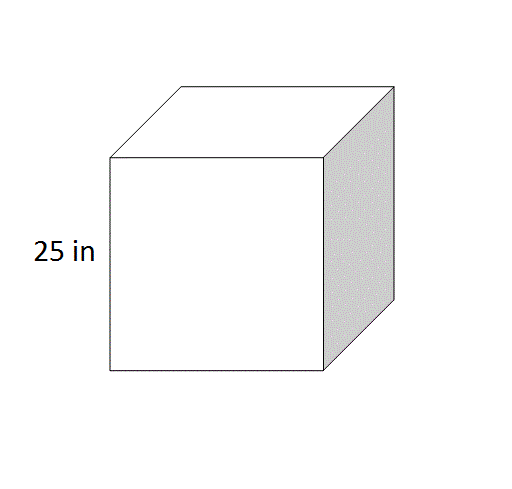
What is the total area of the surface of the cube shown in the above diagram?
What is the total area of the surface of the cube shown in the above diagram?
Tap to reveal answer
A cube comprises six faces, each of which is a square. To find its total surface area, find the area of one face by squaring its sidelength:

Then multiply this by six:

A cube comprises six faces, each of which is a square. To find its total surface area, find the area of one face by squaring its sidelength:
Then multiply this by six:
← Didn't Know|Knew It →
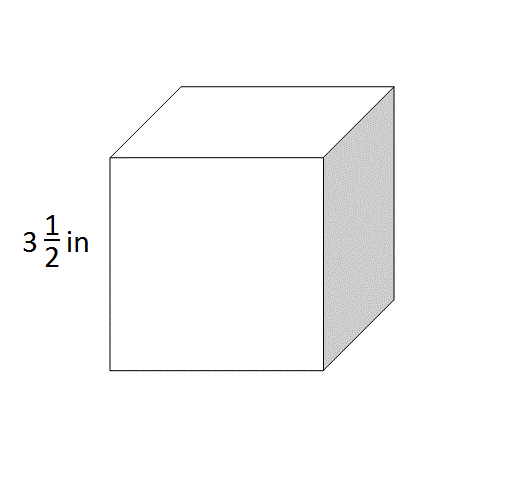
What is the total area of the surface of the cube shown in the above diagram?
What is the total area of the surface of the cube shown in the above diagram?
Tap to reveal answer
A cube comprises six faces, each of which is a square. To find its total surface area, find the area of one face by squaring its sidelength:

Then multiply this by six:

A cube comprises six faces, each of which is a square. To find its total surface area, find the area of one face by squaring its sidelength:
Then multiply this by six:
← Didn't Know|Knew It →
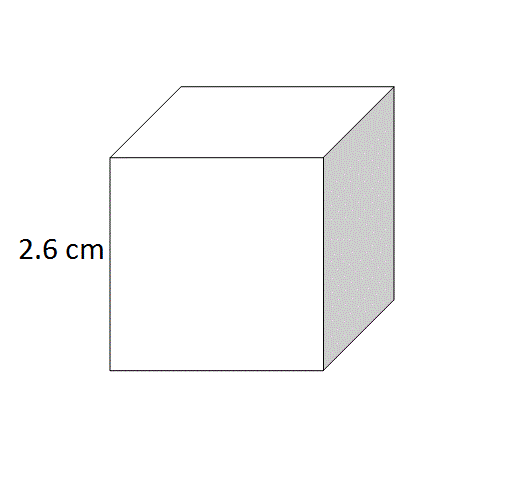
What is the total area of the surface of the cube shown in the above diagram?
What is the total area of the surface of the cube shown in the above diagram?
Tap to reveal answer
A cube comprises six faces, each of which is a square. To find its total surface area, find the area of one face by squaring its sidelength:

Then multiply this by six:

A cube comprises six faces, each of which is a square. To find its total surface area, find the area of one face by squaring its sidelength:
Then multiply this by six:
← Didn't Know|Knew It →
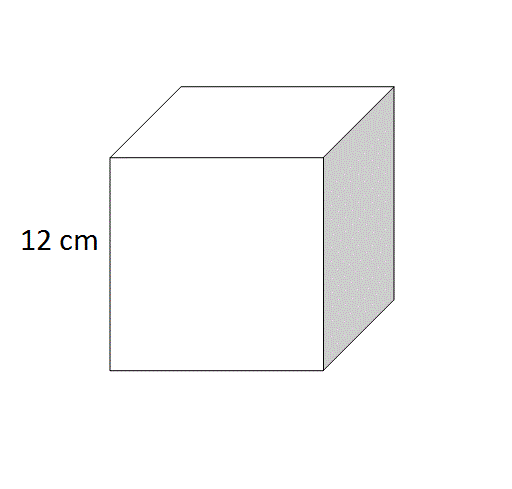
What is the total area of the surface of the cube shown in the above diagram?
What is the total area of the surface of the cube shown in the above diagram?
Tap to reveal answer
A cube comprises six faces, each of which is a square. To find its total surface area, find the area of one face by squaring its sidelength:

Then multiply this by six:

A cube comprises six faces, each of which is a square. To find its total surface area, find the area of one face by squaring its sidelength:
Then multiply this by six:
← Didn't Know|Knew It →
A square is 9 feet long on each side. How many smaller squares, each 3 feet on a side can be cut out of the larger square?
A square is 9 feet long on each side. How many smaller squares, each 3 feet on a side can be cut out of the larger square?
Tap to reveal answer
Each side can be divided into three 3-foot sections. This gives a total of  squares. Another way of looking at the problem is that the total area of the large square is 81 and each smaller square has an area of 9. Dividing 81 by 9 gives the correct answer.
Each side can be divided into three 3-foot sections. This gives a total of
← Didn't Know|Knew It →
Order the following from least area to greatest area:
Figure A: A square with sides of length 3 feet each.
Figure B: A rectangle with length 30 inches and width 42 inches.
Figure C: A rectangle with length 2 feet and width 4 feet.
Order the following from least area to greatest area:
Figure A: A square with sides of length 3 feet each.
Figure B: A rectangle with length 30 inches and width 42 inches.
Figure C: A rectangle with length 2 feet and width 4 feet.
Tap to reveal answer
Figure A has area  square feet.
Figure B has dimensions 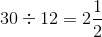 feet by
 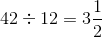 feet, so its area is
 square feet.
Figure C has area  square feet.
From least area to greatest, the figures rank C, B, A.
Figure A has area
Figure B has dimensions
Figure C has area
From least area to greatest, the figures rank C, B, A.
← Didn't Know|Knew It →
The length of one side of a square is  . What is the square's area?
The length of one side of a square is
Tap to reveal answer
The area of any quadrilateral is found by multiplying the length by the width. Because a square has four equal sides, the length and width are the same. For the square in this question, the length and width are  .
.
Remember: area is always given in units2 .
The area of any quadrilateral is found by multiplying the length by the width. Because a square has four equal sides, the length and width are the same. For the square in this question, the length and width are
Remember: area is always given in units2 .
← Didn't Know|Knew It →
If a square has a side that is 3 yards long, what is the area in square feet?
If a square has a side that is 3 yards long, what is the area in square feet?
Tap to reveal answer
The area of a square is found by multiplying the length of a side by itself.

If one side is 3 yards, this means one side is 9 feet since there are 3 feet in a yard.

Since every side is of equal length, you would multiply 9 feet by 9 feet to find the area.



This results in 81 square feet, which is the correct answer.
The area of a square is found by multiplying the length of a side by itself.
If one side is 3 yards, this means one side is 9 feet since there are 3 feet in a yard.
Since every side is of equal length, you would multiply 9 feet by 9 feet to find the area.
This results in 81 square feet, which is the correct answer.
← Didn't Know|Knew It →
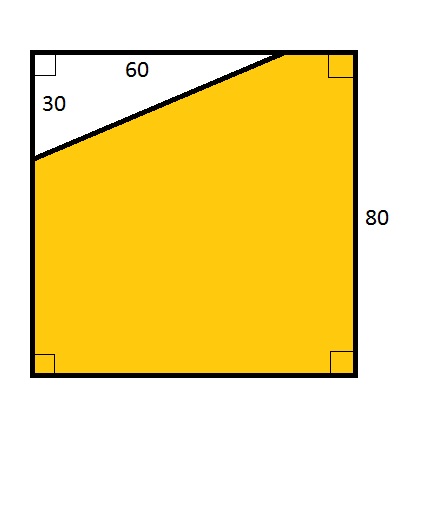
Note: Figure NOT drawn to scale.
Refer to the above diagram, which shows a square. Give the ratio of the area of the yellow region to that of the white region.
Note: Figure NOT drawn to scale.
Refer to the above diagram, which shows a square. Give the ratio of the area of the yellow region to that of the white region.
Tap to reveal answer
The area of the entire square is the square of the length of a side, or
 .
.
The area of the right triangle is half the product of its legs, or
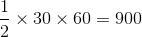 .
.
The area of the yellow region is therefore the difference of the two, or
 .
.
The ratio of the area of the yellow region to that of the white region is
 ; that is, 55 to 9.
The area of the entire square is the square of the length of a side, or
The area of the right triangle is half the product of its legs, or
The area of the yellow region is therefore the difference of the two, or
The ratio of the area of the yellow region to that of the white region is
← Didn't Know|Knew It →