How to find the area of a parallelogram - SSAT Middle Level: Quantitative
Card 1 of 36
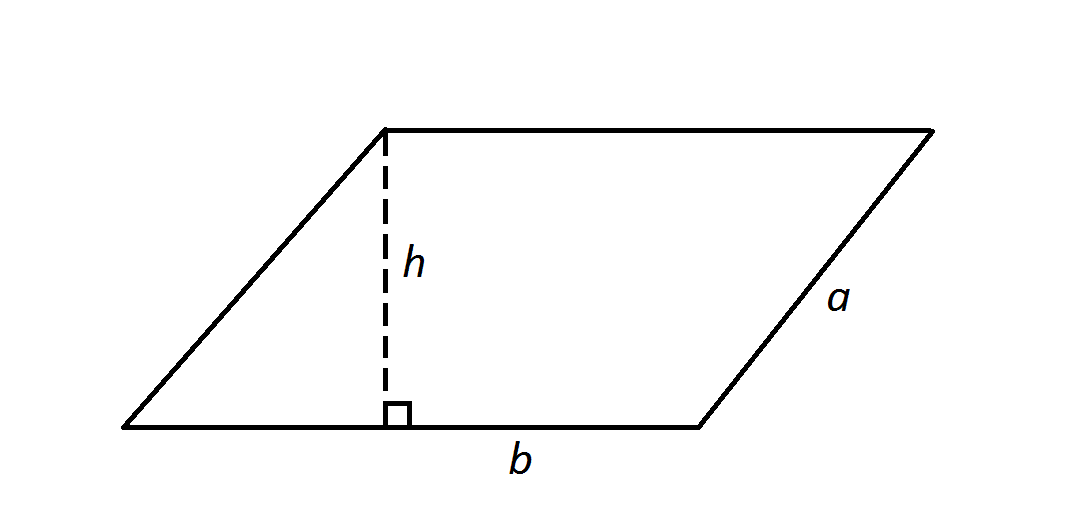
Note: Figure NOT drawn to scale
In the above diagram, 
Give the area of the parallelogram.
Note: Figure NOT drawn to scale
In the above diagram,
Give the area of the parallelogram.
Tap to reveal answer
The area of a parallelogram is its base multiplied by its height - represented by  and
and  here:
here:

Note that the value of  is irrelevant.
The area of a parallelogram is its base multiplied by its height - represented by
Note that the value of
← Didn't Know|Knew It →
Find the area of the following parallelogram:
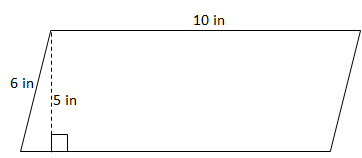
Note: The formula for the area of a parallelogram is  .
.
Find the area of the following parallelogram:
Note: The formula for the area of a parallelogram is
Tap to reveal answer
The base of the parallelogram is 10, while the height is 5.


The base of the parallelogram is 10, while the height is 5.
← Didn't Know|Knew It →
Find the area:
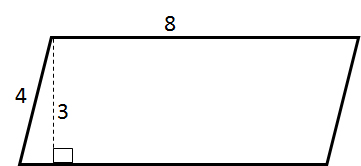
Find the area:
Tap to reveal answer
The area of a parallelogram can be determined using the following equation:

Therefore,

The area of a parallelogram can be determined using the following equation:
Therefore,
← Didn't Know|Knew It →
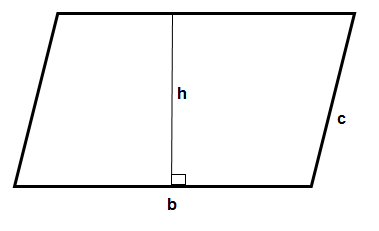
Find the area of the given parallelogram if  .
.
Find the area of the given parallelogram if
Tap to reveal answer
In order to find the area of a parallelogram, we need to find the product of the base length and height.

Notice that only two of the given values were needed to slove this problem.
In order to find the area of a parallelogram, we need to find the product of the base length and height.
Notice that only two of the given values were needed to slove this problem.
← Didn't Know|Knew It →
A given parallelogram has a base  in length, a height
  in length, and a side of length
  opposite the height. What is the area of the parallelogram?
A given parallelogram has a base
Tap to reveal answer
The formula for the area of a parallelogram is  , with base and height represented by
  and
and  , respectively. Substituting values from the question:


The formula for the area of a parallelogram is
← Didn't Know|Knew It →
A parallelogram has a height of  in length, a side of length
  opposite the height, and a base of
  . What is the area of the parallelogram?
A parallelogram has a height of
Tap to reveal answer
Given base  and height
  ,
,  .
.
Substituting the values from our question:


Given base
Substituting the values from our question:
← Didn't Know|Knew It →
A parallelogram has a base of length  , a height of length
  , and a side of length
  . What is the area of the parallelogram?
A parallelogram has a base of length
Tap to reveal answer
Given base and height , .
Substituting the values from our question:


Given base
Substituting the values from our question:
← Didn't Know|Knew It →
Find the area of a parallelogram with a height of  , a base of
  , and a side length of
  .
.
Find the area of a parallelogram with a height of
Tap to reveal answer
The area  of a parallelogram with height
  and base
  can be found with the equation
  . Consequently:


The area
← Didn't Know|Knew It →
Find the area of a parallelogram with a height of  , base of
  , and a side length of
  .
.
Find the area of a parallelogram with a height of
Tap to reveal answer
The area  of a parallelogram with height
  and base
  can be found with the equation
  . Consequently:


The area
← Didn't Know|Knew It →
A parallelogram has a height of in length, a side of length opposite the height, and a base of . What is the area of the parallelogram?
A parallelogram has a height of
Tap to reveal answer
Given base and height , .
Substituting the values from our question:
Given base
Substituting the values from our question:
← Didn't Know|Knew It →
A parallelogram has a base of length , a height of length , and a side of length . What is the area of the parallelogram?
A parallelogram has a base of length
Tap to reveal answer
Given base and height , .
Substituting the values from our question:
Given base
Substituting the values from our question:
← Didn't Know|Knew It →
Note: Figure NOT drawn to scale
In the above diagram,
Give the area of the parallelogram.
Note: Figure NOT drawn to scale
In the above diagram,
Give the area of the parallelogram.
Tap to reveal answer
The area of a parallelogram is its base multiplied by its height - represented by and here:
Note that the value of is irrelevant.
The area of a parallelogram is its base multiplied by its height - represented by
Note that the value of
← Didn't Know|Knew It →
Find the area of the following parallelogram:
Note: The formula for the area of a parallelogram is .
Find the area of the following parallelogram:
Note: The formula for the area of a parallelogram is
Tap to reveal answer
The base of the parallelogram is 10, while the height is 5.
The base of the parallelogram is 10, while the height is 5.
← Didn't Know|Knew It →
Find the area:
Find the area:
Tap to reveal answer
The area of a parallelogram can be determined using the following equation:
Therefore,
The area of a parallelogram can be determined using the following equation:
Therefore,
← Didn't Know|Knew It →
Find the area of the given parallelogram if .
Find the area of the given parallelogram if
Tap to reveal answer
In order to find the area of a parallelogram, we need to find the product of the base length and height.
Notice that only two of the given values were needed to slove this problem.
In order to find the area of a parallelogram, we need to find the product of the base length and height.
Notice that only two of the given values were needed to slove this problem.
← Didn't Know|Knew It →
A given parallelogram has a base in length, a height in length, and a side of length opposite the height. What is the area of the parallelogram?
A given parallelogram has a base
Tap to reveal answer
The formula for the area of a parallelogram is , with base and height represented by and , respectively. Substituting values from the question:
The formula for the area of a parallelogram is
← Didn't Know|Knew It →
Find the area of a parallelogram with a height of , a base of , and a side length of .
Find the area of a parallelogram with a height of
Tap to reveal answer
The area of a parallelogram with height and base can be found with the equation . Consequently:
The area
← Didn't Know|Knew It →
Find the area of a parallelogram with a height of , base of , and a side length of .
Find the area of a parallelogram with a height of
Tap to reveal answer
The area of a parallelogram with height and base can be found with the equation . Consequently:
The area
← Didn't Know|Knew It →
A parallelogram has a height of in length, a side of length opposite the height, and a base of . What is the area of the parallelogram?
A parallelogram has a height of
Tap to reveal answer
Given base and height , .
Substituting the values from our question:
Given base
Substituting the values from our question:
← Didn't Know|Knew It →
A parallelogram has a base of length , a height of length , and a side of length . What is the area of the parallelogram?
A parallelogram has a base of length
Tap to reveal answer
Given base and height , .
Substituting the values from our question:
Given base
Substituting the values from our question:
← Didn't Know|Knew It →