Plane Geometry - SSAT Middle Level Quantitative
Card 1 of 744
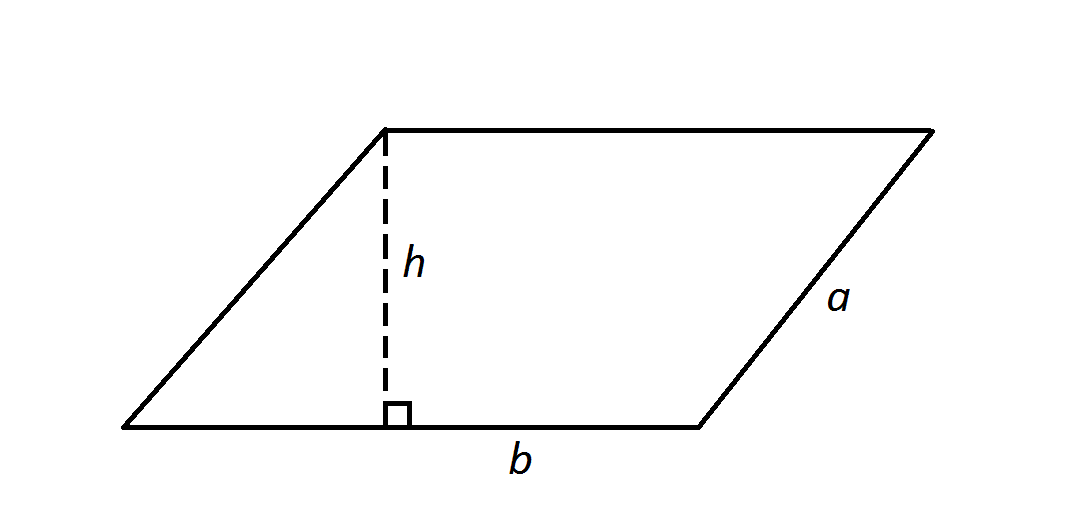
Note: Figure NOT drawn to scale
In the above diagram, 
Give the area of the parallelogram.
Note: Figure NOT drawn to scale
In the above diagram,
Give the area of the parallelogram.
Tap to reveal answer
The area of a parallelogram is its base multiplied by its height - represented by  and
and  here:
here:

Note that the value of  is irrelevant.
The area of a parallelogram is its base multiplied by its height - represented by
Note that the value of
← Didn't Know|Knew It →
Find the area of the following parallelogram:
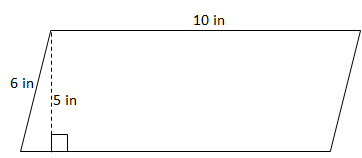
Note: The formula for the area of a parallelogram is  .
.
Find the area of the following parallelogram:
Note: The formula for the area of a parallelogram is
Tap to reveal answer
The base of the parallelogram is 10, while the height is 5.


The base of the parallelogram is 10, while the height is 5.
← Didn't Know|Knew It →
Find the area:
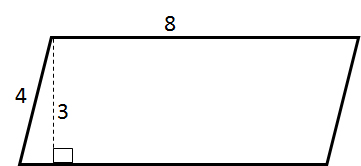
Find the area:
Tap to reveal answer
The area of a parallelogram can be determined using the following equation:

Therefore,

The area of a parallelogram can be determined using the following equation:
Therefore,
← Didn't Know|Knew It →
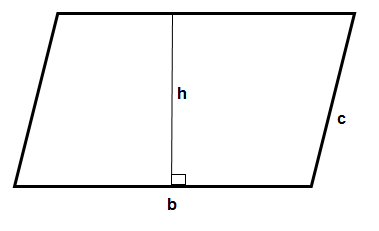
Find the area of the given parallelogram if  .
.
Find the area of the given parallelogram if
Tap to reveal answer
In order to find the area of a parallelogram, we need to find the product of the base length and height.

Notice that only two of the given values were needed to slove this problem.
In order to find the area of a parallelogram, we need to find the product of the base length and height.
Notice that only two of the given values were needed to slove this problem.
← Didn't Know|Knew It →
A given parallelogram has a base  in length, a height
  in length, and a side of length
  opposite the height. What is the area of the parallelogram?
A given parallelogram has a base
Tap to reveal answer
The formula for the area of a parallelogram is  , with base and height represented by
  and
and  , respectively. Substituting values from the question:


The formula for the area of a parallelogram is
← Didn't Know|Knew It →
A parallelogram has a height of  in length, a side of length
  opposite the height, and a base of
  . What is the area of the parallelogram?
A parallelogram has a height of
Tap to reveal answer
Given base  and height
  ,
,  .
.
Substituting the values from our question:


Given base
Substituting the values from our question:
← Didn't Know|Knew It →
A parallelogram has a base of length  , a height of length
  , and a side of length
  . What is the area of the parallelogram?
A parallelogram has a base of length
Tap to reveal answer
Given base and height , .
Substituting the values from our question:


Given base
Substituting the values from our question:
← Didn't Know|Knew It →
Find the area of a parallelogram with a height of  , a base of
  , and a side length of
  .
.
Find the area of a parallelogram with a height of
Tap to reveal answer
The area  of a parallelogram with height
  and base
  can be found with the equation
  . Consequently:


The area
← Didn't Know|Knew It →
Find the area of a parallelogram with a height of  , base of
  , and a side length of
  .
.
Find the area of a parallelogram with a height of
Tap to reveal answer
The area  of a parallelogram with height
  and base
  can be found with the equation
  . Consequently:


The area
← Didn't Know|Knew It →
A triangle has sides  feet,
feet,  feet, and
  feet. Calculate its perimeter.
A triangle has sides
Tap to reveal answer
The perimeter of any figure is the sum of the lengths of the sides:  .
.
The perimeter of any figure is the sum of the lengths of the sides:
← Didn't Know|Knew It →
Which of these choices can the perimeter of an isosceles triangle possibly be if you know that two sides have lengths 12 and 13?
Which of these choices can the perimeter of an isosceles triangle possibly be if you know that two sides have lengths 12 and 13?
Tap to reveal answer
An isosceles triangle has two sides of equal length. If two sides of an isoscelese triangle are of length 12 and 13, then the third must be of length 12 or 13.
This makes the perimeter either

or

Of our choices, we choose 38.
An isosceles triangle has two sides of equal length. If two sides of an isoscelese triangle are of length 12 and 13, then the third must be of length 12 or 13.
This makes the perimeter either
or
Of our choices, we choose 38.
← Didn't Know|Knew It →
The perimeter of an isosceles triangle is 18. What is a possible list of the lengths of the sides?
The perimeter of an isosceles triangle is 18. What is a possible list of the lengths of the sides?
Tap to reveal answer
Since it is isosceles, 2 of the sides must be equal. They must also add to 18.
Since it is isosceles, 2 of the sides must be equal. They must also add to 18.
← Didn't Know|Knew It →
An equilateral triangle has perimeter  centimeters. How long is one side?
An equilateral triangle has perimeter
Tap to reveal answer
An equilateral triangle has three sides of equal measure, so divide its perimeter by  :
:

An equilateral triangle has three sides of equal measure, so divide its perimeter by
← Didn't Know|Knew It →
An equilateral triangle has perimeter 8 feet 6 inches. How long is one side?
An equilateral triangle has perimeter 8 feet 6 inches. How long is one side?
Tap to reveal answer
One foot is equal to 12 inches, so the perimeter 8 feet 6 inches is equal to  inches.
An equilateral triangle has three sides of equal measure, so divide its perimeter by 3:

To convert 34 inches to feet and inches:

One side measures 2 feet 10 inches.
One foot is equal to 12 inches, so the perimeter 8 feet 6 inches is equal to
An equilateral triangle has three sides of equal measure, so divide its perimeter by 3:
To convert 34 inches to feet and inches:
One side measures 2 feet 10 inches.
← Didn't Know|Knew It →
A right triangle with hypotenuse 65 has one leg of length 60. What is its perimeter?
A right triangle with hypotenuse 65 has one leg of length 60. What is its perimeter?
Tap to reveal answer
By the Pythagorean Theorem, if  and
and  are the legs of a right triangle and
  is its hypotenuse, then
 .
.
Set  and solve for
  :
:





The perimeter of the triangle - the sum of the sidelengths - is
 .
.
By the Pythagorean Theorem, if
Set
The perimeter of the triangle - the sum of the sidelengths - is
← Didn't Know|Knew It →

Find the perimeter of the triangle above.
Note: Figure not drawn to scale.
Find the perimeter of the triangle above.
Note: Figure not drawn to scale.
Tap to reveal answer
The perimeter of a shape is the length around the shape. In order to find the perimeter of a triangle, add the lengths of the sides:  .
.
Because the lengths are in inches, the answer must be in inches as well.
The perimeter of a shape is the length around the shape. In order to find the perimeter of a triangle, add the lengths of the sides:
Because the lengths are in inches, the answer must be in inches as well.
← Didn't Know|Knew It →
What is the perimeter of an equilateral triangle with a side length  ?
?
What is the perimeter of an equilateral triangle with a side length
Tap to reveal answer
The perimeter is equal to the sum of the length of the sides. An equilateral triangle has three sides with equal lengths.

The perimeter is equal to the sum of the length of the sides. An equilateral triangle has three sides with equal lengths.
← Didn't Know|Knew It →
A right triangle has legs  feet and
  feet long. What is its perimeter, in inches?
A right triangle has legs
Tap to reveal answer
The length of the hypotenuse of the triangle can be found using the Pythagorean Theorem. Substitute  :
:
 feet
feet
Its perimeter is  feet. Multiply by 12 to get the perimeter in inches:
 inches
The length of the hypotenuse of the triangle can be found using the Pythagorean Theorem. Substitute
Its perimeter is
← Didn't Know|Knew It →
If the triangle below is an isosceles triangle, what of the following choices could be its perimeter?
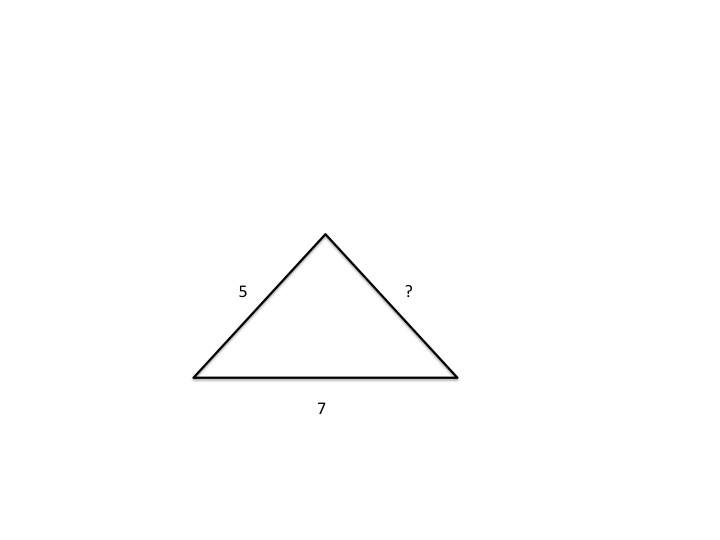
If the triangle below is an isosceles triangle, what of the following choices could be its perimeter?
Tap to reveal answer
An isosceles triangle has 2 equal sides and a third side that is unequal. If one given side is 5 and the other is 7, then the third missing side must equal either 5 or 7. If the missing side has length 5, then the perimeter is 17 (5+5+7). If the missing side is of length 7, then the perimeter is 19 (7+7+5). Of the two, only 19 is an answer choice, so the correct answer is 19.
An isosceles triangle has 2 equal sides and a third side that is unequal. If one given side is 5 and the other is 7, then the third missing side must equal either 5 or 7. If the missing side has length 5, then the perimeter is 17 (5+5+7). If the missing side is of length 7, then the perimeter is 19 (7+7+5). Of the two, only 19 is an answer choice, so the correct answer is 19.
← Didn't Know|Knew It →
The perimeter of equilateral triangle QRS is 4 times the perimeter of equilateral triangle TUV. If the perimeter of QRS is 36, what is the length of one side of TUV?
The perimeter of equilateral triangle QRS is 4 times the perimeter of equilateral triangle TUV. If the perimeter of QRS is 36, what is the length of one side of TUV?
Tap to reveal answer
If the perimeter of QRS is 4 times the perimeter of TUV, and the perimeter of QRS is 36, then the perimeter of TUV is equal to 36 divided by 4, which is 9. If the perimeter of equilateral triangle TUV is 9, then each individual side must have length 3.
If the perimeter of QRS is 4 times the perimeter of TUV, and the perimeter of QRS is 36, then the perimeter of TUV is equal to 36 divided by 4, which is 9. If the perimeter of equilateral triangle TUV is 9, then each individual side must have length 3.
← Didn't Know|Knew It →