Fractions - SSAT Elementary Level Quantitative
Card 1 of 732
What number is in the tenths place of 2.46?
What number is in the tenths place of 2.46?
Tap to reveal answer
The tenths place is the place to the right of the decimal point.
The tenths place is the place to the right of the decimal point.
← Didn't Know|Knew It →
What number is in the tens place in 123.4?
What number is in the tens place in 123.4?
Tap to reveal answer
The tens place is the second place to the left of the decimal. The ones place is the place just to the left of the decimal. The second number to the left of the decimal is 2.
The tens place is the second place to the left of the decimal. The ones place is the place just to the left of the decimal. The second number to the left of the decimal is 2.
← Didn't Know|Knew It →
Put the following numbers in order from least to greatest:
1.9, 1.2, 1.1, 1.8
Put the following numbers in order from least to greatest:
1.9, 1.2, 1.1, 1.8
Tap to reveal answer
All of these numbers are between 1 and 2. Since they all have a 1 in the ones place, we just compare the tenths place digits and put them in order from least to greatest.
The tenths places here are 1, 2, 8, and 9.
So 1.1, 1.2, 1.8, 1.9.
All of these numbers are between 1 and 2. Since they all have a 1 in the ones place, we just compare the tenths place digits and put them in order from least to greatest.
The tenths places here are 1, 2, 8, and 9.
So 1.1, 1.2, 1.8, 1.9.
← Didn't Know|Knew It →
Convert the fraction to a decimal:

Convert the fraction to a decimal:
Tap to reveal answer
When converting a fraction to a decimal, divide the numerator by the denominator:
Divide 1 by 2. Therefore, the decimal equivalent is 0.5.
When converting a fraction to a decimal, divide the numerator by the denominator:
Divide 1 by 2. Therefore, the decimal equivalent is 0.5.
← Didn't Know|Knew It →
Convert the fraction to a decimal. Round to two decimal places.

Convert the fraction to a decimal. Round to two decimal places.
Tap to reveal answer
When converting a fraction to a decimal, divide the denominator by the numerator:

Round to two decimal places. Since the thousandths place is a 6, we will round up: 0.64.
When converting a fraction to a decimal, divide the denominator by the numerator:
Round to two decimal places. Since the thousandths place is a 6, we will round up: 0.64.
← Didn't Know|Knew It →
What is  as a decimal?
What is
Tap to reveal answer
Divide the numerator by the denominator to convert to a decimal.
2 divided by 5 is 0.4.
Divide the numerator by the denominator to convert to a decimal.
2 divided by 5 is 0.4.
← Didn't Know|Knew It →
Convert the fraction to a decimal, rounded to two places:

Convert the fraction to a decimal, rounded to two places:
Tap to reveal answer
When converting a fraction to a decimal, divide the numerator by the denominator.
Divide 4 by 7:

Then, round to two places:
0.57
When converting a fraction to a decimal, divide the numerator by the denominator.
Divide 4 by 7:
Then, round to two places:
0.57
← Didn't Know|Knew It →
Find the probability of the outcome. Express the outcome as a fraction, reduced to its lowest terms.
Sarah saw a basket full of apples. There were 17 green apples, 13 red apples, and 15 yellow apples. What is the probability that Sarah will choose a yellow apple if she picks one at random?
Find the probability of the outcome. Express the outcome as a fraction, reduced to its lowest terms.
Sarah saw a basket full of apples. There were 17 green apples, 13 red apples, and 15 yellow apples. What is the probability that Sarah will choose a yellow apple if she picks one at random?
Tap to reveal answer
To find the probability of an outcome, set up a fraction of the part and the total possible.
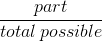
There are 15 yellow apples, but we need to find the total possible by adding all the apples together.

Since there are 15 yellow apples (part) out of 45 apples in all (total possible) the fraction will be 15 over 45.

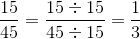
We can reduce the fraction by dividing both parts by 15.
To find the probability of an outcome, set up a fraction of the part and the total possible.
There are 15 yellow apples, but we need to find the total possible by adding all the apples together.
Since there are 15 yellow apples (part) out of 45 apples in all (total possible) the fraction will be 15 over 45.
We can reduce the fraction by dividing both parts by 15.
← Didn't Know|Knew It →
Which fraction is less than  ?
?
Which fraction is less than
Tap to reveal answer
Half of 11 is 5.5, so we know that this fraction is a little bit less than one half.


We are looking for another fraction that is less than one half.
Half of 12 is 6, so  .
.
Half of 8 is 4, so  .
.
Half of 5 is 2.5, so  .
.
Half of 19 is 9.5, so  .
.
Half of 7 is 3.5, so  .
.
The only answer that could possibly be less than  is
is  .
.
Half of 11 is 5.5, so we know that this fraction is a little bit less than one half.
We are looking for another fraction that is less than one half.
Half of 12 is 6, so
Half of 8 is 4, so
Half of 5 is 2.5, so
Half of 19 is 9.5, so
Half of 7 is 3.5, so
The only answer that could possibly be less than
← Didn't Know|Knew It →
Find the decimal equivalent to the fraction. Round to the nearest tenths place, if necessary.

Find the decimal equivalent to the fraction. Round to the nearest tenths place, if necessary.
Tap to reveal answer
When converting a fraction to a decimal, divide the denominator by the numerator. Divide 3 by 20. The quotient is 0.15. The question asked you to round to the nearest tenths place, so the correct choice is: 0.2.
When converting a fraction to a decimal, divide the denominator by the numerator. Divide 3 by 20. The quotient is 0.15. The question asked you to round to the nearest tenths place, so the correct choice is: 0.2.
← Didn't Know|Knew It →
Find the decimal equivalent to the fraction. Round to the nearest hundredths place.

Find the decimal equivalent to the fraction. Round to the nearest hundredths place.
Tap to reveal answer
When converting a fraction to a decimal, divide the denominator by the numerator. Divide  by
by  . The quotient is
  . The question asked you to round to the nearest hundredths place, so the correct choice is:
  .
.
When converting a fraction to a decimal, divide the denominator by the numerator. Divide
← Didn't Know|Knew It →
What is the decimal equivalent to 
What is the decimal equivalent to
Tap to reveal answer


← Didn't Know|Knew It →

Tap to reveal answer


← Didn't Know|Knew It →
What is  equal to in decimal form?
What is
Tap to reveal answer
To find the decimal equivalent of any fraction, simply divide the top number by the bottom number. In this problem,  divided by
  equals
  .
.
To find the decimal equivalent of any fraction, simply divide the top number by the bottom number. In this problem,
← Didn't Know|Knew It →
What is  equal to in decimal form?
What is
Tap to reveal answer
To find the decimal equivalent of a fraction, divide the top number (numerator) by the bottom number (denominator). In this problem, 4 divided by 5 equals 0.8.
To find the decimal equivalent of a fraction, divide the top number (numerator) by the bottom number (denominator). In this problem, 4 divided by 5 equals 0.8.
← Didn't Know|Knew It →
What is  equal to in decimal form?
What is
Tap to reveal answer
To find the decimal equivalent of a fraction, divide the top number \[numerator\] by the bottom number \[denominator\]. In this problem, 6 divided by 12 equals 0.5.
To find the decimal equivalent of a fraction, divide the top number \[numerator\] by the bottom number \[denominator\]. In this problem, 6 divided by 12 equals 0.5.
← Didn't Know|Knew It →
Find the decimal equivalent to the fraction. Round to the nearest hundredth.

Find the decimal equivalent to the fraction. Round to the nearest hundredth.
Tap to reveal answer
If you were to divide a pie into thirds, and then take two of them, you would have more than half of the pie. Thus you can eliminate  .
.
At this point it's probably best to have memorized the common fractions.


If you were to divide a pie into thirds, and then take two of them, you would have more than half of the pie. Thus you can eliminate
At this point it's probably best to have memorized the common fractions.
← Didn't Know|Knew It →
What is  equal to in decimal form?
What is
Tap to reveal answer
To find the decimal equivalent of a fraction, divide the top number (numerator) by the bottom number (denominator). In this problem,  divided by
  equals
To find the decimal equivalent of a fraction, divide the top number (numerator) by the bottom number (denominator). In this problem,
← Didn't Know|Knew It →
What is  equal to in decimal form?
What is
Tap to reveal answer
To find the decimal equivalent of a fraction, divide the top number (numerator) by the bottom number (denominator). In this problem,  divided by
  equals
  .
.
To find the decimal equivalent of a fraction, divide the top number (numerator) by the bottom number (denominator). In this problem,
← Didn't Know|Knew It →
What is  equal to in decimal form?
What is
Tap to reveal answer
To find the decimal equivalent of a fraction, simply divide the top number (numerator) by the bottom number (denominator). In this problem,  divided by
  equals
To find the decimal equivalent of a fraction, simply divide the top number (numerator) by the bottom number (denominator). In this problem,
← Didn't Know|Knew It →