Systems of Polynomial Equations
Help Questions
SAT Math › Systems of Polynomial Equations
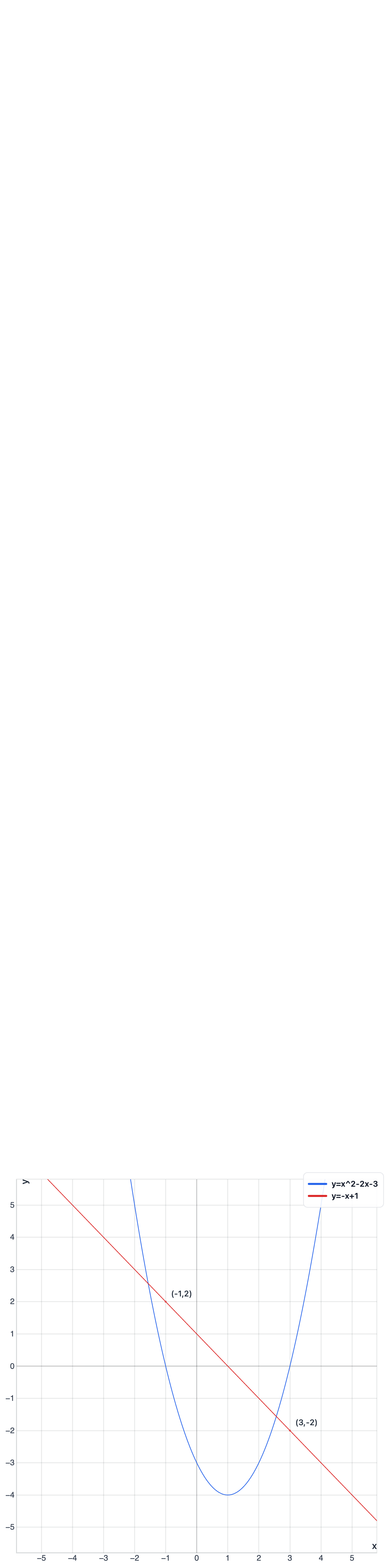
The curves $y=x^2-2x-3$ and $y=-x+1$ are graphed on the coordinate plane, and their intersection points are visible. How many solutions does the system have?
0
1
2
3
Explanation
The question asks for the number of intersection points between y = x² - 2x - 3 and y = -x + 1, with the graphs already drawn showing visible intersections. This system combines a quadratic and linear equation, solved by substitution. Setting equal: x² - 2x - 3 = -x + 1, which becomes x² - x - 4 = 0. The discriminant is b² - 4ac = (-1)² - 4(1)(-4) = 1 + 16 = 17 > 0, confirming two real solutions. Since the discriminant is positive, the parabola and line intersect at exactly 2 points. When reading graphs on the SAT, trust the algebraic verification over visual estimation.
A parabola $y=x^2+4x+5$ models the cross-section of a bowl, and the line $y=1$ represents the water level. How many real solutions does the system have?
0
1
2
4
Explanation
We need to find how many times the parabola y = x² + 4x + 5 intersects the horizontal line y = 1. This system has a quadratic and a constant linear equation, solved by substitution. Setting equal: x² + 4x + 5 = 1, which simplifies to x² + 4x + 4 = 0. This factors as (x + 2)² = 0, giving x = -2 as a repeated root. Since we have one repeated solution, the line is tangent to the parabola at exactly one point. A common misconception is that a quadratic equation always has two distinct solutions, but when the discriminant equals zero, there's exactly one solution (the vertex touches the line).
The system $y=x^2+1$ and $y=-2x-3$ models where a curved track meets a straight railing. How many real solutions does the system have?
0
1
2
4
Explanation
We need to find how many times the parabola y = x² + 1 intersects the line y = -2x - 3. This system combines a quadratic and linear equation, solved by substitution. Setting equal: x² + 1 = -2x - 3, which gives x² + 2x + 4 = 0. To determine the number of real solutions, we check the discriminant: b² - 4ac = (2)² - 4(1)(4) = 4 - 16 = -12 < 0. Since the discriminant is negative, there are no real solutions - the parabola and line don't intersect. A common error is assuming every parabola-line pair must intersect, but when the line is positioned entirely below or above the parabola, there are zero intersection points.
A parabola $y=-x^2+4x$ and a line $y=x$ are used to model two possible routes on a map grid. The routes meet where the equations are both true. What are all solutions $(x,y)$ to the system?
$(0,0)$ and $(3,3)$
$(1,1)$ and $(3,3)$
$(0,0)$ and $(4,4)$
$(0,4)$ and $(4,0)$
Explanation
To find where the parabola y = -x² + 4x meets the line y = x, we solve this system using substitution. Setting equal: -x² + 4x = x, which simplifies to -x² + 3x = 0, then -x(x - 3) = 0. This gives x = 0 or x = 3. When x = 0, y = 0; when x = 3, y = 3. The solutions are (0,0) and (3,3). A common error is forgetting that x = 0 is a valid solution when factoring out x - always include it when you factor out a variable.
A company models profit by $y=-x^2+10x-21$ (in thousands of dollars) for producing $x$ units, and a break-even target by $y=x+3$. The break-even points occur where the graphs intersect. If $(x_1,y_1)$ and $(x_2,y_2)$ are solutions, what is $x_1+x_2$?
5
9
11
13
Explanation
We need to find where the profit curve y = -x² + 10x - 21 meets the break-even line y = x + 3, then find the sum of the x-coordinates. This system combines a quadratic with a linear equation, solved by substitution. Setting equal: -x² + 10x - 21 = x + 3, which simplifies to -x² + 9x - 24 = 0, or x² - 9x + 24 = 0. For a quadratic ax² + bx + c = 0, the sum of roots equals -b/a, so x₁ + x₂ = -(-9)/1 = 9. A common error is trying to find individual roots when only their sum is needed - using Vieta's formulas saves time on the SAT.
A ball’s height $y$ (in meters) after $x$ seconds is modeled by $y=-x^2+6x+1$. A drone flies along the straight path $y=2x+1$ at the same time. Solve the system algebraically to find all times and heights when the ball and drone are at the same height. What are all solutions $(x,y)$ to the system?
$(0,1)$ and $(2,5)$
$(1,3)$ only
$(0,1)$ and $(4,9)$
$(0,1)$ and $(4,9)$
Explanation
We need to find when the ball and drone are at the same height, which occurs where the parabola y = -x² + 6x + 1 intersects the line y = 2x + 1. This is a system with one quadratic and one linear equation, so we'll use substitution. Setting the equations equal: -x² + 6x + 1 = 2x + 1, which simplifies to -x² + 4x = 0, then -x(x - 4) = 0, giving x = 0 or x = 4. When x = 0, y = 2(0) + 1 = 1; when x = 4, y = 2(4) + 1 = 9. A common error is forgetting to find the y-values after solving for x, but the question asks for complete coordinate pairs. Since a parabola and line can intersect at most twice, finding two solutions confirms we have all intersection points.
A designer compares $y=-x^2+4x+4$ with the line $y=4$. The intersections show where the design reaches a constant height. What are all solutions $(x,y)$ to the system?
$(1,4)$ and $(3,4)$
$(0,4)$ and $(4,4)$
$(2,4)$ only
$(0,0)$ and $(4,4)$
Explanation
We need to find where the parabola y = -x² + 4x + 4 intersects the horizontal line y = 4. This system has a quadratic and a constant linear equation, solved by substitution. Setting equal: -x² + 4x + 4 = 4, which simplifies to -x² + 4x = 0, then -x(x - 4) = 0. This gives x = 0 or x = 4. Since y = 4 for both solutions (given by the line equation), our intersection points are (0,4) and (4,4). A common error is thinking a horizontal line can only intersect a parabola once, but it can intersect 0, 1, or 2 times depending on the parabola's position and shape.
On a coordinate plane, the graphs of $y=x^2-4x+1$ and $y=3x-5$ represent two design constraints for a ramp. How many solutions does the system have (that is, how many intersection points are there)?
0
1
2
3
Explanation
The question asks for the number of intersection points between the parabola y = x² - 4x + 1 and the line y = 3x - 5. This is a system of one quadratic and one linear equation, which we solve by substitution. Setting equal: x² - 4x + 1 = 3x - 5, which becomes x² - 7x + 6 = 0. Using the discriminant b² - 4ac = (-7)² - 4(1)(6) = 49 - 24 = 25 > 0, we know there are two real solutions. The positive discriminant tells us the parabola and line intersect at exactly 2 points. When solving systems graphically or algebraically, remember that a parabola and line can intersect 0, 1, or 2 times depending on their relative positions.
Solve the system $y=3x+2$ and $y=x^2+2x+2$. The solutions represent where a straight pipe meets a curved support. What are all solutions $(x,y)$ to the system?
$(0,2)$ only
$(-1,-1)$ and $(1,5)$
$(-1,-1)$ and $(2,8)$
$(0,2)$ and $(1,5)$
Explanation
To find where the line y = 3x + 2 meets the parabola y = x² + 2x + 2, we solve this system using substitution. Setting equal: 3x + 2 = x² + 2x + 2, which simplifies to 0 = x² - x, then 0 = x(x - 1). This gives x = 0 or x = 1. When x = 0, y = 3(0) + 2 = 2; when x = 1, y = 3(1) + 2 = 5. The solutions are (0,2) and (1,5). A common error is making arithmetic mistakes when collecting like terms - always double-check by substituting solutions back into both original equations.
Consider the system $y=x^2-9$ and $y=6$. The solutions represent where a curved cable reaches a fixed height. How many real solutions does the system have?
0
1
2
3
Explanation
We need to find how many times the parabola y = x² - 9 reaches the height y = 6. This system has a quadratic and a constant linear equation, solved by substitution. Setting equal: x² - 9 = 6, which gives x² = 15. This has two real solutions: x = ±√15. Since we get two distinct x-values, the horizontal line y = 6 intersects the parabola at exactly 2 points. A key insight: when a horizontal line intersects a parabola above its vertex, there are always two intersection points.