Direct and Inverse Variation - PSAT Math
Card 1 of 56
The square of  varies inversely with the cube of
  . If
. If  when
when  , then what is the value of
  when
when  ?
?
The square of
Tap to reveal answer
When two quantities vary inversely, their products are always equal to a constant, which we can call k. If the square of x and the cube of y vary inversely, this means that the product of the square of x and the cube of y will equal k. We can represent the square of x as x2 and the cube of y as y3. Now, we can write the equation for inverse variation.
x2y3 = k
We are told that when x = 8, y = 8. We can substitute these values into our equation for inverse variation and then solve for k.
82(83) = k
k = 82(83)
Because this will probably be a large number, it might help just to keep it in exponent form. Let's apply the property of exponents which says that abac = ab+c.
k = 82(83) = 82+3 = 85.
Next, we must find the value of y when x = 1. Let's use our equation for inverse variation equation, substituting 85 in for k.
x2y3 = 85
(1)2y3 = 85
y3 = 85
In order to solve this, we will have to take a cube root. Thus, it will help to rewrite 8 as the cube of 2, or 23.
y3 = (23)5
We can now apply the property of exponents that states that (ab)c = abc.
y3 = 23•5 = 215
In order to get y by itself, we will have the raise each side of the equation to the 1/3 power.
(y3)(1/3) = (215)(1/3)
Once again, let's apply the property (ab)c = abc.
y(3 • 1/3) = 2(15 • 1/3)
y = 25 = 32
The answer is 32.
When two quantities vary inversely, their products are always equal to a constant, which we can call k. If the square of x and the cube of y vary inversely, this means that the product of the square of x and the cube of y will equal k. We can represent the square of x as x2 and the cube of y as y3. Now, we can write the equation for inverse variation.
x2y3 = k
We are told that when x = 8, y = 8. We can substitute these values into our equation for inverse variation and then solve for k.
82(83) = k
k = 82(83)
Because this will probably be a large number, it might help just to keep it in exponent form. Let's apply the property of exponents which says that abac = ab+c.
k = 82(83) = 82+3 = 85.
Next, we must find the value of y when x = 1. Let's use our equation for inverse variation equation, substituting 85 in for k.
x2y3 = 85
(1)2y3 = 85
y3 = 85
In order to solve this, we will have to take a cube root. Thus, it will help to rewrite 8 as the cube of 2, or 23.
y3 = (23)5
We can now apply the property of exponents that states that (ab)c = abc.
y3 = 23•5 = 215
In order to get y by itself, we will have the raise each side of the equation to the 1/3 power.
(y3)(1/3) = (215)(1/3)
Once again, let's apply the property (ab)c = abc.
y(3 • 1/3) = 2(15 • 1/3)
y = 25 = 32
The answer is 32.
← Didn't Know|Knew It →
 varies inversely as both the square of
  and the square root of
  . Assuming that
  does not depend on any other variable, which statement is true of
  concerning its relationship to
  ?
?
Tap to reveal answer
 varies inversely as both the square of
  and the square root of
  , meaning that for some constant of variation
  ,
,
 .
.
Square both sides, and the expression becomes

 takes the role of the new constant of variation here, and we now have
 ,
,
meaning that  varies inversely as the fourth power of
  .
.
Square both sides, and the expression becomes
meaning that
← Didn't Know|Knew It →
 varies directly as the square of
  and inversely as
  ;
;  and
and  . Assuming that
  does not depend on any other variables, which of the following gives the variation relationship of
  to
to  ?
?
Tap to reveal answer
 varies directly as the square of
  and inversely as
  ; therefore, for some constant of variation
  ,
,

Setting  and
and  , the formula becomes
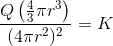
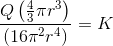


Setting  as the new constant of variation, we have a new variation equation
 ,
,
meaning that  varies directly as
  .
.
Setting
Setting
meaning that
← Didn't Know|Knew It →
The square of varies inversely with the cube of . If when , then what is the value of when ?
The square of
Tap to reveal answer
When two quantities vary inversely, their products are always equal to a constant, which we can call k. If the square of x and the cube of y vary inversely, this means that the product of the square of x and the cube of y will equal k. We can represent the square of x as x2 and the cube of y as y3. Now, we can write the equation for inverse variation.
x2y3 = k
We are told that when x = 8, y = 8. We can substitute these values into our equation for inverse variation and then solve for k.
82(83) = k
k = 82(83)
Because this will probably be a large number, it might help just to keep it in exponent form. Let's apply the property of exponents which says that abac = ab+c.
k = 82(83) = 82+3 = 85.
Next, we must find the value of y when x = 1. Let's use our equation for inverse variation equation, substituting 85 in for k.
x2y3 = 85
(1)2y3 = 85
y3 = 85
In order to solve this, we will have to take a cube root. Thus, it will help to rewrite 8 as the cube of 2, or 23.
y3 = (23)5
We can now apply the property of exponents that states that (ab)c = abc.
y3 = 23•5 = 215
In order to get y by itself, we will have the raise each side of the equation to the 1/3 power.
(y3)(1/3) = (215)(1/3)
Once again, let's apply the property (ab)c = abc.
y(3 • 1/3) = 2(15 • 1/3)
y = 25 = 32
The answer is 32.
When two quantities vary inversely, their products are always equal to a constant, which we can call k. If the square of x and the cube of y vary inversely, this means that the product of the square of x and the cube of y will equal k. We can represent the square of x as x2 and the cube of y as y3. Now, we can write the equation for inverse variation.
x2y3 = k
We are told that when x = 8, y = 8. We can substitute these values into our equation for inverse variation and then solve for k.
82(83) = k
k = 82(83)
Because this will probably be a large number, it might help just to keep it in exponent form. Let's apply the property of exponents which says that abac = ab+c.
k = 82(83) = 82+3 = 85.
Next, we must find the value of y when x = 1. Let's use our equation for inverse variation equation, substituting 85 in for k.
x2y3 = 85
(1)2y3 = 85
y3 = 85
In order to solve this, we will have to take a cube root. Thus, it will help to rewrite 8 as the cube of 2, or 23.
y3 = (23)5
We can now apply the property of exponents that states that (ab)c = abc.
y3 = 23•5 = 215
In order to get y by itself, we will have the raise each side of the equation to the 1/3 power.
(y3)(1/3) = (215)(1/3)
Once again, let's apply the property (ab)c = abc.
y(3 • 1/3) = 2(15 • 1/3)
y = 25 = 32
The answer is 32.
← Didn't Know|Knew It →
varies inversely as both the square of and the square root of . Assuming that does not depend on any other variable, which statement is true of concerning its relationship to ?
Tap to reveal answer
varies inversely as both the square of and the square root of , meaning that for some constant of variation ,
.
Square both sides, and the expression becomes
takes the role of the new constant of variation here, and we now have
,
meaning that varies inversely as the fourth power of .
Square both sides, and the expression becomes
meaning that
← Didn't Know|Knew It →
varies directly as the square of and inversely as ; and . Assuming that does not depend on any other variables, which of the following gives the variation relationship of to ?
Tap to reveal answer
varies directly as the square of and inversely as ; therefore, for some constant of variation ,
Setting and , the formula becomes
Setting as the new constant of variation, we have a new variation equation
,
meaning that varies directly as .
Setting
Setting
meaning that
← Didn't Know|Knew It →
Phillip can paint  square feet of wall per minute. What area of the wall can he paint in 2.5 hours?
Phillip can paint
Tap to reveal answer
Every minute Phillip completes another _ square feet of painting. To solve for the total area that he completes, we need to find the number of minutes that he works.
There are 60 minutes in an hour, and he paints for 2.5 hours. Multiply to find the total number of minutes.

If he completes _ square feet per minute, then we can multiply _
 by the total minutes to find the final answer.

Every minute Phillip completes another _
There are 60 minutes in an hour, and he paints for 2.5 hours. Multiply to find the total number of minutes.
If he completes _
← Didn't Know|Knew It →
The value of  varies directly with the square of _
 _and the cube of
  . If
. If  when
when  and
and  , then what is the value of _
 when
when  and
and  ?
?
The value of
Tap to reveal answer
Let's consider the general case when y varies directly with x. If y varies directly with x, then we can express their relationship to one another using the following formula:
y = kx, where k is a constant.
Therefore, if y varies directly as the square of x and the cube of z, we can write the following analagous equation:
y = _kx_2_z_3, where k is a constant.
The problem states that y = 24 when x = 1 and z = 2. We can use this information to solve for k by substituting the known values for y, x, and z.
24 = k(1)2(2)3 = k(1)(8) = 8_k_
24 = 8_k_
Divide both sides by 8.
3 = k
k = 3
Now that we have k, we can find y if we know x and z. The problem asks us to find y when x = 3 and z = 1. We will use our formula for direct variation again, this time substitute values for k, x, and z.
y = _kx_2_z_3
y = 3(3)2(1)3 = 3(9)(1) = 27
y = 27
The answer is 27.
Let's consider the general case when y varies directly with x. If y varies directly with x, then we can express their relationship to one another using the following formula:
y = kx, where k is a constant.
Therefore, if y varies directly as the square of x and the cube of z, we can write the following analagous equation:
y = _kx_2_z_3, where k is a constant.
The problem states that y = 24 when x = 1 and z = 2. We can use this information to solve for k by substituting the known values for y, x, and z.
24 = k(1)2(2)3 = k(1)(8) = 8_k_
24 = 8_k_
Divide both sides by 8.
3 = k
k = 3
Now that we have k, we can find y if we know x and z. The problem asks us to find y when x = 3 and z = 1. We will use our formula for direct variation again, this time substitute values for k, x, and z.
y = _kx_2_z_3
y = 3(3)2(1)3 = 3(9)(1) = 27
y = 27
The answer is 27.
← Didn't Know|Knew It →
In a growth period, a population of flies triples every week. If the original population had 3 flies, how big is the population after 4 weeks?
In a growth period, a population of flies triples every week. If the original population had 3 flies, how big is the population after 4 weeks?
Tap to reveal answer
We know that the initial population is 3, and that every week the population will triple.
The equation to model this growth will be  , where
  is the initial size,
  is the rate of growth, and
  is the time.
In this case, the equation will be  .
.

Alternatively, you can evaluate for each consecutive week.
Week 1: 
Week 2: 
Week 3: 
Week 4: 
We know that the initial population is 3, and that every week the population will triple.
The equation to model this growth will be
In this case, the equation will be
Alternatively, you can evaluate for each consecutive week.
Week 1:
Week 2:
Week 3:
Week 4:
← Didn't Know|Knew It →
 varies directly as both
  and the cube of
  . Which statement is true of
  concerning its relationship to
  ?
?
Tap to reveal answer
 varies directly as both
  and the cube of
  , meaning that for some constant of variation
  ,
,
 .
.
Take the reciprocal of both sides, and the equation becomes

Take the cube root of both sides, and the equation becomes

 takes the role of the new constant of variation here, and we now have

so  varies inversely as the cube root of
  .
.
Take the reciprocal of both sides, and the equation becomes
Take the cube root of both sides, and the equation becomes
so
← Didn't Know|Knew It →
 varies directly as
  and inversely as
  ;
;  and
and  . Assuming that no other variables affect
  , which statement is true of
  concerning its relationship to
  ?
?
Tap to reveal answer
 varies directly as
  and inversely as
  , meaning that for some constant of variation
  ,
,
 .
.
Setting  and
and  , the formula becomes


Setting  as the new constant of variation, the variation equation becomes
 ,
,
so  varies inversely as
  .
.
Setting
Setting
so
← Didn't Know|Knew It →
The square of varies inversely with the cube of . If when , then what is the value of when ?
The square of
Tap to reveal answer
When two quantities vary inversely, their products are always equal to a constant, which we can call k. If the square of x and the cube of y vary inversely, this means that the product of the square of x and the cube of y will equal k. We can represent the square of x as x2 and the cube of y as y3. Now, we can write the equation for inverse variation.
x2y3 = k
We are told that when x = 8, y = 8. We can substitute these values into our equation for inverse variation and then solve for k.
82(83) = k
k = 82(83)
Because this will probably be a large number, it might help just to keep it in exponent form. Let's apply the property of exponents which says that abac = ab+c.
k = 82(83) = 82+3 = 85.
Next, we must find the value of y when x = 1. Let's use our equation for inverse variation equation, substituting 85 in for k.
x2y3 = 85
(1)2y3 = 85
y3 = 85
In order to solve this, we will have to take a cube root. Thus, it will help to rewrite 8 as the cube of 2, or 23.
y3 = (23)5
We can now apply the property of exponents that states that (ab)c = abc.
y3 = 23•5 = 215
In order to get y by itself, we will have the raise each side of the equation to the 1/3 power.
(y3)(1/3) = (215)(1/3)
Once again, let's apply the property (ab)c = abc.
y(3 • 1/3) = 2(15 • 1/3)
y = 25 = 32
The answer is 32.
When two quantities vary inversely, their products are always equal to a constant, which we can call k. If the square of x and the cube of y vary inversely, this means that the product of the square of x and the cube of y will equal k. We can represent the square of x as x2 and the cube of y as y3. Now, we can write the equation for inverse variation.
x2y3 = k
We are told that when x = 8, y = 8. We can substitute these values into our equation for inverse variation and then solve for k.
82(83) = k
k = 82(83)
Because this will probably be a large number, it might help just to keep it in exponent form. Let's apply the property of exponents which says that abac = ab+c.
k = 82(83) = 82+3 = 85.
Next, we must find the value of y when x = 1. Let's use our equation for inverse variation equation, substituting 85 in for k.
x2y3 = 85
(1)2y3 = 85
y3 = 85
In order to solve this, we will have to take a cube root. Thus, it will help to rewrite 8 as the cube of 2, or 23.
y3 = (23)5
We can now apply the property of exponents that states that (ab)c = abc.
y3 = 23•5 = 215
In order to get y by itself, we will have the raise each side of the equation to the 1/3 power.
(y3)(1/3) = (215)(1/3)
Once again, let's apply the property (ab)c = abc.
y(3 • 1/3) = 2(15 • 1/3)
y = 25 = 32
The answer is 32.
← Didn't Know|Knew It →
varies inversely as both the square of and the square root of . Assuming that does not depend on any other variable, which statement is true of concerning its relationship to ?
Tap to reveal answer
varies inversely as both the square of and the square root of , meaning that for some constant of variation ,
.
Square both sides, and the expression becomes
takes the role of the new constant of variation here, and we now have
,
meaning that varies inversely as the fourth power of .
Square both sides, and the expression becomes
meaning that
← Didn't Know|Knew It →
varies directly as the square of and inversely as ; and . Assuming that does not depend on any other variables, which of the following gives the variation relationship of to ?
Tap to reveal answer
varies directly as the square of and inversely as ; therefore, for some constant of variation ,
Setting and , the formula becomes
Setting as the new constant of variation, we have a new variation equation
,
meaning that varies directly as .
Setting
Setting
meaning that
← Didn't Know|Knew It →
Phillip can paint square feet of wall per minute. What area of the wall can he paint in 2.5 hours?
Phillip can paint
Tap to reveal answer
Every minute Phillip completes another _ square feet of painting. To solve for the total area that he completes, we need to find the number of minutes that he works.
There are 60 minutes in an hour, and he paints for 2.5 hours. Multiply to find the total number of minutes.
If he completes _ square feet per minute, then we can multiply _ by the total minutes to find the final answer.
Every minute Phillip completes another _
There are 60 minutes in an hour, and he paints for 2.5 hours. Multiply to find the total number of minutes.
If he completes _
← Didn't Know|Knew It →
The value of varies directly with the square of __and the cube of . If when and , then what is the value of _ when and ?
The value of
Tap to reveal answer
Let's consider the general case when y varies directly with x. If y varies directly with x, then we can express their relationship to one another using the following formula:
y = kx, where k is a constant.
Therefore, if y varies directly as the square of x and the cube of z, we can write the following analagous equation:
y = _kx_2_z_3, where k is a constant.
The problem states that y = 24 when x = 1 and z = 2. We can use this information to solve for k by substituting the known values for y, x, and z.
24 = k(1)2(2)3 = k(1)(8) = 8_k_
24 = 8_k_
Divide both sides by 8.
3 = k
k = 3
Now that we have k, we can find y if we know x and z. The problem asks us to find y when x = 3 and z = 1. We will use our formula for direct variation again, this time substitute values for k, x, and z.
y = _kx_2_z_3
y = 3(3)2(1)3 = 3(9)(1) = 27
y = 27
The answer is 27.
Let's consider the general case when y varies directly with x. If y varies directly with x, then we can express their relationship to one another using the following formula:
y = kx, where k is a constant.
Therefore, if y varies directly as the square of x and the cube of z, we can write the following analagous equation:
y = _kx_2_z_3, where k is a constant.
The problem states that y = 24 when x = 1 and z = 2. We can use this information to solve for k by substituting the known values for y, x, and z.
24 = k(1)2(2)3 = k(1)(8) = 8_k_
24 = 8_k_
Divide both sides by 8.
3 = k
k = 3
Now that we have k, we can find y if we know x and z. The problem asks us to find y when x = 3 and z = 1. We will use our formula for direct variation again, this time substitute values for k, x, and z.
y = _kx_2_z_3
y = 3(3)2(1)3 = 3(9)(1) = 27
y = 27
The answer is 27.
← Didn't Know|Knew It →
In a growth period, a population of flies triples every week. If the original population had 3 flies, how big is the population after 4 weeks?
In a growth period, a population of flies triples every week. If the original population had 3 flies, how big is the population after 4 weeks?
Tap to reveal answer
We know that the initial population is 3, and that every week the population will triple.
The equation to model this growth will be , where is the initial size, is the rate of growth, and is the time.
In this case, the equation will be .
Alternatively, you can evaluate for each consecutive week.
Week 1:
Week 2:
Week 3:
Week 4:
We know that the initial population is 3, and that every week the population will triple.
The equation to model this growth will be
In this case, the equation will be
Alternatively, you can evaluate for each consecutive week.
Week 1:
Week 2:
Week 3:
Week 4:
← Didn't Know|Knew It →
varies directly as both and the cube of . Which statement is true of concerning its relationship to ?
Tap to reveal answer
varies directly as both and the cube of , meaning that for some constant of variation ,
.
Take the reciprocal of both sides, and the equation becomes
Take the cube root of both sides, and the equation becomes
takes the role of the new constant of variation here, and we now have
so varies inversely as the cube root of .
Take the reciprocal of both sides, and the equation becomes
Take the cube root of both sides, and the equation becomes
so
← Didn't Know|Knew It →
varies directly as and inversely as ; and . Assuming that no other variables affect , which statement is true of concerning its relationship to ?
Tap to reveal answer
varies directly as and inversely as , meaning that for some constant of variation ,
.
Setting and , the formula becomes
Setting as the new constant of variation, the variation equation becomes
,
so varies inversely as .
Setting
Setting
so
← Didn't Know|Knew It →
Phillip can paint square feet of wall per minute. What area of the wall can he paint in 2.5 hours?
Phillip can paint
Tap to reveal answer
Every minute Phillip completes another _ square feet of painting. To solve for the total area that he completes, we need to find the number of minutes that he works.
There are 60 minutes in an hour, and he paints for 2.5 hours. Multiply to find the total number of minutes.
If he completes _ square feet per minute, then we can multiply _ by the total minutes to find the final answer.
Every minute Phillip completes another _
There are 60 minutes in an hour, and he paints for 2.5 hours. Multiply to find the total number of minutes.
If he completes _
← Didn't Know|Knew It →