Trapezoids - PSAT Math
Card 1 of 21
A trapezoid has a base of length 4, another base of length s, and a height of length s. A square has sides of length s. What is the value of s such that the area of the trapezoid and the area of the square are equal?
A trapezoid has a base of length 4, another base of length s, and a height of length s. A square has sides of length s. What is the value of s such that the area of the trapezoid and the area of the square are equal?
Tap to reveal answer
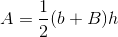
In general, the formula for the area of a trapezoid is (1/2)(a + b)(h), where a and b are the lengths of the bases, and h is the length of the height. Thus, we can write the area for the trapezoid given in the problem as follows:
area of trapezoid = (1/2)(4 + s)(s)
Similarly, the area of a square with sides of length a is given by _a_2. Thus, the area of the square given in the problem is _s_2.
We now can set the area of the trapezoid equal to the area of the square and solve for s.
(1/2)(4 + s)(s) = _s_2
Multiply both sides by 2 to eliminate the 1/2.
(4 + s)(s) = 2_s_2
Distribute the s on the left.
4_s_ + _s_2 = 2_s_2
Subtract _s_2 from both sides.
4_s_ = _s_2
Because s must be a positive number, we can divide both sides by s.
4 = s
This means the value of s must be 4.
The answer is 4.
In general, the formula for the area of a trapezoid is (1/2)(a + b)(h), where a and b are the lengths of the bases, and h is the length of the height. Thus, we can write the area for the trapezoid given in the problem as follows:
area of trapezoid = (1/2)(4 + s)(s)
Similarly, the area of a square with sides of length a is given by _a_2. Thus, the area of the square given in the problem is _s_2.
We now can set the area of the trapezoid equal to the area of the square and solve for s.
(1/2)(4 + s)(s) = _s_2
Multiply both sides by 2 to eliminate the 1/2.
(4 + s)(s) = 2_s_2
Distribute the s on the left.
4_s_ + _s_2 = 2_s_2
Subtract _s_2 from both sides.
4_s_ = _s_2
Because s must be a positive number, we can divide both sides by s.
4 = s
This means the value of s must be 4.
The answer is 4.
← Didn't Know|Knew It →
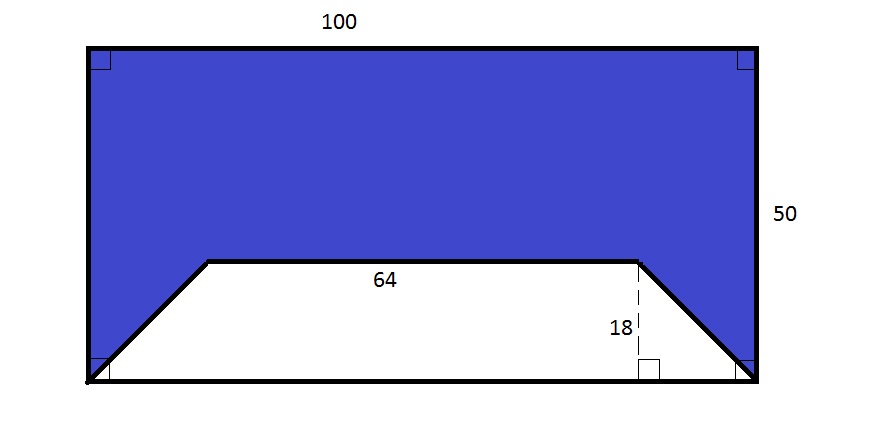
Note: Figure NOT drawn to scale.
The white region in the above diagram is a trapezoid. What percent of the above rectangle, rounded to the nearest whole percent, is blue?
Note: Figure NOT drawn to scale.
The white region in the above diagram is a trapezoid. What percent of the above rectangle, rounded to the nearest whole percent, is blue?
Tap to reveal answer
The area of the entire rectangle is the product of its length and width, or
 .
.
The area of the white trapezoid is one half the product of its height and the sum of its base lengths, or

Therefore, the blue polygon has area
 .
.
This is
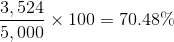 of the rectangle.
Rounded, this is 70%.
The area of the entire rectangle is the product of its length and width, or
The area of the white trapezoid is one half the product of its height and the sum of its base lengths, or
Therefore, the blue polygon has area
This is
Rounded, this is 70%.
← Didn't Know|Knew It →
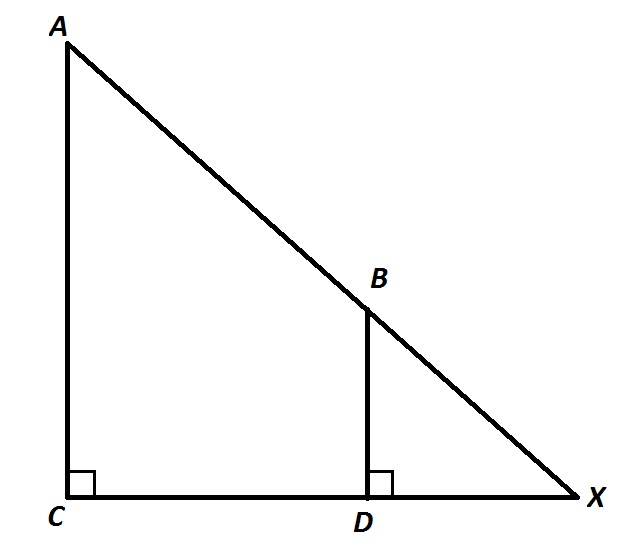
Refer to the above diagram.  .
.
Give the area of Quadrilateral  .
.
Refer to the above diagram.
Give the area of Quadrilateral
Tap to reveal answer
 , since both are right; by the Corresponding Angles Theorem,
  , and Quadrilateral
  is a trapezoid.
By the Angle-Angle Similarity Postulate, since

and
 (by reflexivity),
 ,
,
and since corresponding sides of similar triangles are in proportion,


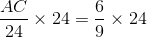
 , the larger base of the trapozoid;
The smaller base is  .
.
 , the height of the trapezoid.
The area of the trapezoid is


By the Angle-Angle Similarity Postulate, since
and
and since corresponding sides of similar triangles are in proportion,
The smaller base is
The area of the trapezoid is
← Didn't Know|Knew It →
A trapezoid has a base of length 4, another base of length s, and a height of length s. A square has sides of length s. What is the value of s such that the area of the trapezoid and the area of the square are equal?
A trapezoid has a base of length 4, another base of length s, and a height of length s. A square has sides of length s. What is the value of s such that the area of the trapezoid and the area of the square are equal?
Tap to reveal answer
In general, the formula for the area of a trapezoid is (1/2)(a + b)(h), where a and b are the lengths of the bases, and h is the length of the height. Thus, we can write the area for the trapezoid given in the problem as follows:
area of trapezoid = (1/2)(4 + s)(s)
Similarly, the area of a square with sides of length a is given by _a_2. Thus, the area of the square given in the problem is _s_2.
We now can set the area of the trapezoid equal to the area of the square and solve for s.
(1/2)(4 + s)(s) = _s_2
Multiply both sides by 2 to eliminate the 1/2.
(4 + s)(s) = 2_s_2
Distribute the s on the left.
4_s_ + _s_2 = 2_s_2
Subtract _s_2 from both sides.
4_s_ = _s_2
Because s must be a positive number, we can divide both sides by s.
4 = s
This means the value of s must be 4.
The answer is 4.
In general, the formula for the area of a trapezoid is (1/2)(a + b)(h), where a and b are the lengths of the bases, and h is the length of the height. Thus, we can write the area for the trapezoid given in the problem as follows:
area of trapezoid = (1/2)(4 + s)(s)
Similarly, the area of a square with sides of length a is given by _a_2. Thus, the area of the square given in the problem is _s_2.
We now can set the area of the trapezoid equal to the area of the square and solve for s.
(1/2)(4 + s)(s) = _s_2
Multiply both sides by 2 to eliminate the 1/2.
(4 + s)(s) = 2_s_2
Distribute the s on the left.
4_s_ + _s_2 = 2_s_2
Subtract _s_2 from both sides.
4_s_ = _s_2
Because s must be a positive number, we can divide both sides by s.
4 = s
This means the value of s must be 4.
The answer is 4.
← Didn't Know|Knew It →
Note: Figure NOT drawn to scale.
The white region in the above diagram is a trapezoid. What percent of the above rectangle, rounded to the nearest whole percent, is blue?
Note: Figure NOT drawn to scale.
The white region in the above diagram is a trapezoid. What percent of the above rectangle, rounded to the nearest whole percent, is blue?
Tap to reveal answer
The area of the entire rectangle is the product of its length and width, or
.
The area of the white trapezoid is one half the product of its height and the sum of its base lengths, or
Therefore, the blue polygon has area
.
This is
of the rectangle.
Rounded, this is 70%.
The area of the entire rectangle is the product of its length and width, or
The area of the white trapezoid is one half the product of its height and the sum of its base lengths, or
Therefore, the blue polygon has area
This is
Rounded, this is 70%.
← Didn't Know|Knew It →
Refer to the above diagram. .
Give the area of Quadrilateral .
Refer to the above diagram.
Give the area of Quadrilateral
Tap to reveal answer
, since both are right; by the Corresponding Angles Theorem, , and Quadrilateral is a trapezoid.
By the Angle-Angle Similarity Postulate, since
and
(by reflexivity),
,
and since corresponding sides of similar triangles are in proportion,
, the larger base of the trapozoid;
The smaller base is .
, the height of the trapezoid.
The area of the trapezoid is
By the Angle-Angle Similarity Postulate, since
and
and since corresponding sides of similar triangles are in proportion,
The smaller base is
The area of the trapezoid is
← Didn't Know|Knew It →
A trapezoid has a base of length 4, another base of length s, and a height of length s. A square has sides of length s. What is the value of s such that the area of the trapezoid and the area of the square are equal?
A trapezoid has a base of length 4, another base of length s, and a height of length s. A square has sides of length s. What is the value of s such that the area of the trapezoid and the area of the square are equal?
Tap to reveal answer
In general, the formula for the area of a trapezoid is (1/2)(a + b)(h), where a and b are the lengths of the bases, and h is the length of the height. Thus, we can write the area for the trapezoid given in the problem as follows:
area of trapezoid = (1/2)(4 + s)(s)
Similarly, the area of a square with sides of length a is given by _a_2. Thus, the area of the square given in the problem is _s_2.
We now can set the area of the trapezoid equal to the area of the square and solve for s.
(1/2)(4 + s)(s) = _s_2
Multiply both sides by 2 to eliminate the 1/2.
(4 + s)(s) = 2_s_2
Distribute the s on the left.
4_s_ + _s_2 = 2_s_2
Subtract _s_2 from both sides.
4_s_ = _s_2
Because s must be a positive number, we can divide both sides by s.
4 = s
This means the value of s must be 4.
The answer is 4.
In general, the formula for the area of a trapezoid is (1/2)(a + b)(h), where a and b are the lengths of the bases, and h is the length of the height. Thus, we can write the area for the trapezoid given in the problem as follows:
area of trapezoid = (1/2)(4 + s)(s)
Similarly, the area of a square with sides of length a is given by _a_2. Thus, the area of the square given in the problem is _s_2.
We now can set the area of the trapezoid equal to the area of the square and solve for s.
(1/2)(4 + s)(s) = _s_2
Multiply both sides by 2 to eliminate the 1/2.
(4 + s)(s) = 2_s_2
Distribute the s on the left.
4_s_ + _s_2 = 2_s_2
Subtract _s_2 from both sides.
4_s_ = _s_2
Because s must be a positive number, we can divide both sides by s.
4 = s
This means the value of s must be 4.
The answer is 4.
← Didn't Know|Knew It →
Note: Figure NOT drawn to scale.
The white region in the above diagram is a trapezoid. What percent of the above rectangle, rounded to the nearest whole percent, is blue?
Note: Figure NOT drawn to scale.
The white region in the above diagram is a trapezoid. What percent of the above rectangle, rounded to the nearest whole percent, is blue?
Tap to reveal answer
The area of the entire rectangle is the product of its length and width, or
.
The area of the white trapezoid is one half the product of its height and the sum of its base lengths, or
Therefore, the blue polygon has area
.
This is
of the rectangle.
Rounded, this is 70%.
The area of the entire rectangle is the product of its length and width, or
The area of the white trapezoid is one half the product of its height and the sum of its base lengths, or
Therefore, the blue polygon has area
This is
Rounded, this is 70%.
← Didn't Know|Knew It →
Refer to the above diagram. .
Give the area of Quadrilateral .
Refer to the above diagram.
Give the area of Quadrilateral
Tap to reveal answer
, since both are right; by the Corresponding Angles Theorem, , and Quadrilateral is a trapezoid.
By the Angle-Angle Similarity Postulate, since
and
(by reflexivity),
,
and since corresponding sides of similar triangles are in proportion,
, the larger base of the trapozoid;
The smaller base is .
, the height of the trapezoid.
The area of the trapezoid is
By the Angle-Angle Similarity Postulate, since
and
and since corresponding sides of similar triangles are in proportion,
The smaller base is
The area of the trapezoid is
← Didn't Know|Knew It →
A trapezoid has a base of length 4, another base of length s, and a height of length s. A square has sides of length s. What is the value of s such that the area of the trapezoid and the area of the square are equal?
A trapezoid has a base of length 4, another base of length s, and a height of length s. A square has sides of length s. What is the value of s such that the area of the trapezoid and the area of the square are equal?
Tap to reveal answer
In general, the formula for the area of a trapezoid is (1/2)(a + b)(h), where a and b are the lengths of the bases, and h is the length of the height. Thus, we can write the area for the trapezoid given in the problem as follows:
area of trapezoid = (1/2)(4 + s)(s)
Similarly, the area of a square with sides of length a is given by _a_2. Thus, the area of the square given in the problem is _s_2.
We now can set the area of the trapezoid equal to the area of the square and solve for s.
(1/2)(4 + s)(s) = _s_2
Multiply both sides by 2 to eliminate the 1/2.
(4 + s)(s) = 2_s_2
Distribute the s on the left.
4_s_ + _s_2 = 2_s_2
Subtract _s_2 from both sides.
4_s_ = _s_2
Because s must be a positive number, we can divide both sides by s.
4 = s
This means the value of s must be 4.
The answer is 4.
In general, the formula for the area of a trapezoid is (1/2)(a + b)(h), where a and b are the lengths of the bases, and h is the length of the height. Thus, we can write the area for the trapezoid given in the problem as follows:
area of trapezoid = (1/2)(4 + s)(s)
Similarly, the area of a square with sides of length a is given by _a_2. Thus, the area of the square given in the problem is _s_2.
We now can set the area of the trapezoid equal to the area of the square and solve for s.
(1/2)(4 + s)(s) = _s_2
Multiply both sides by 2 to eliminate the 1/2.
(4 + s)(s) = 2_s_2
Distribute the s on the left.
4_s_ + _s_2 = 2_s_2
Subtract _s_2 from both sides.
4_s_ = _s_2
Because s must be a positive number, we can divide both sides by s.
4 = s
This means the value of s must be 4.
The answer is 4.
← Didn't Know|Knew It →
Note: Figure NOT drawn to scale.
The white region in the above diagram is a trapezoid. What percent of the above rectangle, rounded to the nearest whole percent, is blue?
Note: Figure NOT drawn to scale.
The white region in the above diagram is a trapezoid. What percent of the above rectangle, rounded to the nearest whole percent, is blue?
Tap to reveal answer
The area of the entire rectangle is the product of its length and width, or
.
The area of the white trapezoid is one half the product of its height and the sum of its base lengths, or
Therefore, the blue polygon has area
.
This is
of the rectangle.
Rounded, this is 70%.
The area of the entire rectangle is the product of its length and width, or
The area of the white trapezoid is one half the product of its height and the sum of its base lengths, or
Therefore, the blue polygon has area
This is
Rounded, this is 70%.
← Didn't Know|Knew It →
Refer to the above diagram. .
Give the area of Quadrilateral .
Refer to the above diagram.
Give the area of Quadrilateral
Tap to reveal answer
, since both are right; by the Corresponding Angles Theorem, , and Quadrilateral is a trapezoid.
By the Angle-Angle Similarity Postulate, since
and
(by reflexivity),
,
and since corresponding sides of similar triangles are in proportion,
, the larger base of the trapozoid;
The smaller base is .
, the height of the trapezoid.
The area of the trapezoid is
By the Angle-Angle Similarity Postulate, since
and
and since corresponding sides of similar triangles are in proportion,
The smaller base is
The area of the trapezoid is
← Didn't Know|Knew It →
A trapezoid has a base of length 4, another base of length s, and a height of length s. A square has sides of length s. What is the value of s such that the area of the trapezoid and the area of the square are equal?
A trapezoid has a base of length 4, another base of length s, and a height of length s. A square has sides of length s. What is the value of s such that the area of the trapezoid and the area of the square are equal?
Tap to reveal answer
In general, the formula for the area of a trapezoid is (1/2)(a + b)(h), where a and b are the lengths of the bases, and h is the length of the height. Thus, we can write the area for the trapezoid given in the problem as follows:
area of trapezoid = (1/2)(4 + s)(s)
Similarly, the area of a square with sides of length a is given by _a_2. Thus, the area of the square given in the problem is _s_2.
We now can set the area of the trapezoid equal to the area of the square and solve for s.
(1/2)(4 + s)(s) = _s_2
Multiply both sides by 2 to eliminate the 1/2.
(4 + s)(s) = 2_s_2
Distribute the s on the left.
4_s_ + _s_2 = 2_s_2
Subtract _s_2 from both sides.
4_s_ = _s_2
Because s must be a positive number, we can divide both sides by s.
4 = s
This means the value of s must be 4.
The answer is 4.
In general, the formula for the area of a trapezoid is (1/2)(a + b)(h), where a and b are the lengths of the bases, and h is the length of the height. Thus, we can write the area for the trapezoid given in the problem as follows:
area of trapezoid = (1/2)(4 + s)(s)
Similarly, the area of a square with sides of length a is given by _a_2. Thus, the area of the square given in the problem is _s_2.
We now can set the area of the trapezoid equal to the area of the square and solve for s.
(1/2)(4 + s)(s) = _s_2
Multiply both sides by 2 to eliminate the 1/2.
(4 + s)(s) = 2_s_2
Distribute the s on the left.
4_s_ + _s_2 = 2_s_2
Subtract _s_2 from both sides.
4_s_ = _s_2
Because s must be a positive number, we can divide both sides by s.
4 = s
This means the value of s must be 4.
The answer is 4.
← Didn't Know|Knew It →
Note: Figure NOT drawn to scale.
The white region in the above diagram is a trapezoid. What percent of the above rectangle, rounded to the nearest whole percent, is blue?
Note: Figure NOT drawn to scale.
The white region in the above diagram is a trapezoid. What percent of the above rectangle, rounded to the nearest whole percent, is blue?
Tap to reveal answer
The area of the entire rectangle is the product of its length and width, or
.
The area of the white trapezoid is one half the product of its height and the sum of its base lengths, or
Therefore, the blue polygon has area
.
This is
of the rectangle.
Rounded, this is 70%.
The area of the entire rectangle is the product of its length and width, or
The area of the white trapezoid is one half the product of its height and the sum of its base lengths, or
Therefore, the blue polygon has area
This is
Rounded, this is 70%.
← Didn't Know|Knew It →
Refer to the above diagram. .
Give the area of Quadrilateral .
Refer to the above diagram.
Give the area of Quadrilateral
Tap to reveal answer
, since both are right; by the Corresponding Angles Theorem, , and Quadrilateral is a trapezoid.
By the Angle-Angle Similarity Postulate, since
and
(by reflexivity),
,
and since corresponding sides of similar triangles are in proportion,
, the larger base of the trapozoid;
The smaller base is .
, the height of the trapezoid.
The area of the trapezoid is
By the Angle-Angle Similarity Postulate, since
and
and since corresponding sides of similar triangles are in proportion,
The smaller base is
The area of the trapezoid is
← Didn't Know|Knew It →
A trapezoid has a base of length 4, another base of length s, and a height of length s. A square has sides of length s. What is the value of s such that the area of the trapezoid and the area of the square are equal?
A trapezoid has a base of length 4, another base of length s, and a height of length s. A square has sides of length s. What is the value of s such that the area of the trapezoid and the area of the square are equal?
Tap to reveal answer
In general, the formula for the area of a trapezoid is (1/2)(a + b)(h), where a and b are the lengths of the bases, and h is the length of the height. Thus, we can write the area for the trapezoid given in the problem as follows:
area of trapezoid = (1/2)(4 + s)(s)
Similarly, the area of a square with sides of length a is given by _a_2. Thus, the area of the square given in the problem is _s_2.
We now can set the area of the trapezoid equal to the area of the square and solve for s.
(1/2)(4 + s)(s) = _s_2
Multiply both sides by 2 to eliminate the 1/2.
(4 + s)(s) = 2_s_2
Distribute the s on the left.
4_s_ + _s_2 = 2_s_2
Subtract _s_2 from both sides.
4_s_ = _s_2
Because s must be a positive number, we can divide both sides by s.
4 = s
This means the value of s must be 4.
The answer is 4.
In general, the formula for the area of a trapezoid is (1/2)(a + b)(h), where a and b are the lengths of the bases, and h is the length of the height. Thus, we can write the area for the trapezoid given in the problem as follows:
area of trapezoid = (1/2)(4 + s)(s)
Similarly, the area of a square with sides of length a is given by _a_2. Thus, the area of the square given in the problem is _s_2.
We now can set the area of the trapezoid equal to the area of the square and solve for s.
(1/2)(4 + s)(s) = _s_2
Multiply both sides by 2 to eliminate the 1/2.
(4 + s)(s) = 2_s_2
Distribute the s on the left.
4_s_ + _s_2 = 2_s_2
Subtract _s_2 from both sides.
4_s_ = _s_2
Because s must be a positive number, we can divide both sides by s.
4 = s
This means the value of s must be 4.
The answer is 4.
← Didn't Know|Knew It →
Note: Figure NOT drawn to scale.
The white region in the above diagram is a trapezoid. What percent of the above rectangle, rounded to the nearest whole percent, is blue?
Note: Figure NOT drawn to scale.
The white region in the above diagram is a trapezoid. What percent of the above rectangle, rounded to the nearest whole percent, is blue?
Tap to reveal answer
The area of the entire rectangle is the product of its length and width, or
.
The area of the white trapezoid is one half the product of its height and the sum of its base lengths, or
Therefore, the blue polygon has area
.
This is
of the rectangle.
Rounded, this is 70%.
The area of the entire rectangle is the product of its length and width, or
The area of the white trapezoid is one half the product of its height and the sum of its base lengths, or
Therefore, the blue polygon has area
This is
Rounded, this is 70%.
← Didn't Know|Knew It →
Refer to the above diagram. .
Give the area of Quadrilateral .
Refer to the above diagram.
Give the area of Quadrilateral
Tap to reveal answer
, since both are right; by the Corresponding Angles Theorem, , and Quadrilateral is a trapezoid.
By the Angle-Angle Similarity Postulate, since
and
(by reflexivity),
,
and since corresponding sides of similar triangles are in proportion,
, the larger base of the trapozoid;
The smaller base is .
, the height of the trapezoid.
The area of the trapezoid is
By the Angle-Angle Similarity Postulate, since
and
and since corresponding sides of similar triangles are in proportion,
The smaller base is
The area of the trapezoid is
← Didn't Know|Knew It →
A trapezoid has a base of length 4, another base of length s, and a height of length s. A square has sides of length s. What is the value of s such that the area of the trapezoid and the area of the square are equal?
A trapezoid has a base of length 4, another base of length s, and a height of length s. A square has sides of length s. What is the value of s such that the area of the trapezoid and the area of the square are equal?
Tap to reveal answer
In general, the formula for the area of a trapezoid is (1/2)(a + b)(h), where a and b are the lengths of the bases, and h is the length of the height. Thus, we can write the area for the trapezoid given in the problem as follows:
area of trapezoid = (1/2)(4 + s)(s)
Similarly, the area of a square with sides of length a is given by _a_2. Thus, the area of the square given in the problem is _s_2.
We now can set the area of the trapezoid equal to the area of the square and solve for s.
(1/2)(4 + s)(s) = _s_2
Multiply both sides by 2 to eliminate the 1/2.
(4 + s)(s) = 2_s_2
Distribute the s on the left.
4_s_ + _s_2 = 2_s_2
Subtract _s_2 from both sides.
4_s_ = _s_2
Because s must be a positive number, we can divide both sides by s.
4 = s
This means the value of s must be 4.
The answer is 4.
In general, the formula for the area of a trapezoid is (1/2)(a + b)(h), where a and b are the lengths of the bases, and h is the length of the height. Thus, we can write the area for the trapezoid given in the problem as follows:
area of trapezoid = (1/2)(4 + s)(s)
Similarly, the area of a square with sides of length a is given by _a_2. Thus, the area of the square given in the problem is _s_2.
We now can set the area of the trapezoid equal to the area of the square and solve for s.
(1/2)(4 + s)(s) = _s_2
Multiply both sides by 2 to eliminate the 1/2.
(4 + s)(s) = 2_s_2
Distribute the s on the left.
4_s_ + _s_2 = 2_s_2
Subtract _s_2 from both sides.
4_s_ = _s_2
Because s must be a positive number, we can divide both sides by s.
4 = s
This means the value of s must be 4.
The answer is 4.
← Didn't Know|Knew It →
Note: Figure NOT drawn to scale.
The white region in the above diagram is a trapezoid. What percent of the above rectangle, rounded to the nearest whole percent, is blue?
Note: Figure NOT drawn to scale.
The white region in the above diagram is a trapezoid. What percent of the above rectangle, rounded to the nearest whole percent, is blue?
Tap to reveal answer
The area of the entire rectangle is the product of its length and width, or
.
The area of the white trapezoid is one half the product of its height and the sum of its base lengths, or
Therefore, the blue polygon has area
.
This is
of the rectangle.
Rounded, this is 70%.
The area of the entire rectangle is the product of its length and width, or
The area of the white trapezoid is one half the product of its height and the sum of its base lengths, or
Therefore, the blue polygon has area
This is
Rounded, this is 70%.
← Didn't Know|Knew It →